

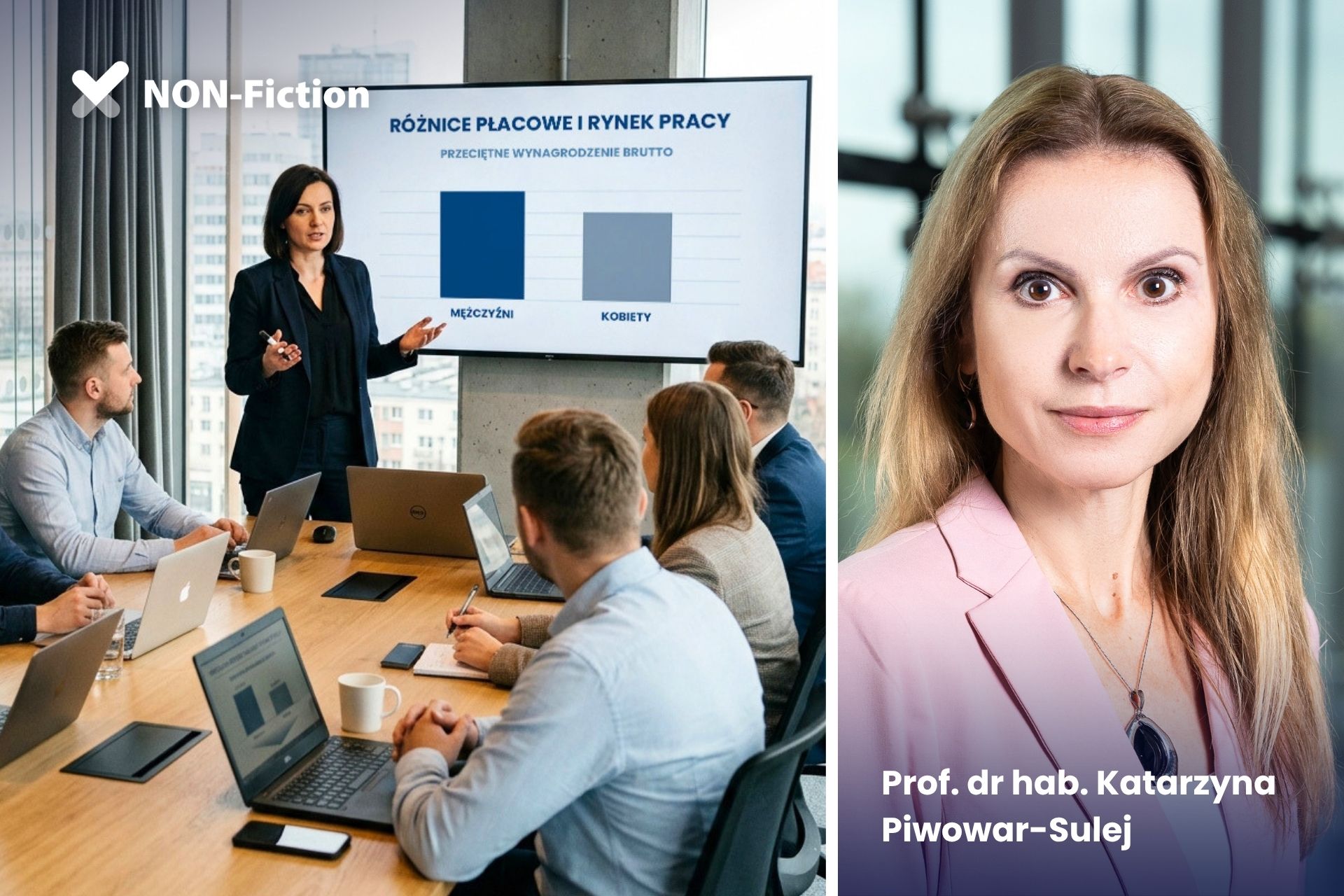
Women raise productivity, innovation and the quality of decisions in the economies where they work. This is not a journalistic phrase. It is the premise from which Professor Katarzyna Piwowar-Sulej of Wrocław University of Economics and Business begins her column in Gazeta Kobiet, a special supplement of Gazeta Wyborcza. And yet, as she goes on, women in Poland are still less likely to become managers, and when they do, their earnings can be one-fifth lower than those of men in the same positions.
“Understanding the role of women in the labour market,” the author reminds us, “is essential for society.” Their professional activity “increases labour resources, innovation and productivity of the economy,” and diversity supports better decisions and creativity. In an ageing society this importance grows, because women make up an increasing share of the older population, and their professional position shapes their economic position in the later decades of life.
The column Between Progress and Inequality, published in the special supplement of Gazeta Wyborcza, reads the Polish labour market through four paradoxes. Two are now widely recognised: the pay gap does not close despite women’s higher level of education, and the career model has not caught up with shifting social roles. Two others ring particularly loudly in the column and still struggle to break into mainstream conversations about the labour market. First: the return to office as a contemporary version of the employment barriers from the first industrial revolution. Second: an ageing society that needs women’s work more than ever, while at the same time bearing down most heavily on them with the bill for earlier inequalities.
Better educated, worse paid
The first paradox concerns education. In Poland, women are on average better educated than men, yet this higher human capital does not translate into position, earnings or promotions in equal measure.
The raw gender pay gap, as the author reminds us, ranges in Poland, depending on the source, “from 4 to 8 per cent.” There is more behind this number. As careers develop, the differences deepen. At senior management levels, income differences can reach twenty per cent. “The devil is in the details,” writes Professor Piwowar-Sulej: in horizontal segregation, that is the concentration of women in poorly paid industries such as education and care, and in vertical segregation, meaning women’s smaller share of senior positions. On top of this, as the author notes, “men negotiate their pay conditions better.”
The higher educational level of women therefore meets existing structures of pay, promotion and performance review. They react more slowly than the pace of educational change would suggest.
Return to office as a barrier from the era of the industrial revolution. Only no one calls it that
The second paradox concerns technology and is far less obvious. The contemporary economy offers women more remote work tools, more flexible employment forms and new occupations. Yet that same progress can work in exactly the opposite direction to its promise.
The author refers here to the work of Claudia Goldin, the 2023 Nobel laureate in economics. The historical example is striking: in nineteenth-century industry, in piecework-based sectors, women earned the same as men for the same work. That equality disappeared not with backwardness, but with development. Goldin showed that the development of industry made labour market participation harder for many women, because factory work meant leaving home for the whole day while household duties remained. That was not their resignation. It was a change in the organisation of work that removed the model in which women worked on the same terms as men.
The author raises a question that the Polish labour-market debate rarely puts directly: are we repeating the same mechanism today, only in new decoration?
The author states this thesis plainly. The current trend of returning to office, she writes, “fully fits with the employment barriers for women from the first industrial revolution era.” That sentence is stronger than it looks. It does not say that the office is discriminatory. It says that the mechanism is the same. The new dominant model of work organisation assumes a single pattern of full availability, and the cost of adjusting falls disproportionately on the group that simultaneously performs most of the care work.
Remote and hybrid work, although not designed in the name of equality, in fact opened to women access to positions and hours that earlier were difficult to combine with care. A full-time return to office may close this access faster than the pandemic opened it. In Polish corporate discourse, the return to office is debated mainly in terms of productivity, organisational culture and worker control. Professor Piwowar-Sulej’s column adds to this conversation a dimension that usually remains out of sight: who actually bears the costs of changes to work models, when care responsibilities remain unequally distributed.
Technological progress is therefore neither neutral nor one-directional. It can open new paths of labour-market participation for women. It can also close them, if organisations choose to use technology and new work models to enforce the older pattern of availability. What looks like modernity is sometimes a hundred-year rollback of working conditions. Except no one calls that rollback by its name.
The motherhood penalty you do not see right away
The third paradox concerns social roles. Professional careers have become for most women a biographical standard, not an exception. The model of the “ideal worker,” however, has remained unchanged in many organisations. It assumes full availability, continuity of employment and a readiness to subordinate private life to work.
Goldin, to whom the author refers, showed that women who decide on motherhood lose on earnings even ten years after the birth of a child. The motherhood penalty does not show up immediately. It appears gradually: in slower promotion, restricted access to development projects, weaker negotiating positions and lower pay rises in subsequent years. Time-use research from 2013, to which the author points, shows that women aged 25 to 60 dedicate on average around 30 hours a week to unpaid domestic work, while the greatest gaps in employment indicators between women and men fall in the 20 to 39 age group, that is, the period when children appear.
The problem is not the moment of return from maternity leave. The problem is the entire career model that has not caught up with the changing social roles of women.
Old age is a poor woman
The fourth paradox concerns demography and is, like the technology one, rarely articulated in the mainstream. A society that is ageing paradoxically needs more, not less, of women’s participation in professional activity. The pool of people of working age is shrinking, while the pool of those who need their work is growing. Yet that same demographic process deepens the economic effects of earlier inequalities and works in direct opposition to what the labour market would need from women.
A second, even less obvious thread is sketched briefly in the column but weighs the most. “The asymmetric model of duties,” the author reminds us, “applies also to care of older relatives (including parents).” The asymmetry does not therefore close at the child-rearing period. It shifts towards care of older family members and, as in the previous life cycle, is more often taken on by women. What public debate calls the “care crisis” in an ageing population has a very specific face. It is performed largely by women aged 45 to 60, that is in the period when the earlier pay gap and broken careers already make it harder for them to build a full-time professional position. The state and employers benefit from this work, but rarely see it. They pay for it even less often.
Differences in employment indicators around retirement age therefore stem not only from care burdens. They are made up also of health, more frequent disabilities and a lower statutory retirement age for women.
Retirement ceases in this arrangement to be the moment of “closing” the career. It is a period in which all earlier differences accumulate: lower earnings, breaks in employment, shorter contribution periods. Hence the column’s powerful conclusion: “old age is a poor woman.” This is no metaphor or journalistic formula. It is an actuarial description. Individual professional biographies meet the pension system, and the consequences burden the whole group of older women.
Lower pension benefits are not solely a private problem. They translate into burdens on the healthcare system, social welfare and quality of life of older people. In a society in which women make up an increasing share of the post-working-age population, their economic position becomes a systemic question.
The cost of inequality is distributed over time and changes addressee. It is created in professional work, is suppressed by unpaid care work in middle age, and surfaces in old age as a pension, health and social burden, which the social safety net is unable to carry in the way it would in a more equal scenario.
Equality as a test of organisational quality
From the management perspective, the most important question is not: does the organisation declare equality. Much more important is whether it can recognise the mechanisms that lead to unequal use of competencies. This concerns pay transparency, promotion rules, performance review, access to development projects, and whether the choice between remote, hybrid and in-office work is designed consciously, or simply returns to where it was before the pandemic.
In a society that is ageing, in an economy increasingly digital and knowledge-based, the quality of management cannot be separated from the question of who, and on what terms, participates in the labour market. The author’s conclusion is firm: equality in the labour market is no longer only a matter of justice, it is a necessity for economic stability and the social future.
The multivoice from which the column grew
The text grew out of the Women’s College (Kolegium Kobiet) in Wrocław, a debate organised by Gazeta Wyborcza. At the table met voices from different sectors, which explains why the column organises the topic at the intersection of management, public policy, labour market and media.
The debate brought together, from the side of academia: Professor Aldona Izabela Wiktorska-Święcka of the Institute of European Studies at the University of Wrocław, Professor Katarzyna Piwowar-Sulej of Wrocław University of Economics and Business, and Professor Karolina Jaklewicz, Vice-Rector for Development and Community Integration at Wrocław University of Science and Technology. Local government and labour market institutions were represented by Aleksandra Krzeszewska, Deputy Mayor of Legnica, and Anna Horodyska, Deputy Director of the Voivodeship Labour Office in Wrocław. Business was represented by Jolanta Dąbrowska, HR Director at KRUK S.A., and Agnieszka Salach, head of public relations and spokesperson at KRUK S.A. The civic sector was represented by Alicja Przepiórska-Ułaszewska, member of the Council of the Via Salutis Foundation in Wałbrzych. From the media side, the discussion was joined by Beata Siworska (Wyborcza.pl) and Agnieszka Urazińska, journalist at Wysokie Obcasy.
This composition is not accidental. It shows that the topic of women’s professional activity plays out simultaneously in four orders: in regulations and public policy, in management practice in companies, in the quality of media debate and in the work of civic organisations.
The voice of academia in the public debate
Professor Katarzyna Piwowar-Sulej works at the Faculty of Management at Wrocław University of Economics and Business. Her research focuses on, among other areas, human resource management, sustainable and ethical leadership, innovation and the future of work.
Her participation in public debate shows how academic knowledge can organise topics often discussed in a shortcut way or solely from a worldview standpoint. The scholarly perspective allows us to see not only the consequences of inequality, but also the mechanisms: organisational, economic, technological and social.
This is an example of the impact of research on the way we talk about work, pay, care, promotion and economic security. Not by repeating obvious diagnoses, but by showing where inequalities are produced, sustained and carried into the next stages of professional life.
Meet the author of the article
Prof. dr hab. Katarzyna Piwowar-Sulej
Expert in the field of: Marketing and branding, New technologies and innovation
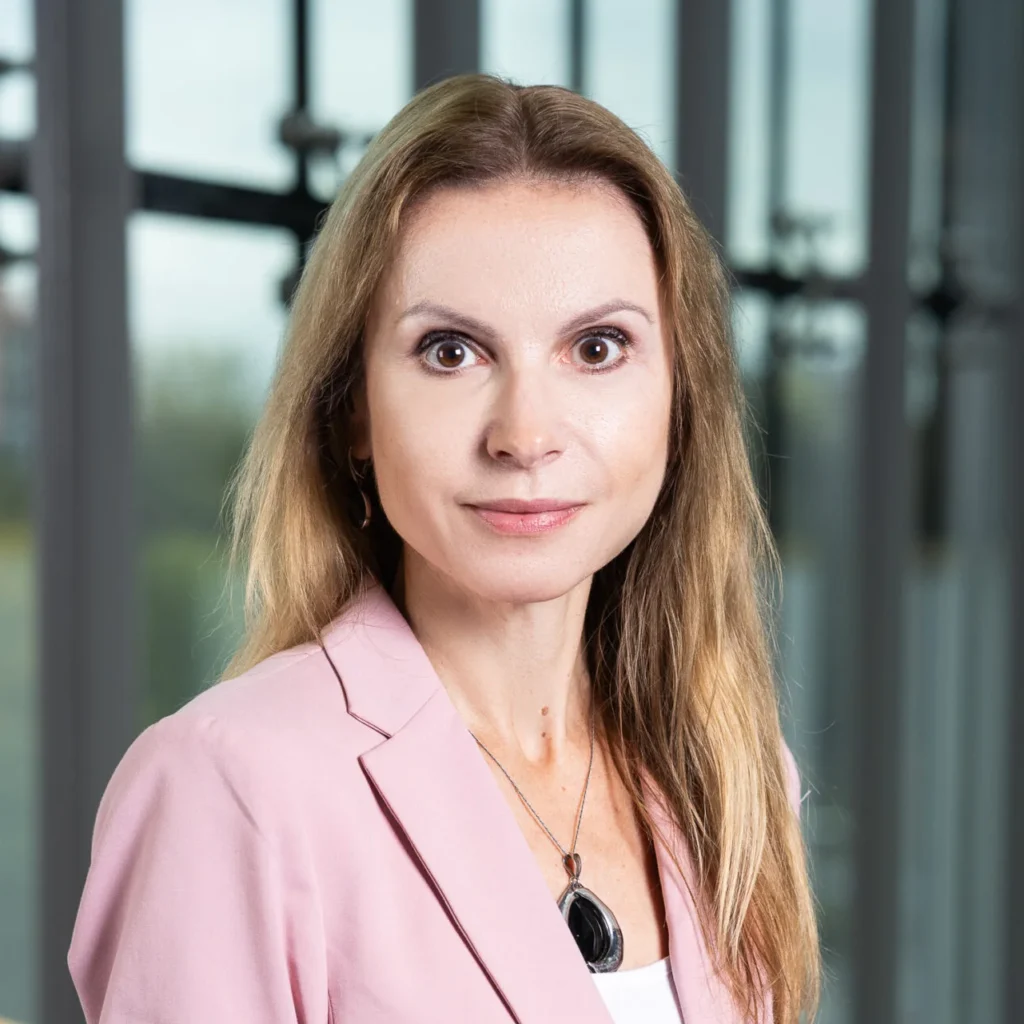
badania.uew.pl — because public debate needs knowledge that organises facts when noise drowns out reason.
Links and sources
Report from the Women’s College in Wrocław, Gazeta Wyborcza: https://wroclaw.wyborcza.pl/wroclaw/7,35771,32684670,kolegium-kobiet-we-wroclawiu-szklane-sufity-sa-czesto-w-naszych.html
Katarzyna Piwowar-Sulej, „Między postępem a nierównością”, „Gazeta Kobiet”, dodatek specjalny do „Gazety Wyborczej”, 25 kwietnia 2026 r.
Directive (EU) 2023/970 on pay transparency, EUR-Lex: https://eur-lex.europa.eu/legal-content/PL/TXT/?uri=CELEX:32023L0970
Polish Ministry of Family, Labour and Social Policy on the implementation of the Directive: https://www.gov.pl/web/rodzina/informacja-dotyczaca-prac-nad-wdrozeniem-dyrektywy-dotyczacej-rownosci-wynagrodzen
Staff profile of Professor Katarzyna Piwowar-Sulej, WUEB: https://www.ue.wroc.pl/pracownicy/katarzyna_piwowar-sulej.html
Minister of Science Award for Professor Piwowar-Sulej (2026): https://uew.pl/en/katarzyna-piwowar-sulej-ministerial-award-2026/
Author: Justyna Morawska-Płoskonka
See similar content

Computer and video games: economy, technology, society. Prof. Patrycja Klimas comments

A new era of space – humanity’s future or visionary wastefulness?
Donald Trump’s presidency, the EU Omnibus package and the climate emergency – how politics shapes the future of ESG

Why doesn’t Poland have its own Spotify? The middle‑income trap and a strategy for the future
See also
How can economic fluctuations be smoothed? The 2026 Nobel Prize in Economic Sciences through the eyes of WUEB researchers
The World Within Wrocław’s Reach. How the PROM research mobilities confirm WUEB’s place on the map of global academia
Wroclaw’s micro-hub at the Economic Forum. Natalia Szozda, Associate Professor, on when a city truly becomes smart
Dr hab. Aleksander Mercik, Professor of the WUEB, receives the Andrzej Gospodarowicz Award in Finance from the President of the Polish Academy of Sciences

WUEB Experts Weekly Review. Research, Projects and Academic Successes (5–11 October 2026)

Wroclaw University of Economics and Business researchers among the world’s leading scientists: six included in the 2026 World’s Top 2% Scientists database
WUEB Experts Weekly Review: Research, Projects and Academic Successes (28 September–4 October 2026)