

Wrocław Women’s Forum (Wrocławskie Forum Kobiet) offers a useful starting point for a conversation about how research meets business and urban practice. In the panel “Creative Wrocław – Science, Innovation and the Future”, the voice of Wroclaw University of Economics and Business is represented by dr hab. inż. Maja Kiba-Janiak, Professor of the WUEB, whose work focuses on one of the most practical challenges facing contemporary cities: logistics.
From innovation to practical urban decisions
Urban logistics usually becomes visible when something stops working.
A delivery van blocks a street. A courier stops with hazard lights on. Residents complain about noise. Businesses need reliable deliveries, because without them the city centre loses part of its retail and service function.
There are other issues in the background: emissions, road safety, limited public space and the need to balance the interests of pedestrians, residents, companies, delivery operators and local authorities.
In this context, research findings can become a practical tool for addressing the logistics conflicts that build up in cities every day.
Wrocław Women’s Forum
On the Wrocław Women’s Forum (Wrocławskie Forum Kobiet) website, dr hab. inż. Maja Kiba-Janiak, Professor of the WUEB, is presented as Professor of the WUEB and EMBA Programme Director. Professor of the WUEB Maja Kiba-Janiak works on urban logistics, transport, last-mile delivery and the organisation of flows in urban space.
*“Last mile” refers to the final stage of delivery. It is often the most difficult, most expensive and most disruptive stage for the city.
Urban logistics is a recurring theme in Professor of the WUEB Maja Kiba-Janiak’s projects and publications. Her work covers urban logistics, freight transport, last-mile delivery, e-commerce and the role of logistics in urban development strategies.
In the completed National Science Centre Poland project, Professor of the WUEB Maja Kiba-Janiak examined sustainable last-mile urban logistics and returns in the e-commerce sector from the perspective of different stakeholder groups.
The most important current development in this research area is NEXTLOGIC, a Horizon Europe project. Dr hab. inż. Maja Kiba-Janiak, Professor of the WUEB, is the project leader at WUEB. The project asks how urban freight transport can be designed to reduce emissions, make better use of space and remain grounded in the everyday realities of companies, couriers, local governments and residents.
Read more about the NEXTLOGIC project: https://badania.uew.pl/innowacyjna-logistyka-miejska-dla-miast-neutralnych-klimatycznie-nextlogic/
Microhub: small infrastructure, a major urban test
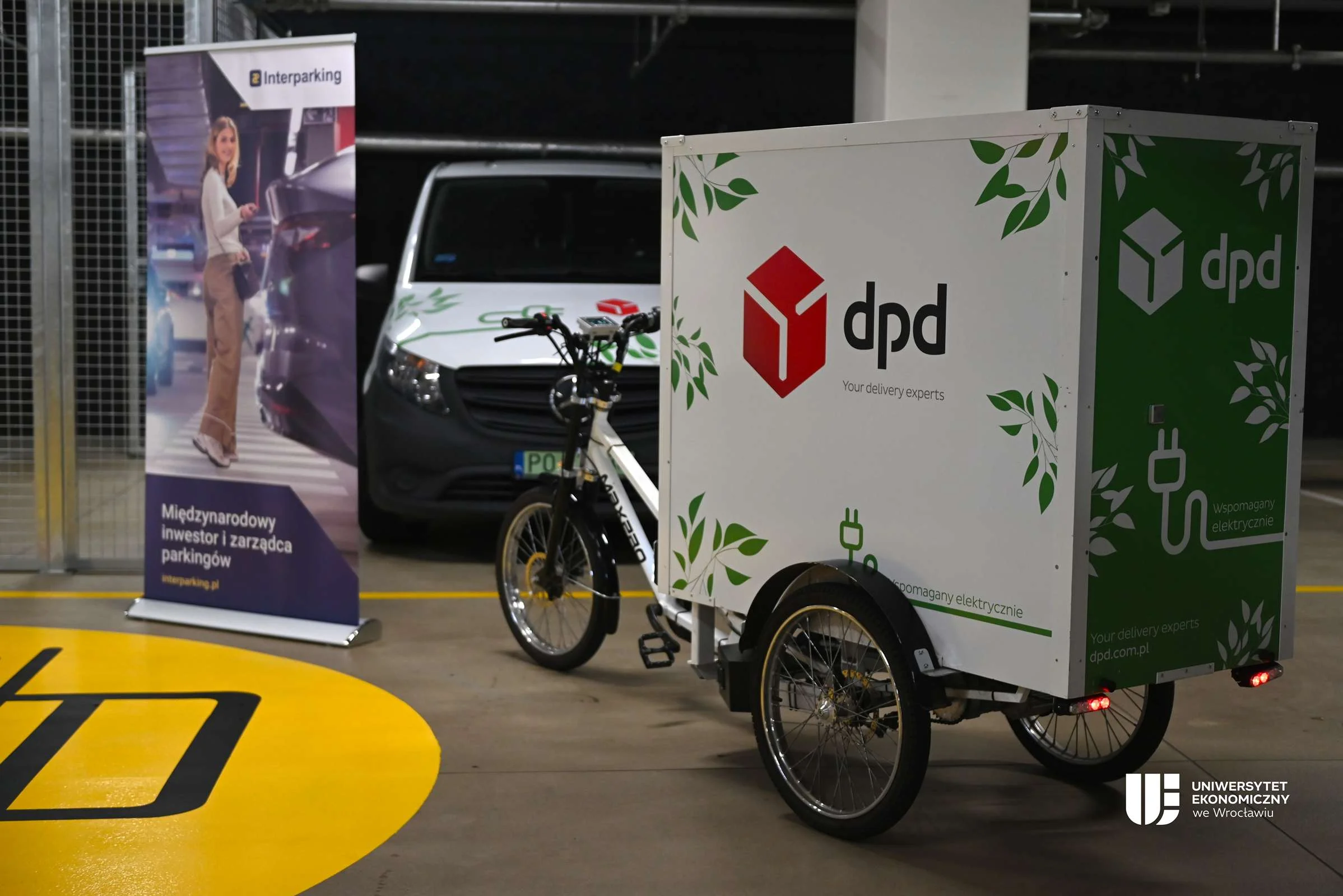
One of the clearest examples of this approach is Poland’s first shared transshipment microhub, launched in Wrocław in early June 2025.
A microhub is a small transshipment point where parcels or goods can be transferred from larger vehicles to smaller, less disruptive modes of transport, such as cargo bikes.
The expert explains the idea in simple terms:
“The idea of the microhub is that courier companies deliver goods by vans of up to 3.5 tonnes to their boxes, which have been set up in the car park near the NFM, and then distribute them by cargo bikes within the centre of Wrocław during the day.”
*NMF – NFM – National Forum of Music in Wrocław.
The solution is not only about technology. It is mainly about organising cooperation.
The interests of the city, logistics operators, courier companies, businesses and residents all need to be aligned. A university can help identify risks, indicate relevant measures and check whether the solution delivers the expected change.
Read more about the microhub: https://badania.uew.pl/dr-hab-inz-maja-kiba-janiak-prof-uew-o-pierwszym-w-polsce-mikrohubie-przeladunkowym/
Research that tests, not only describes
The participation of dr hab. inż. Maja Kiba-Janiak, Professor of the WUEB, in the panel on science, innovation and the future of Wrocław shows that a conversation about urban development does not have to start with broad slogans.
It can begin with a question that returns every day, even if it rarely reaches the centre of public debate: how should deliveries be managed in a city that aims to be accessible, convenient and lower-emission?
This is a question about very specific decisions. Where can a delivery vehicle stop? Can some deliveries be moved to cargo bikes? How should a transshipment point be organised? Who should use it? How should the effects of such a change be measured?
In this sense, the work of Professor of the WUEB Maja Kiba-Janiak shows the practical role of research. It helps test which solutions work in a real city, and which remain only a promise.
Author of text: Barbara Grzelczak
See also
Wroclaw’s micro-hub at the Economic Forum. Natalia Szozda, Associate Professor , on when a city truly becomes smart

WUEB Experts Weekly Review. Research, Projects and Academic Successes (5–11 October 2026)
WUEB Experts Weekly Review: Research, Projects and Academic Successes (28 September–4 October 2026)
WUEB Experts Weekly Review: Research, Projects and Academic Successes (21–27 September 2026)
See similar content
The World Within Wrocław’s Reach. How the PROM research mobilities confirm WUEB’s place on the map of global academia
Wroclaw’s micro-hub at the Economic Forum. Natalia Szozda, Associate Professor , on when a city truly becomes smart
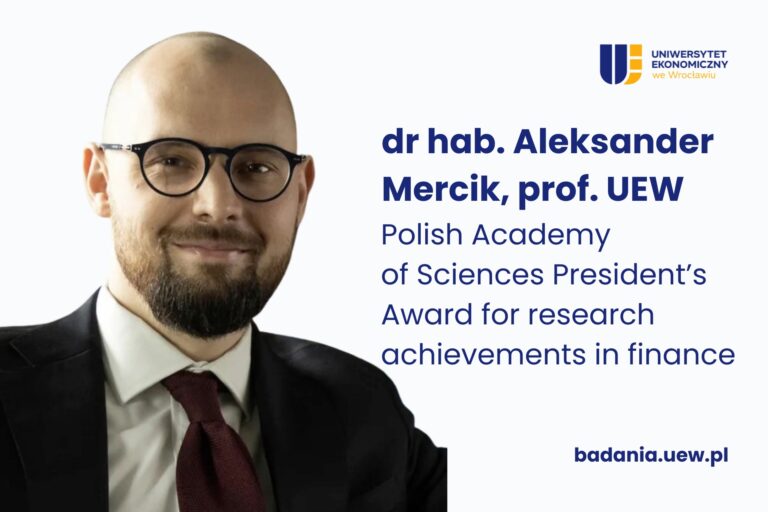
Dr hab. Aleksander Mercik, Professor of the WUEB, receives the Andrzej Gospodarowicz Award in Finance from the President of the Polish Academy of Sciences
WUEB Experts Weekly Review. Research, Projects and Academic Successes (5–11 October 2026)

Wroclaw University of Economics and Business researchers among the world’s leading scientists: six included in the 2026 World’s Top 2% Scientists database
WUEB Experts Weekly Review: Research, Projects and Academic Successes (28 September–4 October 2026)

Vitamins C and D in a single plant-based gel: UEW researcher awarded NCN grant