
An international assessment of responsibility and sustainable development
It is easy to talk about responsibility. It is much harder to show that responsibility is part of an institution’s everyday work: in research, teaching, governance, stakeholder relations and the way outcomes are documented. This is why the debut of Wroclaw University of Economics and Business in the Times Higher Education Sustainability Impact Ratings 2026 is significant for the entire academic community.
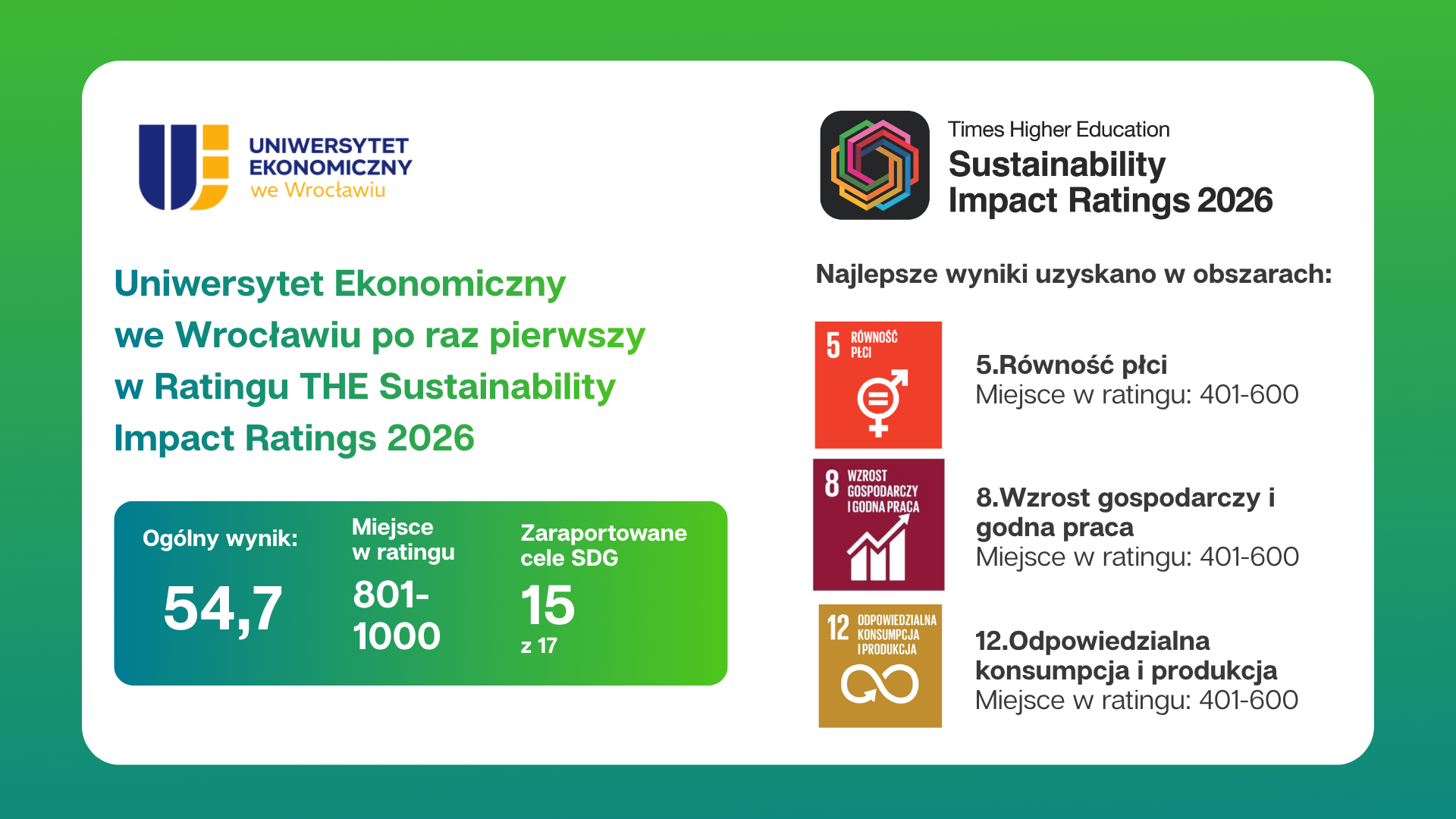
For the first time, UEW has been included in an international ranking assessing universities’ documented contribution to the United Nations Sustainable Development Goals.
In this year’s edition, the University achieved a score of 54.7 out of 100 and was placed in the global 801-1000 band among 1,646 universities from 116 countries.
This is a strong starting point and a clear signal: the work carried out at UEW is visible in areas that matter for the contemporary economy, society and environment.
More than a ranking position
The Times Higher Education Sustainability Impact Ratings differ from traditional academic rankings. They do not assess only publications, reputation or research metrics. They take a broader view, looking at university policies, organisational practices, stakeholder engagement, resource management, equality, education, partnerships and the way in which a university documents its contribution to sustainable development.
For UEW, participation in this assessment has strategic importance. It presents the University as a business school that not only conducts research and provides education in areas related to responsible economy, management, finance and sustainable development, but also submits its own activities to international verification.
A result that highlights UEW’s strengths
In its debut edition, UEW was assessed particularly well in areas closely aligned with the profile of an economics and business university. The University was placed in the 401-600 band in three goals:
- SDG 5: Gender Equality,
- SDG 8: Decent Work and Economic Growth,
- SDG 12: Responsible Consumption and Production.
This matters because these are fields directly connected with UEW’s research, teaching and expert activity. They relate to the labour market, responsible management, consumption models, economic development, equality and institutional quality. In other words, the ranking points to strengths in precisely those areas in which the University is building its recognition and expertise.
Numbers that reflect concrete action
Among the highly rated elements were also indicators relating to UEW’s functioning as an organisation. The University scored 93.2 points for employment stability and 100 points for publishing annual sustainability reports.
These results matter not only in terms of institutional image. For candidates, students, employees and partners, they show that responsibility at UEW is not merely a communication slogan or a teaching topic. It is also part of the way the University is managed, the way its activities are documented and the way it works with external stakeholders.
The strong result in the area of decent work also corresponds with the UEW Strategy 2030, which points to the development of an organisational culture that ensures decent and satisfying working conditions and opportunities for employee development.
Research that contributes to sustainable development
The detailed results also show the importance of UEW’s research output. Publications related to selected Sustainable Development Goals were highly rated, including:
- 82.7 points for publications related to gender equality,
- 81.5 points for publications related to decent work and economic growth,
- 79.4 points for publications related to quality education,
- 71.0 points for publications related to peace, justice and strong institutions,
- 65.8 points for publications related to industry, innovation and infrastructure.
This is a particularly important dimension for the badania.uew.pl portal. It shows that the University’s contribution to sustainable development is not limited to declarations or organisational measures. It also includes knowledge that can support public decision-making, business practice, education, institutional management and cooperation with external stakeholders.
A debut and the beginning of further work
UEW’s first participation in the Times Higher Education Sustainability Impact Ratings 2026 is a reason for satisfaction, but also a reference point for further work. This type of assessment makes it possible to see which activities are already well documented, where the University has strong foundations and which areas require further strengthening.
This is important because in international assessment systems, increasing weight is given not only to what a university does, but also to whether it can describe, document and present that work reliably in the context of its mission.
The preparation of UEW’s participation in the ranking, as well as the coordination of the process and the collection and verification of data, was carried out by the UEW Sustainable Development Office.
The result achieved is the outcome of cooperation between many people and organisational units across the University. It is the everyday research, teaching, organisational and social activity of employees, doctoral students and students that provides the foundation on which UEW can demonstrate its contribution to the Sustainable Development Goals in an international assessment system.
UEW’s debut in the Times Higher Education Sustainability Impact Ratings 2026 shows that responsibility, sustainable development and the quality of governance are areas that can not only be declared, but also documented, compared and developed consistently.
Authors: Justyna Morawska-Płoskonka, dr Ewa Brzozowicz
See similar content
Vitamins C and D in a single plant-based gel: UEW researcher awarded NCN grant

Joanna Radomska of WUEB awarded the title of professor
What comes after a PhD? Dr Milena Kowalska at the Economic Forum in Karpacz
Visual Simulation of Business Processes (WSPB) joins the Polish Roadmap for Research Infrastructures
See also

WUEB Experts Weekly Review: Research, Projects and Academic Successes (28 September–4 October 2026)
Vitamins C and D in a single plant-based gel: UEW researcher awarded NCN grant
Joanna Radomska of WUEB awarded the title of professor
How can solutions for urban freight transport be co-created? Dr hab. inż. Maja Kiba-Janiak’s, Professor of the WUEB research fellowship in Gothenburg
WUEB Experts Weekly Review: Research, Projects and Academic Successes (21–27 September 2026)
Poland’s demographic crisis: Professor Marek Kośny on the economic consequences

What is Bitcoin and How is it Changing Finance? dr Michał Kisiel on the Future of Money