
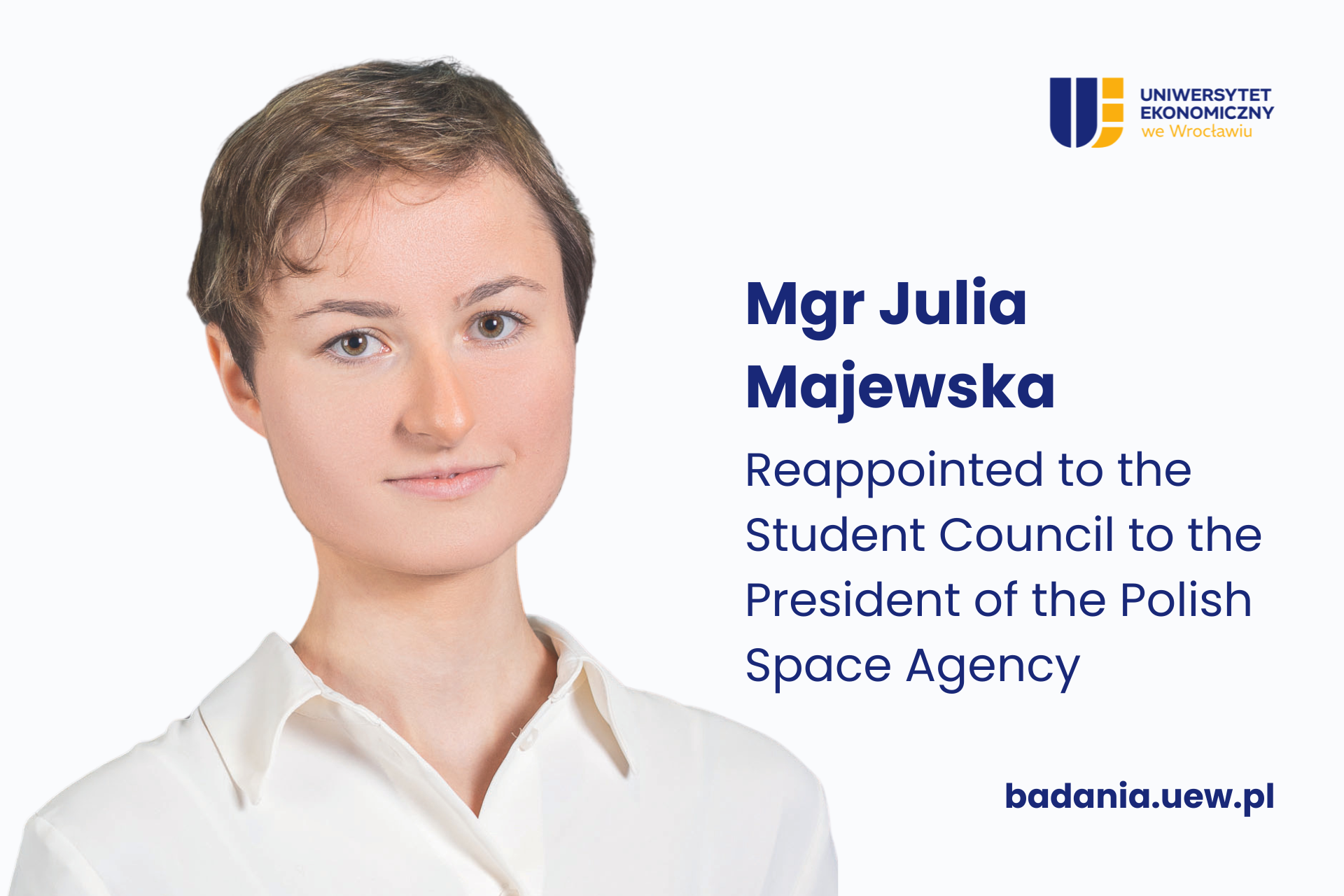
Mgr Julia Majewska of the Wroclaw University of Economics and Business has been appointed for the seventh term of the Student Council to the President of the Polish Space Agency (POLSA). She will continue her work on the Council while linking her research into the space economy with participation in a nationwide advisory forum.
An economic perspective on an interdisciplinary council
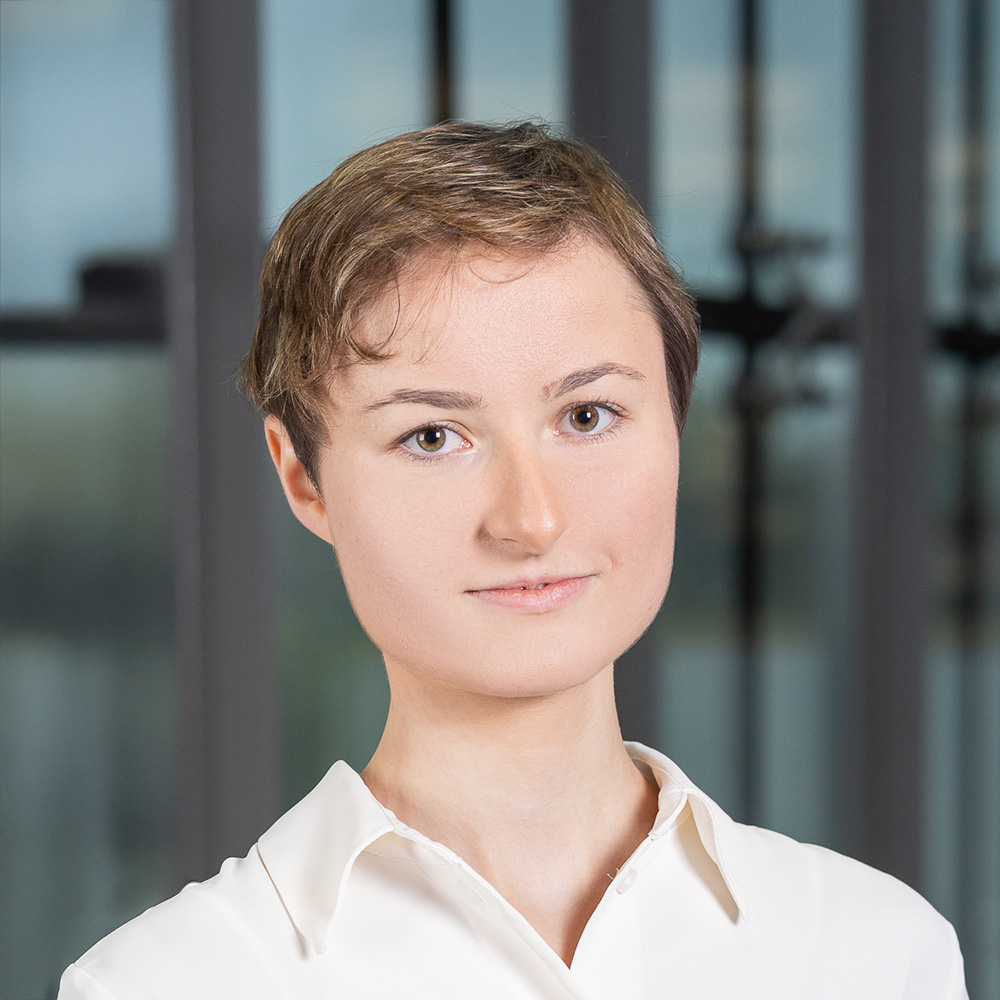
The inaugural meeting of the Council’s seventh term took place on 24–25 July 2026 at the Polish Space Agency’s Warsaw office. Its new membership includes Mgr Julia Majewska, Assistant Lecturer at the Department of International Business and a doctoral student at the Doctoral School of the Wroclaw University of Economics and Business.
Julia Majewska joined the Council in July 2025. Her latest appointment means that she will continue her work for another term. The Council does more than represent people interested in space technologies. It is an interdisciplinary advisory body that reviews selected POLSA initiatives, makes recommendations, launches educational activities and supports cooperation between universities. It also promotes ESA Education programmes run by the European Space Agency and helps develop entrepreneurship and the skills required by the space sector.
Engineering expertise alone is not enough in such a body. The development of the space sector also raises questions about investment viability, funding sources, risk, business models, regulation and the social and economic consequences of new technologies. The participation of a WUEB representative therefore brings an economic and financial perspective to the Council’s work.
The New Space Economy as a research field
Mgr Julia Majewska conducts her research under the supervision of prof. dr hab. Bogusława Drelich-Skulska. Her research interests focus on the New Space Economy and the application of artificial intelligence in economic analysis. She also studies the economic conditions affecting the implementation of innovative AI systems.
The New Space Economy describes a shift in which space activity is no longer the sole domain of governments and national agencies. Private companies, start-ups, investors and organisations developing services based on satellite data are playing an increasingly prominent role. Technological opportunities, however, are accompanied by economic decisions: which projects are likely to be sustainable, how their risks should be assessed and how market development can be reconciled with the responsible use of limited resources.
This issue also features in Mgr Julia Majewska’s research. In the chapter ‘Perspectives on Treating Outer Space as a Resource Within Ecological Economics: An Analysis of the Space for V4 Project’, she examines outer space as a distinct type of resource. Her analysis covers both material resources beyond Earth and space itself, including near-Earth orbits as resources of economic and social significance. This approach brings together economics, sustainable development and space policy.
Mgr Julia Majewska’s participation in the Council is directly connected with her research profile. It allows her to compare research questions with the sector’s current needs while contributing an economic perspective to the discussion, from analysing the impact of innovation to assessing the conditions for its implementation.
Read the interview with Julia Majewska about the new space age:
https://badania.uew.pl/en/a-new-era-of-space-humanitys-future-or-visionary-wastefulness/
From research to cooperation and recommendations
The Student Council to the President of POLSA has operated since 2020. Its members represent different universities and fields of study but share an interest in the development of Poland’s space sector. This diversity has practical value. Contemporary space activity sits at the intersection of engineering, computer science, law, economics, management and public policy. Without cooperation between these fields, even the most advanced technological solution may fail to secure funding, find an application or operate within an appropriate legal framework.
Mgr Julia Majewska’s appointment for the Council’s seventh term strengthens the Wroclaw University of Economics and Business’s contribution to this debate. It also shows that the role of an economics university in the space sector begins well before a technology is ready for use. It includes decisions about investment priorities, cost–benefit analysis, assessments of the impact of innovation and recommendations for public administration and business.
The Council’s new term comprises 29 members representing 19 universities. They will work to connect the academic community with the Polish Space Agency, support young talent and initiate projects that could increase the participation of Polish students and doctoral students in space-sector initiatives. For Mgr Julia Majewska, this will be another year of work in a setting where economic knowledge can inform discussions about the sector’s future direction.
Meet the expert
Mgr Julia Majewska
Expert in the field of: Polityka społeczno-gospodarcza, Nowe technologie i innowacje
More on this topic: https://forumakademickie.pl/nowy-sklad-rady-studentow-przy-prezesie-polsa/
Author of text: Barbara Grzelczak
See also
Vitamins C and D in a single plant-based gel: UEW researcher awarded NCN grant

Joanna Radomska of WUEB awarded the title of professor
What comes after a PhD? Dr Milena Kowalska at the Economic Forum in Karpacz
Visual Simulation of Business Processes (WSPB) joins the Polish Roadmap for Research Infrastructures
See similar content
Vitamins C and D in a single plant-based gel: UEW researcher awarded NCN grant
Joanna Radomska of WUEB awarded the title of professor
How can solutions for urban freight transport be co-created? Dr hab. inż. Maja Kiba-Janiak’s, Professor of the WUEB research fellowship in Gothenburg

WUEB Experts Weekly Review: Research, Projects and Academic Successes (21–27 September 2026)
Poland’s demographic crisis: Professor Marek Kośny on the economic consequences

What is Bitcoin and How is it Changing Finance? dr Michał Kisiel on the Future of Money
WUEB Experts Weekly Review: Research, Projects and Academic Successes (14–20 September 2026)