
The past week brought discussions about how economic expertise can support businesses, cities and regions. WUEB experts contributed to debates at the Economic Forum in Karpacz and explained developments in logistics and financial markets. We also introduce three expert profiles that make it easier to contact researchers and explore cooperation with the University.
Report presentation by SGH and the Economic Forum 2026 opens the Economic Forum in Karpacz
WUEB Expert: prof. dr hab. Czesław Zając, Rector of WUEB
Prof. Czesław Zając was among the invited guests at the presentation of the SGH Report and the Economic Forum, which on 8 September opened the substantive part of the meetings in Karpacz. The publication, prepared by SGH experts, addresses economic resilience, development financing and technological transformation, among other topics. It served as a reference point for discussions on the challenges facing Poland and Central and Eastern Europe
Rector of the University of Economics: “We are developing skills that help people navigate new realities”
WUEB Expert: prof. dr hab. Czesław Zając, Rector of WUEB
In an interview with wyborcza.pl, Prof. Czesław Zając outlines the key challenges facing modern higher education in Europe. The UEW Rector stresses that academic education must go beyond preparing graduates for their first job, focusing instead on developing skills that allow flexible responses to market and technological change throughout their professional lives.
In the article, the expert also discusses the use of AI tools in teaching, the need to reform public university funding mechanisms, and the necessity of translating academic innovation into business practice more effectively.
35th Economic Forum in Karpacz. Universities as support for the development and resilience of local governments
WUEB Expert: prof. dr hab. Marek Kośny, Vice-Rector for Science, WUEB
During the Economic Forum in Karpacz, Prof. Marek Kośny took part in a debate on how universities can support regional development and prepare regions for crises. The discussion covered cooperation between researchers, local governments and entrepreneurs, the use of expertise, and aligning education with the needs of the economy.
The Vice-Rector also spoke about the significance of the Forum for universities on Radio Rodzina. Both radio segments, along with material from the Podlaskie regional government, illustrate UEW’s presence in discussions on the practical application of academic knowledge.
Additional source: https://www.radiorodzina.pl/2026/09/08/xxxv-forum-ekonomiczne-w-karpaczu-oficjalnie-otwarte/
Addictional source: https://www.radiorodzina.pl/2026/09/11/xxxv-forum-ekonomiczne-w-karpaczu-jak-zaprezentowal-sie-dolny-slask/
Rectors on the challenges of the G20
WUEB Expert: prof. dr hab. Czesław Zając, Rector of WUEB
What role can universities play in strengthening Poland’s international standing? This was one of the questions addressed in a debate among rectors of economic universities held at the SGH Zone. Prof. Czesław Zając highlighted the need to seek compromise in dialogue with states holding differing visions of development, while preserving one’s own identity. The discussion also touched on the importance of education, research and competencies for economic competitiveness.
Source: https://perspektywy.pl/aktualno%C5%9Bci/wydarzenia/rektorzy-o-wyzwaniach-g20
WRO Venture Connect 2.0 at the 35th Economic Forum in Karpacz. From grants, through startups and DeepTech, to legislation
WUEB Expert: Jan Jakub Cendrowski, Director of InQUBE University Business Incubator, WUEB
At WRO Venture Connect 2.0, Jan Jakub Cendrowski spoke about the barriers that make it difficult for young companies to collaborate with corporations. Large organisations often expect experience and an existing base of paying customers, which puts early-stage teams in a difficult position.
The InQUBE Director pointed to the role incubators play in facilitating connections that can lead to joint ventures. His remarks are cited in two pieces covering debates on financing and the development of innovative companies.
Additional source: https://faktywroclaw.pl/20260910414661/umowa-araw-z-ncbr-ma-polaczyc-startupy-z-kapitalem-do-15-mln-euro
Unique Smart City implementations. Cities that did it differently, at the Economic Forum in Karpacz
WUEB Expert: dr hab. Natalia Szozda, Professor of the WUEB
During the Economic Forum in Karpacz, in the panel “Unique Smart City implementations. Cities that did it differently,” a joint project between Wrocław and UEW was highlighted, in which cargo bikes deliver parcels on the last leg of the journey to the recipient. The solution is being piloted in part of the Old Town. UEW expert Dr hab. Natalia Szozda, Professor of UEW, took part in the discussion on Smart City solutions.
Researchers are analysing data to assess its impact on the day-to-day functioning of the city centre, including traffic and residents’ comfort. The example shows how cooperation with a university allows the effects of urban solutions to be studied as they are rolled out.
Modest foreign expansion. Polish firms fare worse than their Czech and Hungarian counterparts
WUEB Expert: dr hab. Artur Klimek, Professor of the WUEB
In a byline piece for “Dziennik Gazeta Prawna,” Artur Klimek examines the limited scale of foreign expansion by Polish enterprises. He compares their position with firms from the Czech Republic and Hungary, and highlights the importance of recognisable brands, proprietary technologies and operations conducted abroad for the strength of a home economy.
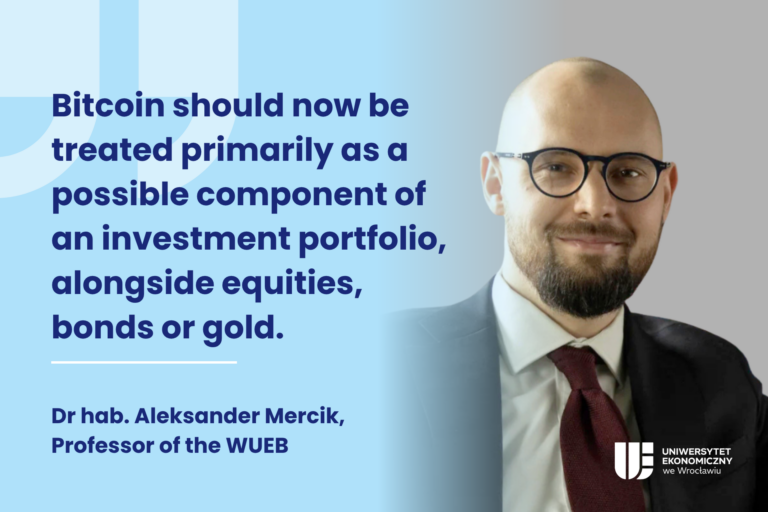
Bitcoin is not a digital Polish złoty. A UEW expert explains how to understand cryptocurrencies
WUEB Expert: dr hab. Aleksander Mercik, Professor of the WUEB
Aleksander Mercik explains why bitcoin and money held in a bank account operate on different principles. In an article on badania.uew.pl, based on an interview with Radio Wrocław, the expert presents crypto-assets as a distinct asset class and discusses their possible place within an investment portfolio.
He notes, however, that risk does not end with price fluctuations. The condition of the intermediary and the way funds are stored and access is secured also matter
Young researchers present their findings
National Conference of Young Researchers, “Entering the World of Science”
On 11 September 2026, UEW hosted the conference “Entering the World of Science,” aimed at students, doctoral candidates and early-career researchers holding a PhD. The event provided a platform for presenting research findings and building collaboration between academic centres.
The leading discipline was food technology and nutrition, with the thematic programme also covering biotechnology, health sciences and environmental sciences, among others. The interdisciplinary format gave participants the opportunity to engage with methods and perspectives from other fields.
Source: https://badania.uew.pl/events/ogolnopolska-konferencja-mlodych-naukowcow-wkraczajac-w-swiat-nauki/
Lower Silesian Science Festival at the UEW Branch in Jelenia Góra
WUEB Branch in Jelenia Góra
The UEW branch in Jelenia Góra has announced free lectures and workshops for secondary school students, to be held on 15 October as part of the Lower Silesian Science Festival. The programme includes topics such as innovation in logistics, informed consumer decisions, and applications of artificial intelligence in English-language learning and accounting work.
Registration is handled by those responsible for each session. Full programme details and contact information are available in the announcement published by the Jelonka.com portal
Source: https://jelonka.com/dolnoslaski-festiwal-nauki-w-filii-uew-w-jeleniej-gorze-179610/
Meet the expert in local government finance
WUEB Expert: dr Małgorzata Gałecka
How can the financial health of a local government be assessed, and how can one check whether public funds are being spent efficiently? These are the questions addressed by Dr Małgorzata Gałecka. On the “Collaborate with our experts” page, we present her research on local government budgets, financial inequalities and the operation of cultural institutions.
The expert serves as academic coordinator of the Financial Ranking of Local Government in Poland. Her profile outlines the scope for potential collaboration and contact details for those seeking analysis or expert commentary.
Source: https://badania.uew.pl/en/cooperation-with-experts/malgorzata-galecka/
Meet the expert in economic decision-making and auctions
WUEB Expert: dr hab. Paweł Kuśmierczyk, Professor of the WUEB
Paweł Kuśmierczyk studies how people make economic decisions and how to design the rules governing markets. He specialises in experimental and behavioural economics, with a particular focus on auctions and tenders. He is also interested in retirement planning and decision-making under risk.
His profile on badania.uew.pl outlines opportunities for collaboration on experimental research, data analysis, and the evaluation of auction and tender procedure efficiency.
Source: https://badania.uew.pl/en/cooperation-with-experts/pawel-kusmierczyk/
Meet the expert in corporate responsibility
WUEB Expert: dr hab. Agnieszka Sokołowska-Durkalec, Professor of the WUEB
Agnieszka Sokołowska-Durkalec researches corporate social responsibility and irresponsibility, as well as the management of intangible resources such as employee knowledge and competencies. She studies the links between ethics, organisational culture, leadership and people management.
The expert’s page includes information on collaboration opportunities covering the evaluation of CSR activities, the development of incentive systems and competency models, and coaching and mentoring.
Source: https://badania.uew.pl/en/cooperation-with-experts/agnieszka-sokolowska-durkalec/
Homo economicus grows irrational with age
WUEB Expert: dr Łukasz Jurek, Professor of the WUEB
In an interview with the “Polityka Senioralna” portal, Dr Łukasz Jurek explains why apocalyptic visions of pension system collapse need not come to pass, and what role technological progress and rising labour productivity play in adapting to demographic change. The expert notes that people do not act with perfect rationality in financial decisions, and that effective public policy should therefore draw on psychological nudges rather than relying solely on traditional economic incentives.
He points out that building a secure system requires a stable legal framework – including the introduction of social long-term care insurance – as well as recognition of the high opportunity cost borne by informal carers who give up paid employment.
Source: https://polityka-senioralna.pl/homo-economicus-nieracjonalny-na-starosc/
The activity of WUEB experts over the past week reflects the university’s broad engagement – from the Economic Forum in Karpacz and debates on economic resilience, through the transfer of knowledge to business and local government, to the promotion of science among young researchers and local communities.
Author: Barbara Grzelczak
See similar content
Bitcoin is not the digital equivalent of the Polish zloty. A WUEB expert explains how to understand cryptocurrencies.

WUEB Experts Weekly Review. Research, Projects and Academic Successes (31 August–6 September 2026)
WUEB Experts Weekly Review. Research, Projects and Academic Successes (24 – 30 August 2026)
WUEB experts weekly rewiev. Research, Projects and Academic Successes (17–23 August 2026)
See also
Bitcoin is not the digital equivalent of the Polish zloty. A WUEB expert explains how to understand cryptocurrencies.
WUEB Experts Weekly Review. Research, Projects and Academic Successes (31 August–6 September 2026)
What comes after a PhD? Dr Milena Kowalska at the Economic Forum in Karpacz
Bridging V4 Universities and Business through Design Thinking
WUEB Experts Weekly Review. Research, Projects and Academic Successes (24 – 30 August 2026)
Visual Simulation of Business Processes (WSPB) joins the Polish Roadmap for Research Infrastructures
WUEB experts weekly rewiev. Research, Projects and Academic Successes (17–23 August 2026)