
Do European funds really help less developed regions catch up with the economic leaders? Why do productivity gaps between regions of the European Union persist despite years of investment? These questions are at the heart of the research of Dr hab. Paweł Dobrzański, Associate Professor at Wroclaw University of Economics and Business (UEW), winner of the 2026 Polish Economic Society (PTE) Professor Edward Lipiński Award.
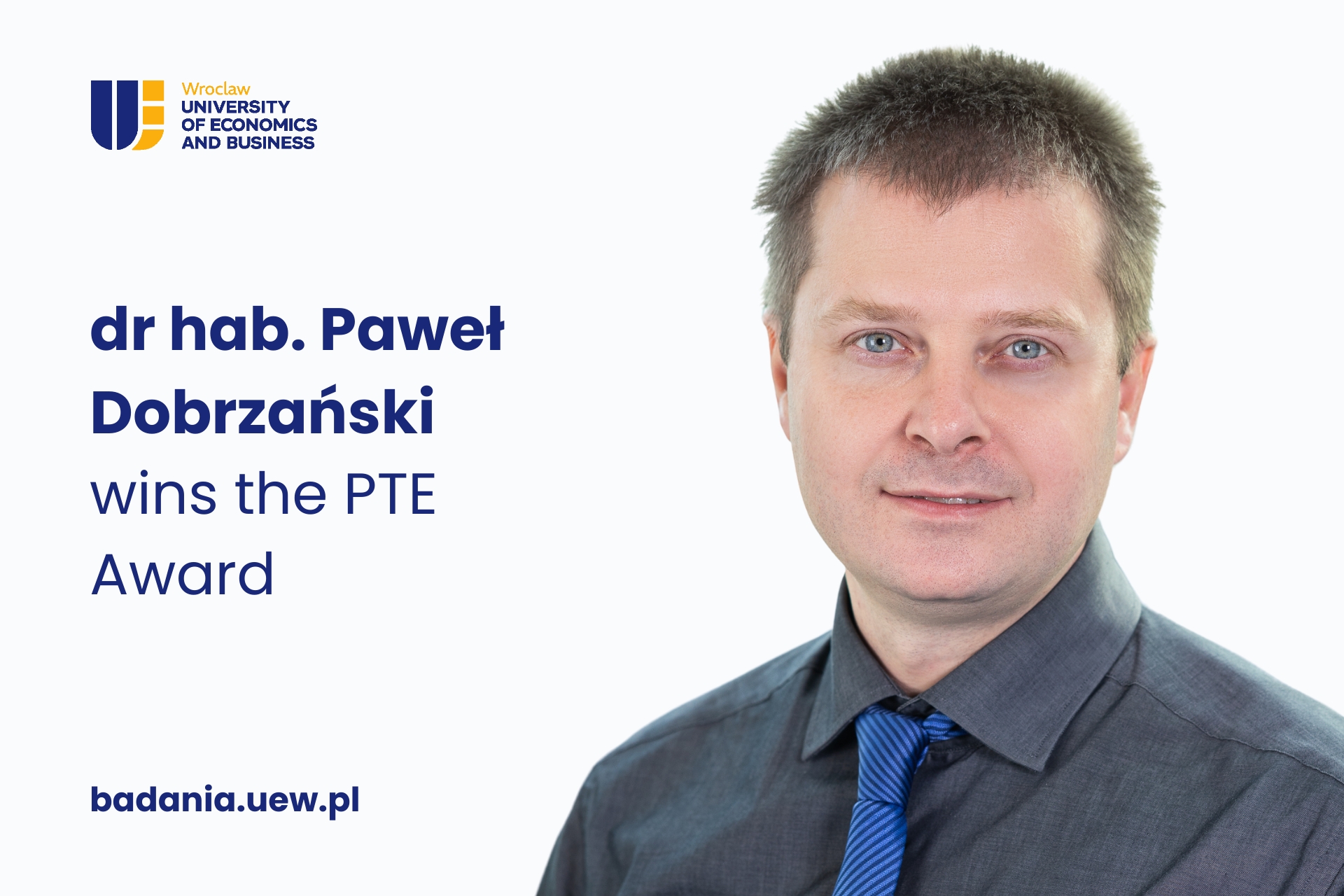
The award was given for his monograph Lagging Regions in the European Union: Structural, Productivity and Efficiency Aspects, published by the international academic publisher Routledge. The prize is awarded each year for books that bring new value to economic theory.
Why is part of Europe falling behind?
European integration and globalisation support economic development, but their benefits are not evenly distributed. Some regions attract investment, grow innovative firms and raise productivity, while others struggle to narrow the gap with the economic leaders.
These lagging regions, referred to in the English-language literature as left-behind regions, are the focus of Professor Dobrzański’s work.
In the monograph, he analyses regional economic inequalities in the European Union, their structural determinants and changes in labour productivity. He pays particular attention to the effectiveness of EU cohesion policy, one of whose core aims is to reduce development disparities.
Do European funds translate into productivity growth?
One of the central issues addressed in the book is how efficiently EU funds are used in less developed regions.
The author applies quantitative methods, including shift-share analysis, which examines how changes in economic structure affect labour productivity, and Data Envelopment Analysis (DEA), which assesses the relative efficiency of resource use.
This approach goes beyond comparing levels of financial input and focuses on the economic results achieved.
The research therefore addresses a question that matters to economists and policymakers alike: how should support instruments be designed so that they strengthen the development potential of regions more effectively?
Research evidence for better regional policy
The relevance of this work extends beyond academic debate. With limited public funds and persistent territorial inequalities, it is increasingly important to assess how much is invested in regional development and what results those investments deliver.
Professor Dobrzański’s monograph provides an analytical basis for discussing the effectiveness of European cohesion policy and how regions that are falling behind can be supported more effectively.
The award recognises the scientific value of research carried out at Wroclaw University of Economics and Business and its relevance to the current debate on Europe’s economic development.
About the publication: Paweł Dobrzański, Lagging Regions in the European Union: Structural, Productivity and Efficiency Aspects, Routledge.
More information (in Polish): https://www.pte.pl/aktualnosci/posty/konkurs-o-nagrode-pte-im-prof-edwarda-lipinskiego-5
Book description: https://www.routledge.com/Lagging-Regions-in-the-European-Union-Structural-Productivity-and-Efficiency-Aspects/Dobrzanski/p/book/9781032615516
About the author
Dr hab. Paweł Dobrzański, Associate Professor at UEW, works in the Department of Mathematical Economics at the Faculty of Economics and Finance, Wroclaw University of Economics and Business. His research covers regional development, economic growth, productivity, international competitiveness and regional inequalities, including left-behind regions. He has been a Visiting Scholar at the Minda de Gunzburg Center for European Studies, Harvard University (in the 2021/2022 academic year and in spring 2024), and at the University of Cambridge. In 2016 he received the CEDIMES Institute award for the best doctoral dissertation.
Author of text: Justyna Morawska-Płoskonka
See similar content
Dr hab. Aleksander Mercik, Professor of the WUEB, receives the Andrzej Gospodarowicz Award in Finance from the President of the Polish Academy of Sciences
Wroclaw University of Economics and Business researchers among the world’s leading scientists: six included in the 2026 World’s Top 2% Scientists database
Vitamins C and D in a single plant-based gel: UEW researcher awarded NCN grant

Joanna Radomska of WUEB awarded the title of professor
See also

WUEB Experts Weekly Review. Research, Projects and Academic Successes (12–18 October 2026)
How can economic fluctuations be smoothed? The 2026 Nobel Prize in Economic Sciences through the eyes of WUEB researchers
The World Within Wrocław’s Reach. How the PROM research mobilities confirm WUEB’s place on the map of global academia
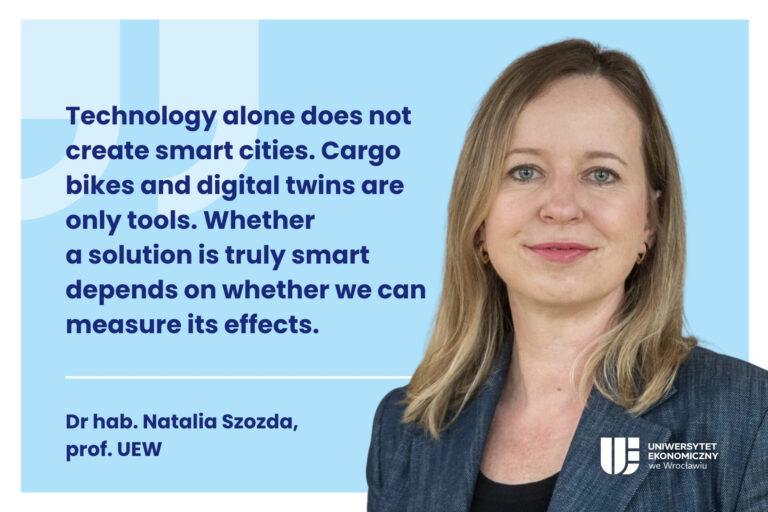
Wroclaw’s micro-hub at the Economic Forum. Natalia Szozda, Associate Professor, on when a city truly becomes smart
Dr hab. Aleksander Mercik, Professor of the WUEB, receives the Andrzej Gospodarowicz Award in Finance from the President of the Polish Academy of Sciences
WUEB Experts Weekly Review. Research, Projects and Academic Successes (5–11 October 2026)
Wroclaw University of Economics and Business researchers among the world’s leading scientists: six included in the 2026 World’s Top 2% Scientists database