

The award of the 2026 Nobel Prize in Economic Sciences has prompted a discussion on how to cushion economic shocks and limit the risk of high unemployment and runaway inflation.
Commenting on the prize in the media, Prof. Marek Kośny, Prof. Krzysztof Jajuga and Prof. Stanisław Czaja of the Wroclaw University of Economics and Business explained why the effectiveness of action by governments and central banks depends on people’s decisions, expectations and trust. That effectiveness determines the stability of the economy, which matters most for families with small financial reserves, who find it harder to cope with a sudden downturn.
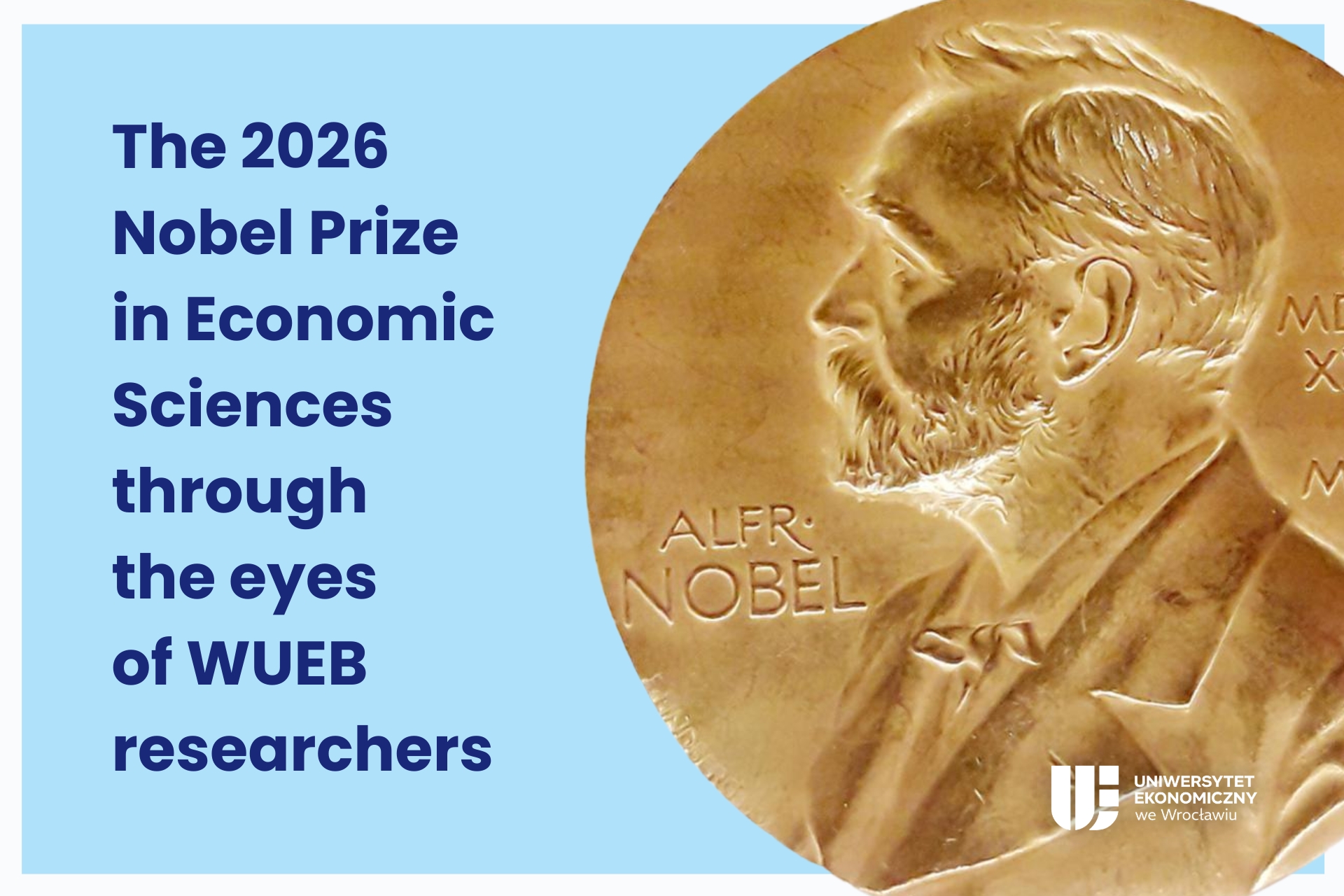
Robert E. Hall and Michael Woodford received the 2026 Nobel Prize in Economic Sciences “for microeconomic foundations of macroeconomic stabilisation” (Royal Swedish Academy of Sciences). Behind this phrase lies a shift in how we think about the economy: to explain fluctuations in consumption, output or inflation, we need to take into account the decisions of individual households and firms (scientific background). Comments by WUEB researchers show why this approach matters beyond economics.
A central bank can change interest rates, and a government can influence households’ purchasing power through changes to taxes and benefits, such as support for families with children. These tools serve to dampen fluctuations in economic growth and unemployment. Choosing an instrument does not, however, determine the outcome: policymakers also need to understand how people and businesses will respond to it.
Today’s spending also depends on how we see the future
The starting point for understanding these responses is a decision everyone knows from their own life: spend money now or save it for later. In a comment for “Rzeczpospolita”, Prof. Marek Kośny noted that in Hall’s research on consumption “the key driver of change is new information and expectations about changes in income”. From this perspective, looking at today’s earnings is not enough to understand spending decisions: people’s assessment of their future financial situation matters too (“Rzeczpospolita”).
Prof. Stanisław Czaja explained on Radio Wrocław what this distinction means for public policy. Discussing Hall’s work, he referred to social benefits: “[…] it is not at all easy to say that if we increase, for example, social benefits, this will immediately translate proportionally into consumer spending”. The level of support can be set in legislation. How recipients respond is a separate matter that has to be considered when assessing a programme.
If the aim of a support programme is to boost consumer spending, it is essential to understand what makes recipients reach for their wallets and what makes them save. As Prof. Czaja pointed out, “we cannot always expect the effects that follow from existing models”. Designing support therefore requires assessing both its amount and the circumstances of the people it is meant to reach.
Expectations can be shaped, but trust is needed
The decisions of consumers and firms then have to be assembled into a picture of the whole economy. Prof. Kośny summed up the relationship between the laureates’ work: “The achievements of Robert E. Hall and Michael Woodford are mutually complementary” (“Rzeczpospolita”). Woodford developed models based on the decisions of households and firms that are used to analyse how monetary policy affects the economy (scientific background).
In this approach, what economic agents expect from the central bank’s future actions also matters, which is why its credibility and transparent communication become important for the effectiveness of monetary policy (scientific background).
Prof. Krzysztof Jajuga also addressed the role of communication in a TVP Nauka programme devoted to the 2026 Nobel Prize in Economic Sciences, this time with regard to governments. He stressed that they “above all should send clear signals”.
He linked this call to specific choices: investing, buying property, saving and everyday spending. As he put it: “… where are we supposed to get information about how the economy will change over the next year, two, three, five? Well, from governments”. What these choices have in common is the future: the decision is made today, but its consequences may extend over years.
Prof. Jajuga added that the state does not make these choices on behalf of citizens and businesses. Economic policy should be understandable to them, so “that trust in it returns, above all among ordinary citizens and entrepreneurs”. His remarks suggest that announcing a plan is not the end of the matter. What also counts is whether people treat the plan as credible information on which they can base their own decisions.
From models to interest rate decisions
Models developed on the basis of the laureates’ work are used not only by central banks but also by finance ministries to analyse the effects of economic policy (Royal Swedish Academy of Sciences). In a radio interview, Prof. Czaja was asked about precisely this practice: whether the findings would help decide when to raise or cut interest rates. He replied that they would help us better understand how interest rates affect various economic phenomena.
At the same time, he distinguished a better understanding of these relationships from the promise of a precise result. He cautioned that the laureates did not provide a universal ratio by which every change in interest rates translates into the economy. Prof. Jajuga pointed to a similar limit. He noted that in economics the same data do not guarantee a single outcome, because people may suddenly behave differently from what a model predicts.
In both comments, the limitations of models are part of explaining how they are used. A model helps analyse relationships and the possible effects of an action, but it does not remove the need to assess the conditions in which that action will be taken. Prof. Czaja described the place of the prize-winning work in the development of economics as follows: “There is still a great, great deal of effort ahead of us, but these are works that are important on this path of development of modern economics”.
A long horizon in a short electoral cycle
In the programme “Rozmowy o biznesie” (Business Talks) on Radio Wrocław, Prof. Krzysztof Jajuga also highlighted the tension between the rhythm of politics and the time horizon that households and businesses need. Politicians think in terms of an electoral cycle lasting a few years, while the effects of economic decisions can be felt for much longer. He pointed out that the temptation to make short-term promises makes it harder to use researchers’ findings in planning economic policy.
Prof. Jajuga also applied this perspective to students. Today’s twenty-year-olds will work and make financial decisions in a world different from the one their lecturers knew at the start of their careers. That is why, in his view, thinking about stability should reach beyond the next election and take into account the conditions in which young people will live many years from now. In this way, the discussion of expectations and trust leads to a question of responsibility for the future.
Knowledge needed in public debate
The media comments by WUEB researchers move the discussion of the 2026 Nobel Prize in Economic Sciences from the language of models to questions about the effectiveness of specific public decisions. Higher benefits, a change in interest rates and a government announcement appear in them as actions whose effects depend on the responses of households and businesses, as well as on the credibility of the central bank and the government. This explanation is also useful for people who are not professional economists but who assess economic proposals and make their own financial decisions.
The common thread in these comments is expectations. People and firms respond not only to current decisions but also to what they expect from central banks and governments. That is why clear signals and trust become part of economic policy, and models, while helping to analyse the effects of policy, do not replace an assessment of the conditions in which it is pursued. What is at stake are predictable conditions for planning spending, investment and employment over a horizon longer than a single electoral cycle. They are needed by families with small financial reserves, by entrepreneurs and by young people who will be making economic decisions many years from now.
Learn more about the mechanisms of economic stabilisation and the contributions of both laureates. Read the full scientific background on Hall and Woodford’s research prepared by the Royal Swedish Academy of Sciences.
Source
- Royal Swedish Academy of Sciences – announcement of the 2026 Nobel Prize in Economic Sciences
- Royal Swedish Academy of Sciences – scientific background on the research of Robert E. Hall and Michael Woodford
- “Rzeczpospolita” – article on the 2026 laureates with a comment by Prof. Marek Kośny (in Polish)
- Radio Wrocław – “Tydzień Noblowski w Radiu Wrocław” (Nobel Week on Radio Wrocław) featuring Prof. Stanisław Czaja (in Polish)
- TVP Nauka – “Nagrody Nobla” (Nobel Prizes), episode 6, featuring Prof. Krzysztof Jajuga (in Polish)
- Radio Wrocław – “Rozmowy o biznesie” (Business Talks), 14 October 2026, featuring Prof. Krzysztof Jajuga (in Polish)
Author of text: Justyna Morawska-Płoskonka
See similar content
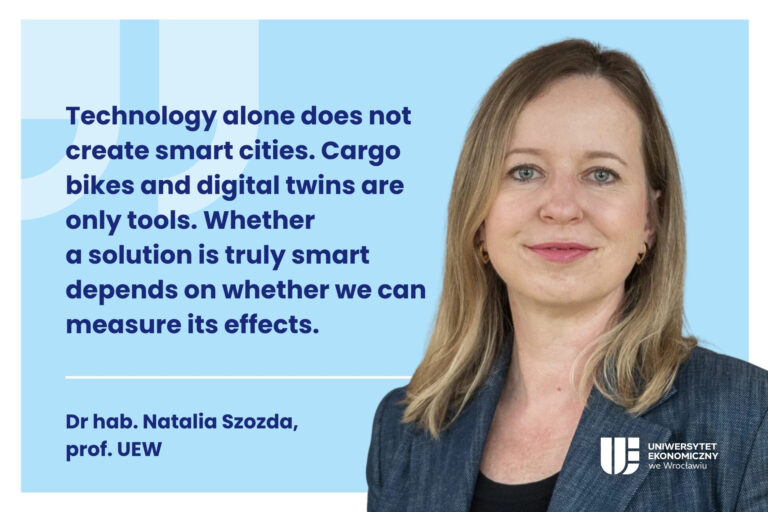
Wroclaw’s micro-hub at the Economic Forum. Natalia Szozda, Associate Professor, on when a city truly becomes smart

WUEB Experts Weekly Review. Research, Projects and Academic Successes (5–11 October 2026)
WUEB Experts Weekly Review: Research, Projects and Academic Successes (28 September–4 October 2026)
WUEB Experts Weekly Review: Research, Projects and Academic Successes (21–27 September 2026)
See also
The World Within Wrocław’s Reach. How the PROM research mobilities confirm WUEB’s place on the map of global academia
Wroclaw’s micro-hub at the Economic Forum. Natalia Szozda, Associate Professor, on when a city truly becomes smart

Dr hab. Aleksander Mercik, Professor of the WUEB, receives the Andrzej Gospodarowicz Award in Finance from the President of the Polish Academy of Sciences
WUEB Experts Weekly Review. Research, Projects and Academic Successes (5–11 October 2026)
Wroclaw University of Economics and Business researchers among the world’s leading scientists: six included in the 2026 World’s Top 2% Scientists database
WUEB Experts Weekly Review: Research, Projects and Academic Successes (28 September–4 October 2026)
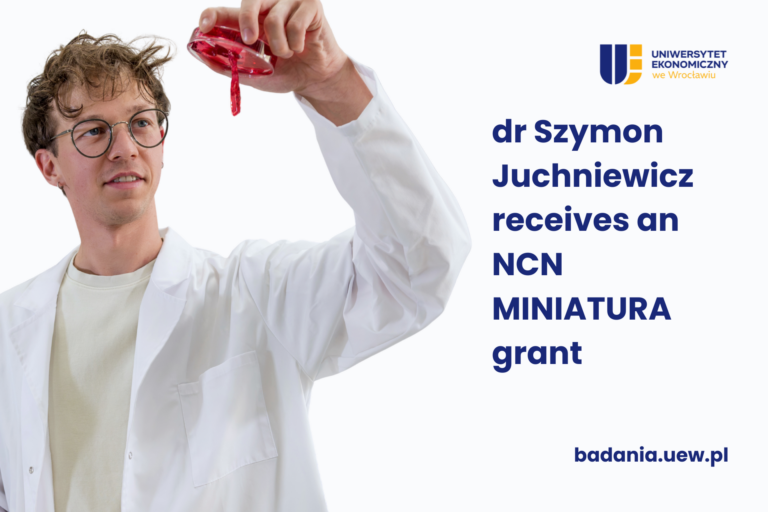
Vitamins C and D in a single plant-based gel: UEW researcher awarded NCN grant