

When leaders from politics, business, local government and academia meet in Karpacz, discussions about the future of cities quickly move from slogans to concrete solutions. At the 35th Economic Forum, one such example was Wroclaw, a city where a parcel can finish its journey by van and complete the last stretch on a cargo bike.
Prof. Natalia Szozda spoke about what such a model can change in the city centre and how to tell an interesting innovation from a solution that actually delivers results. The Vice-Dean of the Faculty of Business and Management and Head of the Department of Logistics at Wroclaw University of Economics and Business took part in the panel “Unique Smart City Implementations. Cities That Did It Differently” at the 35th Economic Forum in Karpacz.
The Economic Forum is one of the most important meetings devoted to the economy, public policy and the development of Central Europe. This year’s edition brought together more than 6,500 participants from 55 countries. Its more than 500 events included debates on security, technology, economic transformation, cooperation between science and business, and the challenges facing cities.
In this company, Professor Szozda brought to the discussion the perspective of a researcher who has spent years analysing the digital transformation of supply chains.
„Smart City starts with the real needs of residents, not with a catalogue of technologies. Logistics in a city is usually most visible when something goes wrong: when a delivery van is parked on the pavement or blocking a narrow street. That is why we first ask what problem we want to solve, and only then look for a tool,”
— emphasises Professor Szozda.
This is where the most interesting part of the conversation about smart cities begins. A smart city does not mean a city equipped with new technology. It means a city that can check whether a new solution addresses a real problem, who benefits from it and how it affects the functioning of the city and the lives of its residents.
The Wroclaw case discussed during the debate is an example of this approach. Beneath the National Forum of Music (NFM) there is a micro-hub, a transhipment point where parcels are moved from vans to cargo bikes. As a result, the last stage of delivery through the inner city centre can take place without another delivery van.
A parcel changes its mode of transport
The micro-hub beneath the NFM was officially opened on 25 June 2025. It serves the so-called last mile, the final and often most difficult stage of delivery. It is used by courier companies and food distributors. The city describes it as Poland’s first micro-hub shared by multiple operators. The initiative is being developed by the City of Wroclaw, WUEB and business partners; the partnership was initiated and is coordinated by Maja Kiba-Janiak, Associate Professor at WUEB.
The mechanism is simple: a delivery van brings parcels to the transhipment point, and cargo bikes then deliver them to recipients in the centre. In practice, the solution is intended to respond to the growing number of deliveries for e-commerce, restaurants, services and residents.
However, the operation of the micro-hub itself must be carefully distinguished from an assessment of its impact on the city. After the point opened, Professor Kiba-Janiak gave an example from one operator: within a specified delivery window, the number of its vans entering the inner city centre fell from six to three. A fourth, larger vehicle served the micro-hub, and the parcels were then delivered by cargo bike. This shows that deliveries can be organised differently.
An expert in the logistics of the future
Professor Szozda studies how digitalisation is changing supply chains and the decisions of companies and consumers. In 2025, she received the Award of the Minister of Science and Higher Education for significant achievements in research.
In an article published in LogForum, she analysed the impact of Industry 4.0 solutions on the functioning of supply chains. In her monograph Zarządzanie produktem w łańcuchu dostaw w dobie transformacji cyfrowej [Product Management in the Supply Chain in the Era of Digital Transformation], which received an award from the Committee on Organisational and Management Sciences of the Polish Academy of Sciences, she described the challenges of digitalising business processes. Her research on omnichannel retail, in turn, shows how technology is changing the experience of customers who use online and offline channels at the same time.
The publications mentioned do not directly concern the Wroclaw micro-hub. They do, however, help explain why urban logistics is no longer merely a support function for retail and transport. Increasingly, it is becoming part of urban policy, residents’ quality of life and the city’s economic competitiveness.
Professor Szozda is also a member of the WUEB team working on NEXTLOGIC, a Horizon Europe project on urban logistics. Wroclaw is one of eight pilot cities. One of the team’s tasks is to design, launch and evaluate a second micro-hub in Wroclaw, this time a mobile one. Planning and assessing solutions will be supported by a digital twin, a data-based model of the city. It will make it possible to compare different ways of organising deliveries, including in terms of emissions, before they are tested on the streets. The aim is logistics that serves the city efficiently while reducing emissions and air pollution. Residents are expected to gain cleaner air and more comfortable shared space.
What determines the success of an urban innovation
The micro-hub beneath the NFM in Wroclaw shows that change in urban logistics is not just about replacing a van with a cargo bike. It is an attempt to organise the last stage of deliveries differently, so as to reduce the number of vehicles serving the inner city centre without hindering businesses’ work or residents’ daily lives.
That is why, in the discussion in Karpacz, questions about local needs, data and the ability to assess results were as important as the technology itself.
For Professor Szozda, assessing results is the key point: a solution can be considered smart not because it uses new tools, but because its effects can be reliably assessed in the conditions of a specific city. Her participation in the Economic Forum showed that the Wroclaw case is an important voice in the wider conversation about how to combine logistics, research and local government practice.
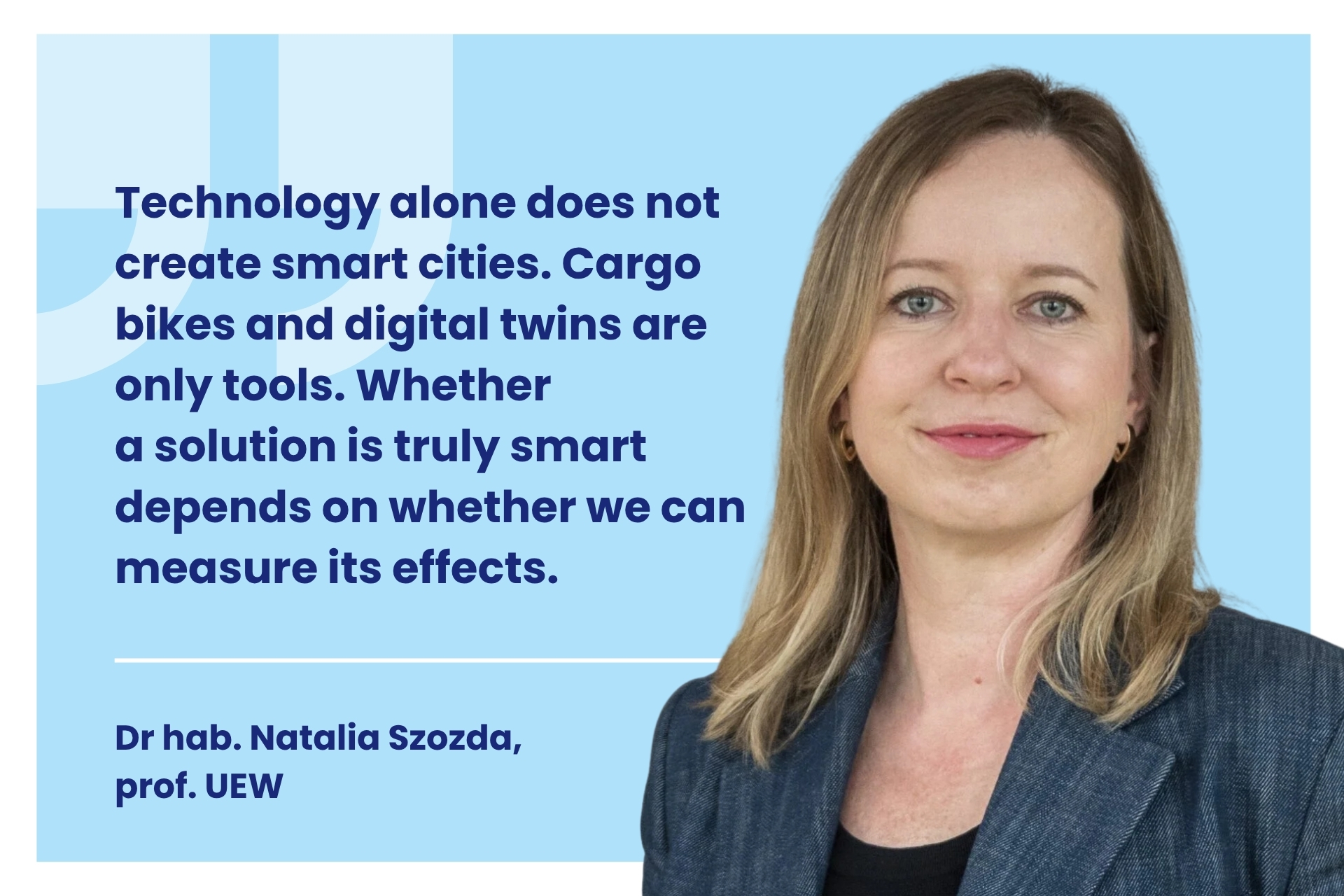
„Technology alone does not create smart cities. Cargo bikes and digital twins are only tools. Whether a solution is truly smart depends on whether we can measure its effects: whether there are fewer delivery vans on the streets, whether residents notice a difference, whether the model benefits businesses and whether it helps reduce air pollution. This cannot be assessed without cooperation between the city, business and academia,”
— concludes Professor Natalia Szozda.
- Panel report on Wroclaw.pl: https://www.wroclaw.pl/przedsiebiorczy-wroclaw/unikalne-wdrozenia-smart-city-forum-ekonomiczne-karpacz
- Professor Szozda’s comment after the panel: https://pl.linkedin.com/posts/szozdanatalia_forumekonomiczne-smartcity-wroc%C5%82aw-activity-7504523977592123392-PtY3
- Opening of the micro-hub and number of partners: https://www.wroclaw.pl/przedsiebiorczy-wroclaw/mikrohub-nowy-punkt-przeladunkowy-pod-nfm-dpd-gls-inpost-allegro-makro
- Observation concerning one operator: https://badania.uew.pl/dr-hab-inz-maja-kiba-janiak-prof-uew-o-pierwszym-w-polsce-mikrohubie-przeladunkowym/
- About the NEXTLOGIC project: https://badania.uew.pl/innowacyjna-logistyka-miejska-dla-miast-neutralnych-klimatycznie-nextlogic/
- Szozda N., Zarządzanie produktem w łańcuchu dostaw w dobie transformacji cyfrowej, Wydawnictwo UEW 2022, DOI: https://doi.org/10.15611/2022.995.5
- Szozda N., Industry 4.0 and its impact on the functioning of supply chains, „LogForum” 13 (2017), nr 4, s. 401–414, DOI: https://doi.org/10.17270/J.LOG.2017.4.2
- Szozda N., Omnichannel as a driver of digitalization: evidence from the emerging market in the fashion industry, „Journal of Fashion Marketing and Management” 27 (2023), nr 5, s. 905–923, DOI: https://doi.org/10.1108/JFMM-11-2021-0293
Author of text: Justyna Morawska-Płoskonka
See similar content

WUEB Experts Weekly Review. Research, Projects and Academic Successes (5–11 October 2026)
WUEB Experts Weekly Review: Research, Projects and Academic Successes (28 September–4 October 2026)
WUEB Experts Weekly Review: Research, Projects and Academic Successes (21–27 September 2026)
Poland’s demographic crisis: Professor Marek Kośny on the economic consequences
See also
The World Within Wrocław’s Reach. How the PROM research mobilities confirm WUEB’s place on the map of global academia
Dr hab. Aleksander Mercik, Professor of the WUEB, receives the Andrzej Gospodarowicz Award in Finance from the President of the Polish Academy of Sciences
WUEB Experts Weekly Review. Research, Projects and Academic Successes (5–11 October 2026)

Wroclaw University of Economics and Business researchers among the world’s leading scientists: six included in the 2026 World’s Top 2% Scientists database
WUEB Experts Weekly Review: Research, Projects and Academic Successes (28 September–4 October 2026)
Vitamins C and D in a single plant-based gel: UEW researcher awarded NCN grant

Joanna Radomska of WUEB awarded the title of professor