


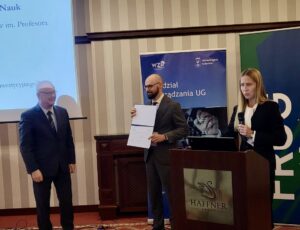
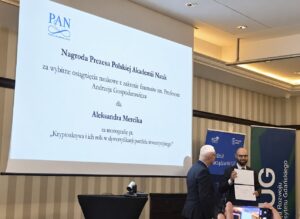
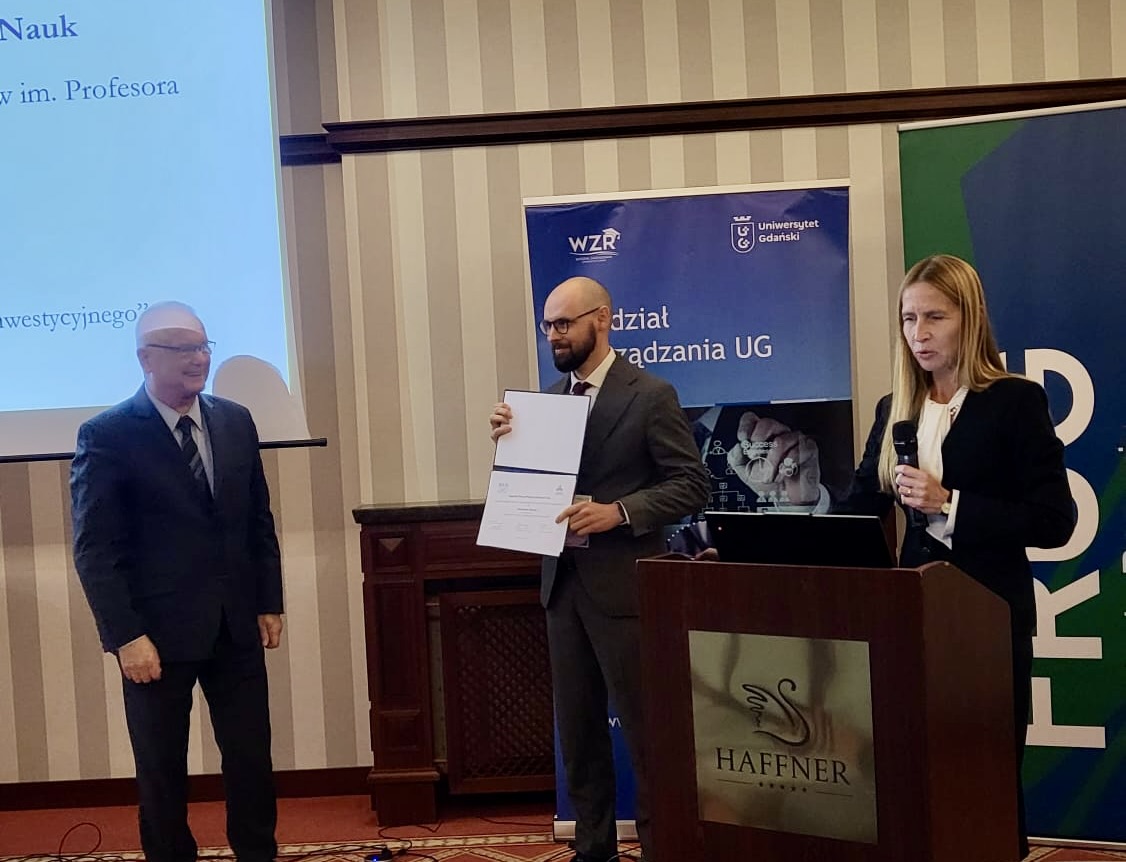
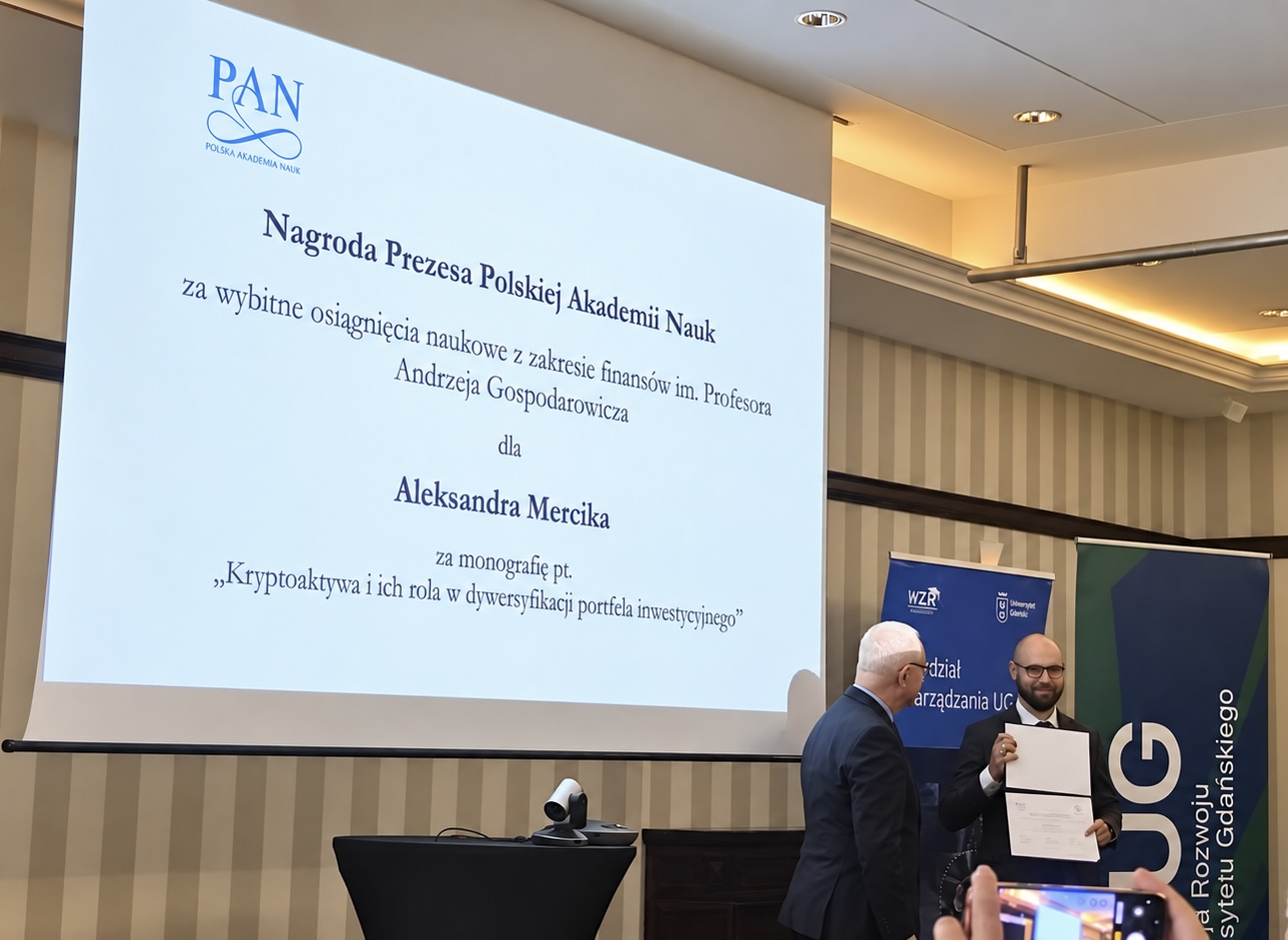
On 28 September 2026, dr hab. Aleksander Mercik, prof. UEW, from the Department of Financial Investments and Risk Management at Wroclaw University of Economics and Business, received the Polish Academy of Sciences President’s Award named after Professor Andrzej Gospodarowicz for his monograph “Kryptoaktywa i ich rola w dywersyfikacji portfela inwestycyjnego” [Cryptoassets and their role in investment portfolio diversification].

An expert in investment and financial risk management, he presents the research question, analytical approach and main findings of the award-winning publication.
The award-winning monograph
Title: Kryptoaktywa i ich rola w dywersyfikacji portfela inwestycyjnego [Cryptoassets and their role in investment portfolio diversification]
Author: Aleksander R. Mercik
Publisher: Wydawnictwo Naukowe PWN, Warszawa 2025
ISBN: 978-83-01-24144-5
DOI: https://doi.org/10.53271/2025.021
“The question of whether it is worth investing in cryptoassets is the wrong one. The right question is: under what conditions, and for how long, will the benefit persist? My findings show that diversification benefits exist, but they are not a permanent property of this asset class — they result from the current structure of the market, and that structure is changing.”
Research question
The monograph addresses one central question: does including cryptoassets in an investment portfolio actually improve its risk–return characteristics — and if so, under what conditions and for how long?
This question is more difficult than it might appear. High historical returns alone do not settle the matter, because an asset with high returns and equally high risk does not necessarily improve the performance of the portfolio as a whole. The value of a new asset class depends on its return-to-risk ratio and how closely it is related to the other portfolio components. In the book, I therefore posed a broader methodological question: how should we empirically test whether a new asset class adds value to an investment portfolio?
How the research was conducted
The empirical analysis draws on a dataset of 1,142 cryptoassets traded between 2013 and 2023, comprising more than 1.4 million daily observations. Using their technical documentation, I classified tokens into five types — cryptocurrencies, utility tokens, stablecoins, tokens backed by other assets, and other tokens — and then constructed 33 indices representing different segments of this market. This approach avoided a common simplification in the literature: treating the entire cryptoasset market as homogeneous or reducing it to bitcoin alone.
I compared cryptoassets with other asset classes: equities, government bonds, gold and commodities, from two perspectives — those of US and Polish investors. Including the domestic market is important because Polish investors also face exchange rate risk, an issue that is almost absent from the international literature.
Part of the research was supported by a MINIATURA grant from Poland’s National Science Centre (No. 2023/07/X/HS4/00463).
Main findings
- High returns were compensation for high risk
Cryptoassets had a higher return-to-risk ratio than equity indices, but the differences were not statistically significant over the full study period. The advantage was confined to the early stages of the market’s development and faded as it matured. This finding is consistent with the hypothesis that the early cryptoasset market was less efficient and that this inefficiency is gradually diminishing. - Links between cryptoassets and traditional markets are growing
Relationships between cryptoasset returns and risk factors in financial markets are not constant over time. I identified a statistically significant increase in these links, particularly after 2019. Significantly, this increase coincides with greater institutional investor participation in the bitcoin futures market. The integration of the cryptoasset market into the financial system therefore stems from a change in the composition of its participants rather than from the technology itself. - Including cryptoassets improves a portfolio, but the effect is conditional
Including cryptoassets significantly improved the risk–return characteristics of portfolios in both the US and Polish markets. The optimal allocation proved relatively small — approximately 6–7 per cent of portfolio value. However, as links with other markets grow, this benefit may diminish over time. It is therefore not a permanent property of this asset class, but a condition that requires regular monitoring. - The effect is stronger for Polish investors
The improvement in portfolio efficiency was greater in Poland than in the United States. This results from a negative correlation between cryptoasset returns and returns on the zloty index — dollar-denominated assets provide Polish investors with an additional hedge against exchange rate risk. Some of the diversification benefit therefore comes from currency exposure rather than solely from the properties of cryptoassets themselves. - The “digital gold” thesis is not supported
Gold and cryptoassets are not substitutes within a portfolio. Their correlation remains low and unstable, and including cryptoassets does not remove gold from the optimal portfolio — the two play complementary roles. It is also worth emphasising that cryptoassets do not behave as a safe haven: during periods of market stress, they do not protect portfolios against losses.
Who may find these results useful
- Investors and portfolio managers. The book shows that an allocation of a few per cent can be justified empirically, but involves much greater risk than standard deviation alone would suggest. Bitcoin’s maximum drawdown during the study period reached 83 per cent, compared with 34 per cent for the S&P 500 index.
- Regulators and supervisory institutions. Growing correlation with traditional markets means a growing potential for shocks to spread between the cryptoasset market and the financial system. The argument that this market remains isolated is becoming less tenable.
- Researchers. The monograph proposes a complete procedure for testing the usefulness of a new asset class in a portfolio: from comparing return-to-risk ratios, through analysing the stability of relationships over time, to formally testing the significance of portfolio effects. The procedure is universal and can be applied to any new asset class, not only cryptoassets.
- Teaching. The book can serve as a resource for teaching portfolio theory and quantitative methods in finance, as it shows how established tools can be applied to unusual, challenging data.
Bitcoin should be viewed primarily as a possible component of an investment portfolio, alongside equities, bonds or gold, dr hab. Aleksander Mercik, prof. UEW emphasised in an interview with Radio Wrocław.
He also noted that assessing such an investment requires consideration of both changes in asset values and the risks associated with intermediaries entrusted with investors’ funds.
Author of text: dr hab. Aleksander R. Mercik, Professor of the WUEB; editorial work: Barbara Grzelczak
See similar content

Wroclaw University of Economics and Business researchers among the world’s leading scientists: six included in the 2026 World’s Top 2% Scientists database

Vitamins C and D in a single plant-based gel: UEW researcher awarded NCN grant

Joanna Radomska of WUEB awarded the title of professor

What comes after a PhD? Dr Milena Kowalska at the Economic Forum in Karpacz
See also

WUEB Experts Weekly Review. Research, Projects and Academic Successes (5–11 October 2026)
Wroclaw University of Economics and Business researchers among the world’s leading scientists: six included in the 2026 World’s Top 2% Scientists database
WUEB Experts Weekly Review: Research, Projects and Academic Successes (28 September–4 October 2026)
Vitamins C and D in a single plant-based gel: UEW researcher awarded NCN grant
Joanna Radomska of WUEB awarded the title of professor

How can solutions for urban freight transport be co-created? Dr hab. inż. Maja Kiba-Janiak’s, Professor of the WUEB research fellowship in Gothenburg
WUEB Experts Weekly Review: Research, Projects and Academic Successes (21–27 September 2026)