
Poland’s demographic crisis will affect the labour market, local government finances, access to social services and the pension system. Its consequences extend well beyond a shrinking population, explains Professor Marek Kośny, Vice-Rector for Research at Wroclaw University of Economics and Business.
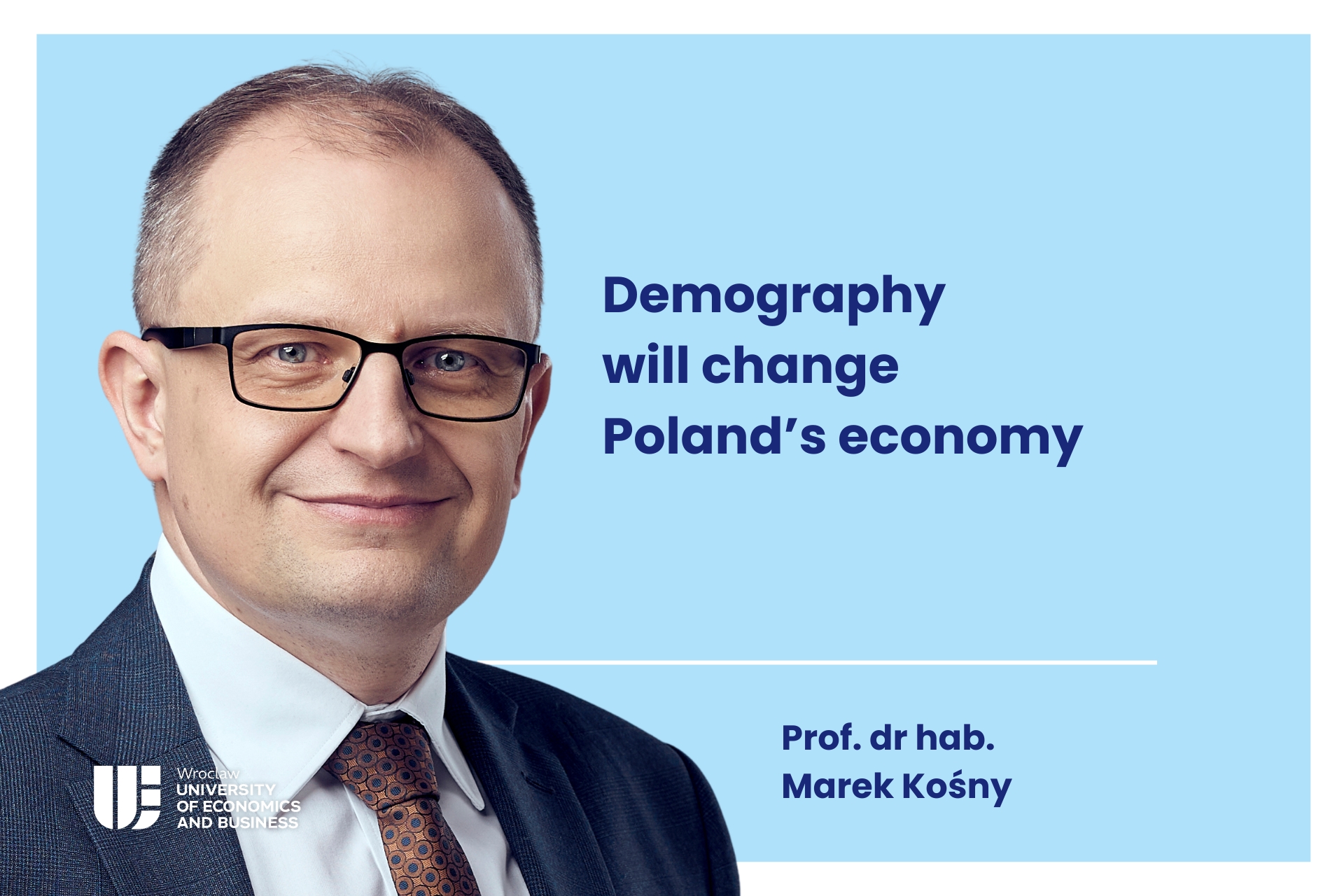
Robert Czepielewski interviewed Professor Kośny for Zachodnia.TV’s Economic Forum Studio at the 35th Economic Forum in Karpacz. An economist specialising in quantitative analysis of social and economic policy, Professor Kośny studies inequality, household economic security and the labour market, as well as evaluating the effects of public policy. Since December 2025, he has also served on the Family and Demography Council advising the President of Poland, where he contributes to work on family, demographic and social policy.
Visit expert profile
Prof. dr hab. Marek Kośny
Expert in the field of: Socio-Economic Policy, New Technologies & Innovation
Population change in Lower Silesia: growing cities and shrinking towns
Demographic change varies across Poland. Smaller towns and areas outside the main urban centres are losing residents fastest. In Lower Silesia, this is particularly evident in the Kłodzko region. Wrocław continues to grow and attract new residents, as does the Copper Basin, which is also faring relatively well thanks to its strong labour market.
Who leaves matters for local communities. Young women are more likely than men to move to large cities, often to pursue education or work. This leaves fewer people who might start families in smaller towns. Limited job opportunities, services and prospects encourage further departures, making it harder for local authorities to plan investment and maintain essential infrastructure.
Falling fertility will affect employment and local government finances
Poland’s fertility rate has fallen below 1.1 children per woman, compared with the replacement level of around 2.1 needed for each generation to replace itself. This gap shows the scale of the problem, although its full consequences will take years to emerge.
Nurseries and schools will be the first to feel the effects of fewer births. In around twenty years, these smaller generations will reach working age, with far fewer young people entering the labour market. This will mean labour shortages, lower revenues from taxes and social insurance contributions, and greater pressure on the pension system.
For the economy, a smaller workforce means lower revenues from taxes and social insurance contributions and growing pressure on pensions. With the population falling so sharply, continued growth in Poland’s total GDP cannot be taken for granted. A reduced capacity to generate economic output could weaken Poland’s position in the global economy and limit funding for public services.
Local authorities outside the major cities will be particularly affected. They will have fewer residents and lower revenues, while demand for care and services for older people will rise. Meeting these needs will require local transport, help with daily activities, healthcare and the development of social service centres. If young people continue to leave smaller towns, there will also be too few workers to provide these services.
Demographic policy requires more than cash benefits
Asked about the results of the 500+ and 800+ programmes, Professor Kośny distinguishes their social effects from their effects on fertility. The 500+ programme helped reduce poverty and improved the financial circumstances of larger families, but it did not bring about a sustained increase in fertility. This does not make the benefit pointless: its results need to be assessed against its intended aims.
Professor Kośny suggests revisiting whether entitlement to the benefit for a first child should depend on household income, limiting eligibility among wealthier families. The savings could fund measures more directly related to decisions about having children. One option he discusses is housing support at the time of a child’s birth. This is an example raised in expert discussions, rather than a fully developed programme he has proposed.
‘What Poland lacks is a coherent demographic policy, including migration policy, which is itself part of demographic policy.’
Migration could help ease labour shortages, but this requires a consistent policy and clarity about whom Poland wants to encourage to settle permanently. Poles living abroad are an important group. The return of some emigrants suggests that better living conditions, higher wages and a sense of security can make Poland a more attractive place to live.
In the article ‘Why are Poles returning to Poland?’, dr Paweł Dobrzański, prof. UEW, also discussed the reasons behind these decisions. However, the number of people returning is currently too small to reverse population decline on its own.
The interview makes clear that higher benefits alone will not be enough. Decisions about having children also depend on housing, a sense of security and employment prospects. Family policy needs to take account of labour demand, local authorities’ circumstances and care for older people, alongside a carefully considered approach to migration.
Watch the full interview with Professor Marek Kośny.
Author of text: Barbara Grzelczak
See similar content

What is Bitcoin and How is it Changing Finance? dr Michał Kisiel on the Future of Money

WUEB Experts Weekly Review: Research, Projects and Academic Successes (14–20 September 2026)
WUEB Experts Weekly Review: Research, Projects and Academic Successes (7–13 September 2026)

Bitcoin is not the digital equivalent of the Polish zloty. A WUEB expert explains how to understand cryptocurrencies.
See also
What is Bitcoin and How is it Changing Finance? dr Michał Kisiel on the Future of Money
WUEB Experts Weekly Review: Research, Projects and Academic Successes (14–20 September 2026)
WUEB Experts Weekly Review: Research, Projects and Academic Successes (7–13 September 2026)
Bitcoin is not the digital equivalent of the Polish zloty. A WUEB expert explains how to understand cryptocurrencies.
WUEB Experts Weekly Review. Research, Projects and Academic Successes (31 August–6 September 2026)
What comes after a PhD? Dr Milena Kowalska at the Economic Forum in Karpacz

Bridging V4 Universities and Business through Design Thinking