
The past week was dominated by summaries of the Economic Forum in Karpacz and discussions on how economic expertise helps make sense of changes in the economy and society. WUEB experts spoke about leadership in the age of algorithms, logistics resilience, the consequences of the demographic crisis, future skills, young people’s changing approach to studying, the profitability of organic farming, Poland’s rating downgrade and fuel prices, cryptocurrencies, financial education in schools and the appeal of Wrocław. We also announce participation in Business PRECOP and invite readers to a conference on contemporary security.
Leaders who are changing Poland. The conclusion of the 35th Economic Forum
WUEB Expert: prof. dr hab. Marek Kośny, Vice-Rector for Research at WUEB
At the closing gala of the 35th Economic Forum in Karpacz, prof. Marek Kośny presented the Forum’s Culture and Science Award. The Vice-Rector stressed that for the first time in its history the award went to a woman: prof. Marta Kwiatkowska of the University of Oxford. The laureate said that her academic career is proof of the high quality of Polish universities.
The Forum summary published by PAP MediaRoom confirms the presence in Karpacz of WUEB Rector prof. Czesław Zając, who was among the university rectors attending the event. A commentary on the wGospodarce.pl portal lists WUEB among the universities that have long been present at the Forum and helped shape its debate zones.
Source: https://www.pap.pl/mediaroom/xxxv-forum-ekonomiczne-w-karpaczu
Karpacz 2026: Technology will change the leader of the future
WUEB Expert: prof. dr hab. Andrzej Kaleta
In the “Leader of the Future” panel at the Economic Forum in Karpacz, prof. Andrzej Kaleta argued that technology will change how leaders operate but will not make them irrelevant. In his view, leaders shaped by earlier management models managed to adapt to the new economy after the pandemic. Today’s leaders are expected to take a broader view and draw better conclusions.
The panel, conceived and moderated by prof. dr hab. Ewa Stańczyk-Hugiet, Head of the Department of Advanced Management Research at WUEB, brought together representatives of academia, large corporations and smaller firms.
Source: https://executivemagazine.pl/nowe-technologie/karpacz-2026-algorytmy-zmienia-lidera-przyszlosci/
WUEB Expert: prof. dr hab. Jarosław Witkowski
WUEB Expert: prof. dr hab. Jarosław Witkowski
In a conversation in the Zachodnia.TV Forum Studio, prof. Jarosław Witkowski discussed the logistical security of the state. He noted that no country can be fully prepared for unpredictable emergencies, and that the flood in the Kłodzko Valley showed how a lack of coordination leads to chaos: numerous shipments of drinking water were sent to one place while other urgently needed supplies were missing.
The expert pointed out that Poland and the European Union have no coherent logistics policy, and that global supply chains are moving away from the Just in Time model towards resilience and security. In his view, future investments such as the Central Transport Hub (CPK) should also include a military component enabling efficient reception of NATO assistance.
The depopulation of Poland. Prof. Marek Kośny of WUEB on the demographic crisis
WUEB Expert: prof. dr hab. Marek Kośny, Vice-Rector for Research at WUEB
In a conversation in the Economic Forum Studio in Karpacz, prof. Marek Kośny warned about the consequences of Poland’s depopulation. He noted that the fertility rate has fallen below 1.1 and that the trend hits smaller towns hardest, as young women leave for large cities. In the expert’s view, Poland could lose as many as 10 million residents over several decades.
He listed empty kindergartens and schools, lower municipal revenues, fewer young people entering the labour market, and pressure on public finances and the pension system among the consequences. He assessed that the 500+ and 800+ programmes reduced poverty but did not deliver the expected demographic breakthrough. He proposed reintroducing an income criterion for the first child and using the funds released for a housing incentive, for example PLN 100,000 at the birth of a child.
Source: https://zachodnia.tv/wyludnianie-polski-prof-marek-kosny-z-uew/
Do young people want to study today? “Those interested increasingly prefer shorter forms of education” [VIDEO]
WUEB Expert: prof. dr hab. Czesław Zając, Rector of WUEB
In an interview with Gazeta Wyborcza at the Economic Forum in Karpacz, prof. Czesław Zając noted that both among WUEB applicants and across the market, young people increasingly choose shorter forms of education. Interest in master’s degrees is declining, while bachelor’s degrees and micro-credentials, meaning condensed courses that provide specific qualifications, are gaining popularity.
The Rector stressed that universities must not turn into vocational schools. A university should keep an academic foundation, which at WUEB means economics, philosophy, sociology and the social sciences, combined with strong preparation for work. Students need to be equipped to make decisions under uncertainty and to use new technologies, including artificial intelligence, responsibly and ethically.
Rector of the University of Economics: “We develop skills that help people find their way in new realities”
WUEB Expert: prof. dr hab. Czesław Zając, Rector of WUEB
In an interview with Gazeta Wyborcza, prof. Czesław Zając stressed that universities cannot prepare students for specific future occupations, but can prepare them to function effectively in a world of constant change. According to the Rector, the main labour-market challenge will be not a shortage of jobs but a mismatch between skills and needs, so a university should develop analytical abilities, critical thinking, a strategic approach to management and the ability to make decisions under uncertainty.
The Rector noted that WUEB is introducing data analysis, digital transformation and the impact of artificial intelligence on the economy into its study programmes, while also focusing on what AI cannot replace: solving complex problems, an interdisciplinary approach and social skills. He pointed out that it is people who bear responsibility for ethics and for the consequences of decisions made with AI. To narrow the skills gap, he called for, among other things, more flexible joint study programmes, more implementation doctorates, tax incentives for companies investing in cooperation with science, and simpler rules for commercialising research results.
Różne punkty słyszenia: Money of the future or a financial trap? Economists on cryptocurrencies
WUEB Expert: dr Michał Kisiel
Dr Michał Kisiel of WUEB was a guest on the “Różne punkty słyszenia” programme on Radio Wrocław, devoted to cryptocurrencies. The programme announcement referred to the scandal around the Zondacrypto exchange, after which investors lost substantial funds, and to the EU’s MiCA regulation, which is meant to introduce clear legal rules for the crypto-asset market.
It set the arguments of critics, who say the asset’s rapid rise in value bears the hallmarks of a speculative bubble, against the view of supporters who believe digital assets will force traditional banking to transform.
Różne Punkty Słyszenia: Is Wrocław an attractive city to live in?
WUEB Expert: dr inż. Anita Makowska
Dr inż. Anita Makowska took part in the “Różne Punkty Słyszenia” programme on Radio Wrocław, which compared Wrocław’s image in surveys and rankings with residents’ everyday experience. The announcement cited, among other things, the city’s high marks for innovation and tourist appeal.
It also pointed to everyday challenges: air pollution, time lost in traffic, falling tram speeds and housing affordability, with the average salary buying about 0.74 m² on the secondary market. The studio guests also included a sociologist, the director of Wrocław’s City Brand Department and the chair of a student council.
Agrofakty – organic farming
WUEB Expert: dr hab. Karol Kociszewski, prof. UEW
n the “Agrofakty” programme on TVP Wrocław, dr hab. Karol Kociszewski, Professor of the WUEB, said it is not possible to state unequivocally whether organic farming is profitable. He recalled that after Poland joined the European Union the number of organic farms grew by more than 500% and the cultivated area by more than 800%, with EU subsidies the main driver of that growth
The expert explained that organic farmers must meet additional environmental and quality requirements, which raises production costs, while the higher prices of EKO-certified products meet a demand barrier: Polish consumers are less willing to pay a premium than those in Western Europe. Demand has grown for several years at a pace slightly above that of the overall food market, but clearly slower than in the “old” EU member states. In his view, Polish organic farms do not yet compete with conventional ones, unlike in the USA and, to a lesser extent, Western Europe.
Online workshops presenting educational materials for teaching financial topics in grades 4–8, prepared for the Ministry of Finance
WUEB Expert: dr Agnieszka Wojtasiak-Terech
Dr Agnieszka Wojtasiak-Terech was among the speakers at an online workshop for teachers and school principals scheduled for 16 September, devoted to mathematics materials and case studies. The workshops present materials for teaching financial topics in grades 4–8, which the Warsaw Banking Institute Foundation is preparing for the Ministry of Finance.
Local governments under pressure from energy and climate. This is what Business PRECOP 2026 will be about
WUEB Expert: dr hab. Bożena Ryszawska, Professor of the WUEB
Dr hab. Bożena Ryszawska, Professor of the WUEB, a member of the Climate Council of UN Global Compact Network Poland, is among the speakers at Business PRECOP 2026. The event will take place on 30 September and 1 October at the International Congress Centre in Katowice, and its participants will be preparing for the COP31 climate summit in Türkiye.
The programme includes 30 sessions covering, among other topics, energy costs, local energy sources, the role of local governments in the energy transition, building modernisation and the circular economy. Portal Samorządowy highlights the pressure of energy and climate issues on local governments, while a further announcement presents more of the event’s speakers.
7th Scientific Conference “Bezpieczeństwo współczesnego świata” 2026
7th National Scientific Conference “Bezpieczeństwo współczesnego świata” (Security of the Contemporary World)
The Department of Macroeconomics and the Department of International Economic Relations at WUEB’s Faculty of Economics and Finance invite participants to the seventh edition of the conference, to be held on 21 October 2026 at 10:00 in WUEB Building A (room 213). The event combines the academic perspective with the experience of business and public administration practitioners, analysing current global problems, including market stability, defence policy, supply chains and crisis management, through the lens of economics and finance.
The programme includes two plenary sessions. The first addresses global value chains, economic security and crisis management in practice; the second covers the impact of crises on financial markets, the security of the pharmaceutical sector and foreign trade, and sanctions policy and state defence spending.
Source: https://badania.uew.pl/events/bezpieczenstwo_wspolczesnego_swiata_2026/
Author of text: Barbara Grzelczak
See similar content

WUEB Experts Weekly Review: Research, Projects and Academic Successes (7–13 September 2026)
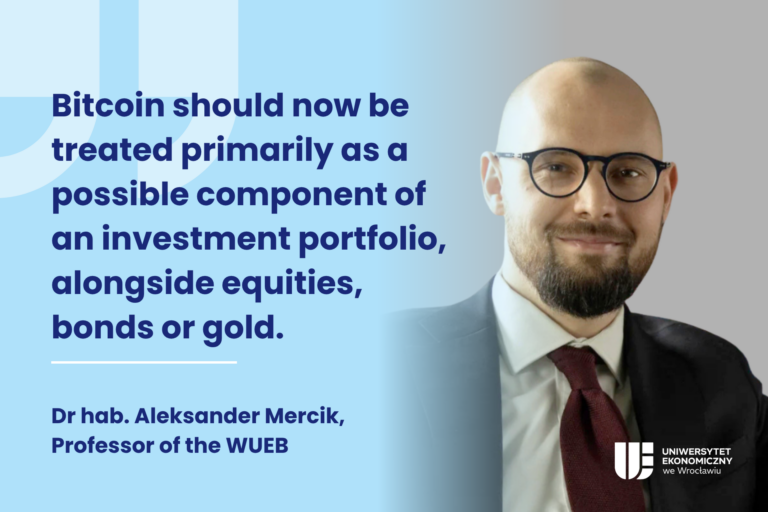
Bitcoin is not the digital equivalent of the Polish zloty. A WUEB expert explains how to understand cryptocurrencies.
WUEB Experts Weekly Review. Research, Projects and Academic Successes (31 August–6 September 2026)
WUEB Experts Weekly Review. Research, Projects and Academic Successes (24 – 30 August 2026)
See also
WUEB Experts Weekly Review: Research, Projects and Academic Successes (7–13 September 2026)
Bitcoin is not the digital equivalent of the Polish zloty. A WUEB expert explains how to understand cryptocurrencies.
WUEB Experts Weekly Review. Research, Projects and Academic Successes (31 August–6 September 2026)
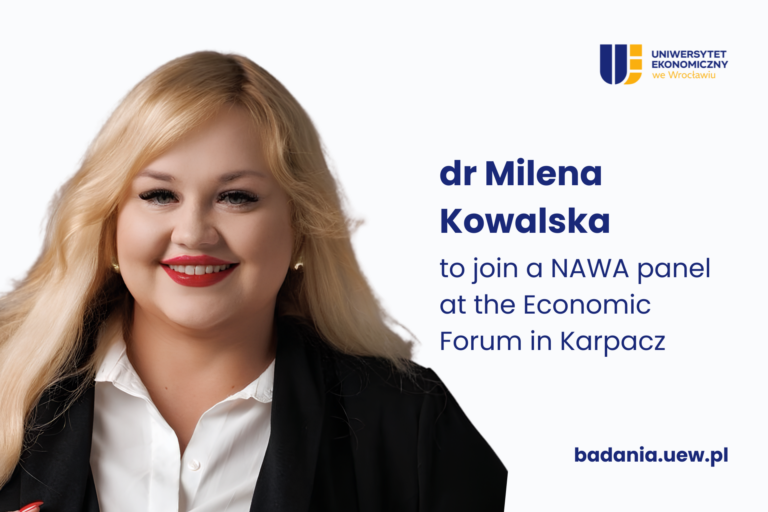
What comes after a PhD? Dr Milena Kowalska at the Economic Forum in Karpacz
Bridging V4 Universities and Business through Design Thinking
WUEB Experts Weekly Review. Research, Projects and Academic Successes (24 – 30 August 2026)
Visual Simulation of Business Processes (WSPB) joins the Polish Roadmap for Research Infrastructures