
Bitcoin is a digital asset that operates on a computer network. It can be transferred directly between users without a bank acting as an intermediary. It has no physical form and no central issuer. Transactions are recorded on a blockchain: a public, distributed ledger whose copies are maintained by many computers. This may sound technical, but the underlying question is practical: can Bitcoin become money for everyday use, or does its real significance lie elsewhere?
Where Does Bitcoin’s Value Come From?
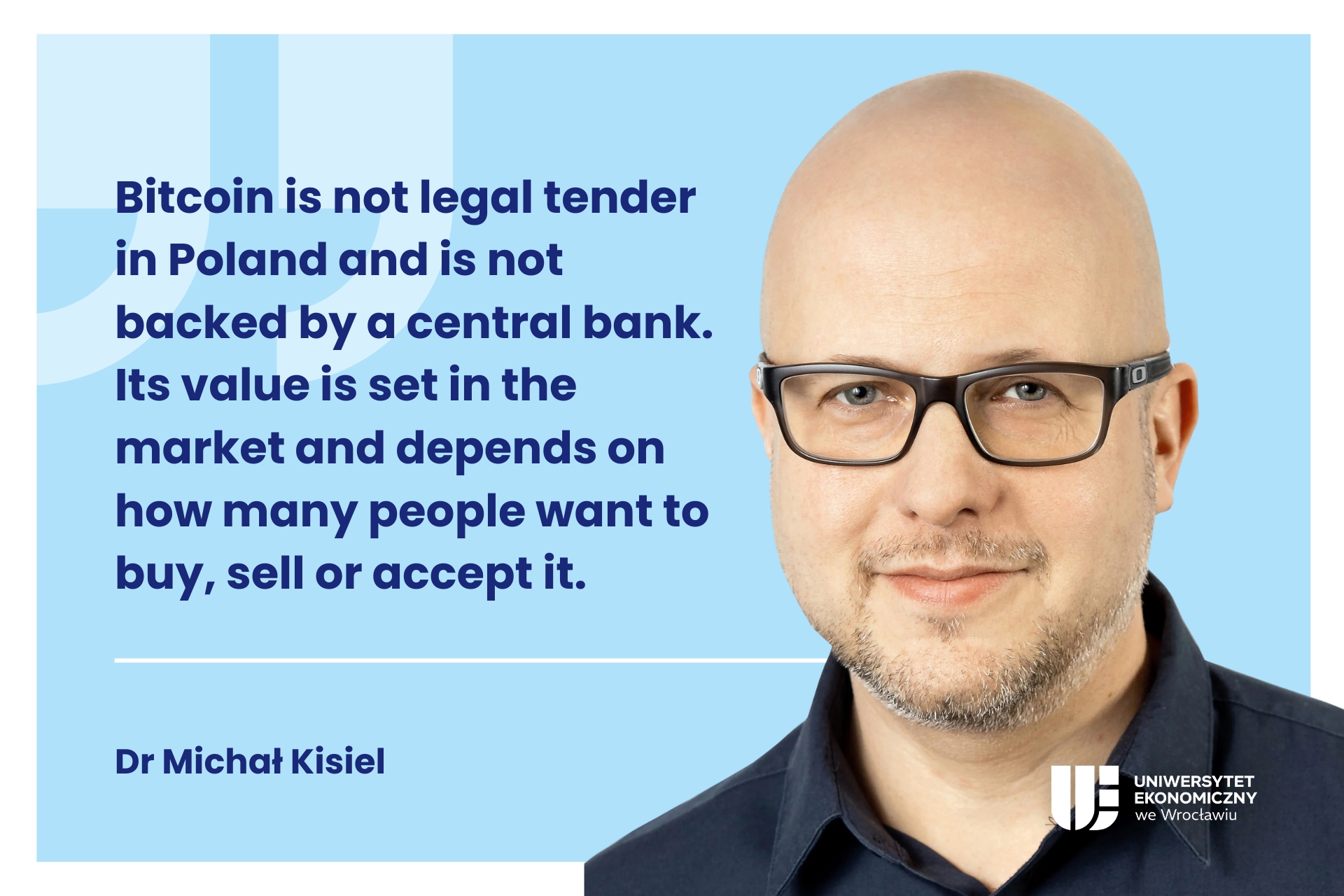
Bitcoin is not legal tender in Poland and is not backed by a central bank. Its value is set in the market and depends on how many people want to buy, sell or accept it. Scarcity also matters: the network’s rules will result in a total supply of slightly fewer than 21 million bitcoins.
Bitcoin Pizza Day illustrates the scale of change. In May 2010, 10,000 bitcoins were paid for the delivery of two pizzas. It was one of the first widely documented purchases of a real-world product using the cryptocurrency. The present-day value of that transaction should not be treated as an investment argument. What it does show is how sharply the price of an asset driven by demand and expectations can change.
Why Is Bitcoin Not Ordinary Money?
Money should make payments easier, allow prices to be compared and preserve value. Bitcoin performs these functions only partly. It can be used for payment if the other party accepts it, but most prices, taxes and wages in Poland are still settled in zloty. Its substantial price volatility creates a further difficulty.
‘Because of its volatile value, Bitcoin is not really suitable for payments,’
— says dr Michał Kisiel of the Department of Finance at Wroclaw University of Economics and Business.
Limited supply may encourage holders to keep Bitcoin in the hope of a price increase rather than spend it. It therefore more often functions as a risky asset than as an everyday means of payment. The expert also stresses that forecasting its future price would require a ‘crystal ball’.
Bitcoin Has Already Changed Financial Infrastructure
The most important conclusion from the discussion is not about price.
‘In some respects, Bitcoin has already won,’
– dr Kisiel argues.
This does not mean that it will replace the zloty or the euro. The lasting change is the architecture it has popularised. Distributed ledger technology, or DLT, allows many participants to use a shared, synchronised database without a single central administrator.
This logic underpins asset tokenisation, stablecoins and tokenised deposits. Tokenisation means representing rights to an asset, such as a financial instrument, as a digital token. A stablecoin is designed to maintain a value linked to a specified asset, usually a currency. A tokenised deposit is a digital representation of money deposited with a bank. Payment and settlement systems, along with cooperation between banks and the fintech sector, are central to dr Kisiel’s research.
Regulation Focuses Mainly on Intermediaries
The EU Markets in Crypto-Assets Regulation, known as MiCA, establishes common rules for issuers of certain crypto-assets and for service providers such as trading platforms and businesses that safeguard customers’ wallets. It sets requirements for governance, safeguards, risk management and customer information. As dr Kisiel notes, regulation will not automatically distinguish good ideas from bad ones, but it can screen out intermediaries that lack adequate resources and controls.
Separate EU rules govern the information accompanying crypto-asset transfers. The Travel Rule helps identify the sender and recipient where a regulated service provider is involved, including transfers to or from a self-hosted wallet. Blockchain therefore does not guarantee complete anonymity, particularly where it meets the regulated financial system. The conclusion for customers and businesses is straightforward: Bitcoin may not replace money, but the technologies developed around it are already changing how payments and financial services are designed.
Listen to the interview: https://www.radiowroclaw.pl/articles/view/163935/Rozne-punkty-slyszenia-Pieniadz-przyszlosci-czy-finansowa-pulapka-Ekonomisci-o-kryptowalutach
Read more expert commentary from WUEB:
Author of text: Barbara Grzelczak
See similar content

WUEB Experts Weekly Review: Research, Projects and Academic Successes (14–20 September 2026)
WUEB Experts Weekly Review: Research, Projects and Academic Successes (7–13 September 2026)
Bitcoin is not the digital equivalent of the Polish zloty. A WUEB expert explains how to understand cryptocurrencies.
WUEB Experts Weekly Review. Research, Projects and Academic Successes (31 August–6 September 2026)
See also
WUEB Experts Weekly Review: Research, Projects and Academic Successes (14–20 September 2026)
WUEB Experts Weekly Review: Research, Projects and Academic Successes (7–13 September 2026)
Bitcoin is not the digital equivalent of the Polish zloty. A WUEB expert explains how to understand cryptocurrencies.
WUEB Experts Weekly Review. Research, Projects and Academic Successes (31 August–6 September 2026)

What comes after a PhD? Dr Milena Kowalska at the Economic Forum in Karpacz

Bridging V4 Universities and Business through Design Thinking
WUEB Experts Weekly Review. Research, Projects and Academic Successes (24 – 30 August 2026)