

Poland is a country of talented engineers, dynamic entrepreneurs and a strengthening economy. Yet where are our global technology brands? Where is our Spotify, Tesla or Netflix? Why do our companies sell themselves to foreign investors before achieving global success? According to WUEB researcher Dr Piotr Wanicki [sprawdź], the brutal answer is that Poland has fallen into the middle‑income trap.
What is the middle‑income trap?
The trap occurs when a country develops rapidly and then hits a growth barrier. It stops competing with cheap labour yet cannot leap to the league of global innovation leaders. Firms stay in a comfort zone because what has worked for the past decade seems sufficient. Poland exports excellent IT specialists but fails to build global technology companies; our start‑ups grow abroad because conditions for scaling are better there.
The Responsible Development Strategy – is it enough?
In 2017 the Polish government announced a Responsible Development Strategy (SOR) that promised innovation, reindustrialisation and greater competitiveness. The goal was ambitious: to move from a cheap‑labour model to a knowledge‑based economy. Declarations are one thing, reality another. Poland’s research‑and‑development spending amounts to 1.44 per cent of GDP, whereas the EU average is 2.27 per cent. The economic structure still relies on outsourcing and production for foreign companies rather than building our own global brands. Innovation is often treated as a risk rather than a necessity. The result is that Poland still lacks its own Spotify.
What blocks innovation in Poland?
Dr Wanicki points to several barriers: entrepreneurs rarely have access to capital for long‑term investment in technology; many firms lack a strategy and wait for external changes instead of investing in development; and business failure is often stigmatised rather than seen as part of the learning process. This culture of risk aversion keeps firms from pursuing ambitious innovation.
How to change it? A model for innovation in SMEs
Instead of dwelling on problems, Dr Wanicki proposes research‑based solutions. He is studying 150 Polish companies to identify tools that might help them break out of stagnation. He is developing a practical innovation strategy model for small and medium‑sized enterprises so that the model becomes a decision‑making tool rather than merely an academic theory. Consultations with investors, advisors and entrepreneurs ensure that the model reflects what actually works rather than empty slogans.
Can Poland produce its own unicorn?
Yes – but only if we stop treating innovation as a luxury and start treating it as a survival strategy. Investment in technological development is not a cost but a competitive advantage; companies need to abandon short‑term thinking and plan strategically. Poland cannot remain merely a country of cheap labour; it must build its own global brands. We lack unicorns because we do not create conditions for them, but we can change that if we muster the courage and develop a clear strategy.
Watch the entire video on YouTube
badania.uew.pl – because innovation is not a luxury. It is a necessity.
See similar content
Women raise productivity and innovation in the economy. Yet female managers still earn one-fifth less
Computer and video games: economy, technology, society. Prof. Patrycja Klimas comments
A new era of space – humanity’s future or visionary wastefulness?
Donald Trump’s presidency, the EU Omnibus package and the climate emergency – how politics shapes the future of ESG
See also
How can economic fluctuations be smoothed? The 2026 Nobel Prize in Economic Sciences through the eyes of WUEB researchers
The World Within Wrocław’s Reach. How the PROM research mobilities confirm WUEB’s place on the map of global academia
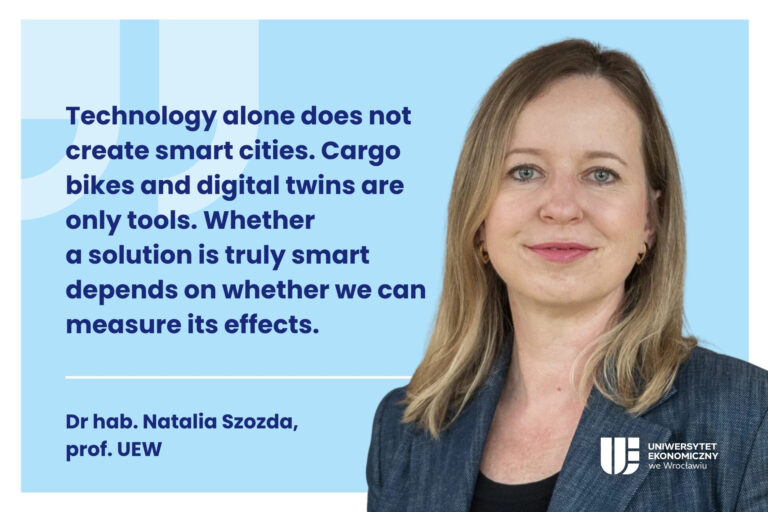
Wroclaw’s micro-hub at the Economic Forum. Natalia Szozda, Associate Professor, on when a city truly becomes smart
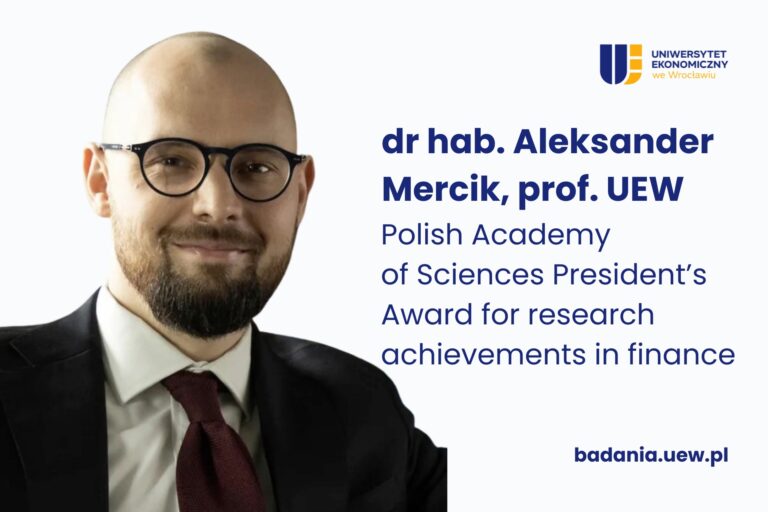
Dr hab. Aleksander Mercik, Professor of the WUEB, receives the Andrzej Gospodarowicz Award in Finance from the President of the Polish Academy of Sciences

WUEB Experts Weekly Review. Research, Projects and Academic Successes (5–11 October 2026)
Wroclaw University of Economics and Business researchers among the world’s leading scientists: six included in the 2026 World’s Top 2% Scientists database
WUEB Experts Weekly Review: Research, Projects and Academic Successes (28 September–4 October 2026)