

Banks do not operate in isolation. When pressure builds in the economy, their capital decisions can strengthen the resilience of the whole system or reveal where its weaker points lie.

The article “Ryzyko systemowe a adekwatność kapitałowa banków w Europie” [Systemic risk and bank capital adequacy in Europe], written by Dr Marta Karaś from Wroclaw University of Economics and Business in cooperation with Dr Michał Stachura from Jan Kochanowski University in Kielce and Dr Michał Boda from Krakow University of Economics, received first prize in the competition for the National Bank of Poland President’s Award for the best article published in Bank i Kredyt in 2025.
The award recognises a research article with a subject that is closely linked to everyday economic life. Bank stability affects the safety of savings, access to credit, business decisions and the economy’s ability to withstand crises. The authors ask a precise question: how do banks in Europe adjust their capital levels when systemic risk increases?
Systemic risk does not stop at one bank
Systemic risk describes a situation in which problems in one institution or one part of the market can spread further. It is not only about the condition of a single bank. It is about the network of links between banks, financial markets, states, businesses and customers.
In Europe, this issue is particularly relevant because the economy relies heavily on bank financing. Banks fund a substantial part of business activity and household needs. When the banking sector becomes less resilient, the effects may be felt well beyond financial markets.
The authors analyse the period 2010-2023. These were the years after the global financial crisis, but also a time of further shocks: the euro area sovereign debt crisis, Brexit, the COVID-19 pandemic, rising inflation, the energy shock and the economic consequences of the war in Ukraine. In other words, this was not a calm period for the European economy.
At the centre of the study is bank capital adequacy. In simple terms, this means a bank’s ability to maintain a level of capital that allows it to absorb unexpected losses and continue operating safely. The authors measure it using the total capital ratio, or TCR.
A large sample, difficult data and a precise question
The scale of the study is substantial. The analysis covered 2,336 banks from 37 European countries and was based on around 960,000 observations. This allowed the authors to look beyond Europe’s largest economies and include smaller and emerging markets, which may be particularly exposed during periods of crisis.
Systemic risk does not look the same everywhere. It may work differently in a large commercial bank, in a cooperative bank, and in a country whose financial sector is smaller and more vulnerable to external shocks.
The study uses advanced measures of systemic risk, including ΔCoVaR. This tool helps capture how a deterioration in one part of the financial system is linked to increased risk for the system as a whole. The authors also use panel models, which make it possible to analyse many banks across many periods and to examine how relationships change over time.
The authors state the practical relevance of the study directly:
“The results may be useful for banking sector supervisors.”
How banks respond to crisis
The authors show that not only the level of risk matters, but also the point at which it is observed. When pressure in the financial system is still building, banks may respond cautiously: by strengthening capital, limiting riskier activity and preparing for a possible deterioration.
The post-crisis stage looks different. Earlier tensions then start to weigh on banks in real terms: financial performance weakens, balance sheets come under pressure, and some losses or costs appear with a delay. The study shows that a previous rise in systemic risk may, after some time, be associated with lower capital ratios.
This is an important finding. Bank stability cannot be assessed only on the basis of the current level of risk. Earlier developments also need to be taken into account, because the effects of crises often return to the banking sector with a delay.
The authors also identify differences between commercial and cooperative banks. Commercial banks, which are more strongly connected to financial markets, respond more quickly and more sharply. Cooperative banks respond less strongly, but their adjustments are spread over a longer period. This reflects, among other things, a different operating model: a local profile, a more conservative policy and lower exposure to market risk.
From this perspective, the study by Dr Marta Karaś, Dr Michał Stachura and Dr Michał Boda shows that effective regulation should take account of the diversity of the banking sector. Large commercial banks may require different tools from cooperative banks, which operate closer to local communities and businesses.
The award-winning article is an example of research that combines advanced methodology with practical relevance. Dr Marta Karaś, as an expert at Wroclaw University of Economics and Business in finance and systemic risk, shows how data analysis can help us better understand economic resilience. Not only when a crisis is already under way, but also when its first signals begin to appear.
Read full tekst: https://bankikredyt.nbp.pl/content/2025/06/BIK_06_2025_03.pdf
More information about the award and the article is available on the competition organiser’s website:https://bankikredyt.nbp.pl/home.aspx?f=/content/konkurs/laureaci_2025_pl.html
Author: Barbara Grzelczak
See similar content

Dr hab. Aleksander Mercik, Professor of the WUEB, receives the Andrzej Gospodarowicz Award in Finance from the President of the Polish Academy of Sciences

Wroclaw University of Economics and Business researchers among the world’s leading scientists: six included in the 2026 World’s Top 2% Scientists database

Vitamins C and D in a single plant-based gel: UEW researcher awarded NCN grant

Joanna Radomska of WUEB awarded the title of professor
See also
The World Within Wrocław’s Reach. How the PROM research mobilities confirm WUEB’s place on the map of global academia
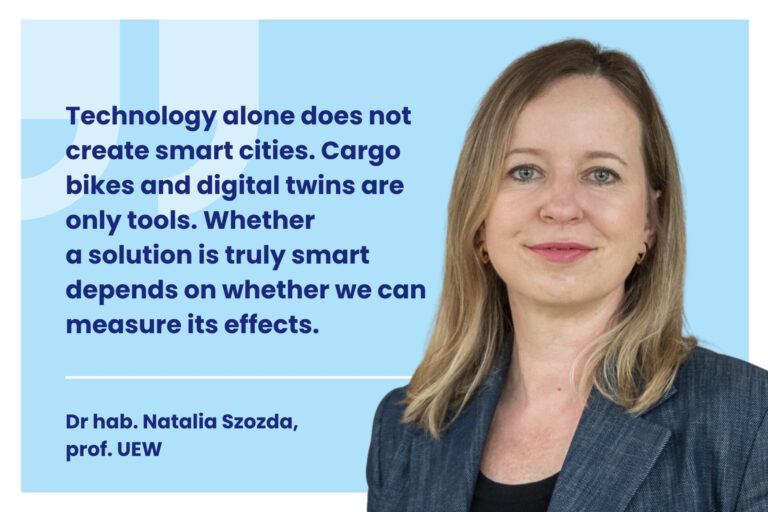
Wroclaw’s micro-hub at the Economic Forum. Natalia Szozda, Associate Professor , on when a city truly becomes smart
Dr hab. Aleksander Mercik, Professor of the WUEB, receives the Andrzej Gospodarowicz Award in Finance from the President of the Polish Academy of Sciences

WUEB Experts Weekly Review. Research, Projects and Academic Successes (5–11 October 2026)
Wroclaw University of Economics and Business researchers among the world’s leading scientists: six included in the 2026 World’s Top 2% Scientists database
WUEB Experts Weekly Review: Research, Projects and Academic Successes (28 September–4 October 2026)
Vitamins C and D in a single plant-based gel: UEW researcher awarded NCN grant