

The 2026 Positive Impact Rating shows that the credibility of a business school is increasingly shaped not only by the quality of its programmes, publications or international position. What matters more and more is the coherence between what an institution declares and how its everyday work is assessed by those who experience it directly: students and academic faculty.
Does the university teach responsibility in practice? Does it create conditions for research that responds to the challenges facing the economy, public administration and society? Is impact visible in the way the institution works, not only in the language of strategy and mission?
In this year’s Positive Impact Rating, 87 business schools from 32 countries across five continents were rated. Wroclaw University of Economics and Business achieved Level 3, or Progressing School status. The result is based on the student voice and confirms evidence of results across several impact dimensions at once.
A rating that does not turn universities into a league table
The Positive Impact Rating is run by a not-for-profit Swiss association based in Lucerne. PIR does not create a conventional league table. Schools are grouped into five levels and listed alphabetically within each level. This model deliberately shifts the emphasis from competition to institutional learning: from the question “who is higher?” to the question “what should change so that declared impact becomes visible in practice?”.
For a university, this creates a different kind of international point of reference. PIR does not replace rankings, accreditations or bibliometrics. It complements them with the perspective of those who experience the institution every day: students and, since 2025, academic faculty assessing the institutional conditions for research connected with the external environment.
In 2026, PIR collected more than 20,000 student responses from 90 schools. The official rating covered 87 business schools from 32 countries, based on 19,789 valid student responses. The report also shows that schools participating in PIR repeatedly tend to achieve higher average scores than first-time participants. First-time schools averaged 7.2 points, schools participating for the second or third time averaged 8.0, and schools participating four times or more averaged 8.2. WUEB is now part of this last group.
What PIR tells employers, candidates and university partners
For employers, the Positive Impact Rating offers information that conventional rankings based on publications, reputation or institutional indicators do not provide. It shows how students assess the university from which they enter the labour market: whether education is connected with practice, whether programmes develop responsibility for economic and social decisions, and whether the institution creates an environment conducive to cooperation, agency and understanding the challenges of the contemporary economy.
For prospective students, PIR is one of the few international points of reference that is not based solely on institutional declarations. It is the voice of people who already study at the university and assess it from within: through the everyday experience of classes, support, organisational culture, relations with the external environment and coherence between what the university says about responsibility and how it operates.
For business and institutional partners, the rating has a further meaning. It shows whether a business school functions as an institution confined to the logic of degrees and publications, or as one capable of working with its environment: educating people who understand complex problems, conducting research connected with practice and including the voices of students and faculty in the process of improvement.
In this sense, PIR is not only a communication about WUEB’s presence in an international rating. It is also information for those who cooperate with the university, employ its graduates or are considering studying here: it shows how the university is perceived by its own community and whether its declarations translate into educational experience.
How to measure positive impact
PIR is based on two separate sources of data. The published school level is based on the student survey. Students assess their institution in seven dimensions: governance, institutional culture, programmes, learning methods, student support, the institution as a role model and public engagement.
Since the 2025 edition, PIR has also developed a separate faculty survey. In 2026, its results fed for the first time into the new eighth dimension of the model: research impact, placed in the Enabling area.
Faculty answer questions about whether research helps better understand significant societal challenges, whether researchers collaborate with partners from the private, public and non-profit sectors, and whether the university recognises and rewards research for its relevance to the external environment.
This distinction is important: PIR does not measure full research impact and does not replace case studies, expert review, bibliometrics, partner feedback or Theory of Change logic. Rather, it shows whether the institution has the conditions that increase the likelihood that research will be useful for the economy, public administration and society.
What the global student voice says
A clear global pattern returns in student responses. Students expect more coherent institutions: ones that do not limit sustainability to declarations, but embed it in programmes, teaching methods, relations with the external environment and everyday organisational practices.
Students point to the need for stronger partnerships with companies, public institutions, social organisations and alumni. They emphasise the importance of education that is more practical and less detached from actual business and societal challenges. They also criticise greenwashing, excessive declarative language, outdated teaching models and theory disconnected from practice.
The signal is global, but its emphasis is local. In Eastern Europe, the need for greater student agency and access to international opportunities is particularly visible. For universities, this means building mechanisms in which the student voice does not end with a survey, but becomes part of work on the quality of education and the academic experience.
A new dimension: research impact
The new PIR dimension is particularly important from the perspective of an economics and business university. Research impact is not understood here as a simple alternative to publications, citations or journal quality. It is a broader question: whether research conducted in a business school helps better understand social and economic challenges, whether it is developed in relation with the external environment, and whether the institution is able to recognise its relevance beyond academic circulation.
In this sense, PIR reflects a broader change in the international assessment of business schools. What matters increasingly is not only declaring responsibility, but the institution’s capacity to show how responsibility, impact and cooperation with the external environment are present in governance, education, research and reward systems.
In 2026, PIR collected 1,189 valid faculty responses from 25 schools, more than four times the number gathered in the previous year’s pilot. WUEB academic faculty took part in this survey for the first time.
“We treat participation in the Positive Impact Rating as part of systematic work on quality and institutional credibility. This year’s inclusion of the research impact dimension is especially important for us. The question of whether research helps us better understand social and economic challenges, and whether the university creates the conditions for its use, is one of the key questions a business school should be asking today.”
— Professor Marek Kośny, Vice-Rector for Research, Wroclaw University of Economics and Business.
Faculty and students see the institution differently
In 2026, 25 schools conducted both surveys: the student survey and the faculty survey. The comparison is diagnostically significant. Faculty rate their school’s impact higher than students: 8.1 compared with 7.6.
The largest differences appear in three areas: the institution as a role model, student support and learning methods. Where faculty may perceive transformation as advanced, students still see a gap between declarations and everyday experience.
PIR treats this difference not as a weakness, but as material for institutional work. It shows where a conversation between students, faculty and university leadership should begin: about what is actually changing, what requires better communication and what remains at the level of intention.
WUEB result: what Level 3 means
Level 3 in the Positive Impact Rating means that WUEB students confirmed evidence of results across several impact dimensions at once. This is not an assessment of one selected initiative or a single project. It is an image of the institution as seen by students in everyday experience: in education, organisational culture, support, programmes, public engagement and coherence between declarations and practice.
The schools alongside which WUEB appears in the PIR list are institutions recognised in the international responsible management community, including schools linked with PRME, AACSB and EQUIS. Participation in PIR places WUEB in a global circuit of business schools that submit themselves to assessment by their own students and faculty and treat the results as material for further work.
For WUEB, participation in PIR therefore has more than reputational significance. It is part of systematic work on the coherence between what the University declares and how it operates in practice: in education, research, cooperation with the external environment and the experience of its community.
“The Positive Impact Rating is important to us because it shows the perspective of students: people who experience the university every day and can assess whether our work on sustainability is visible to them. We treat this result as confirmation of our direction, but also as a commitment to continue working on the coherence between declarations and the everyday practice of the institution.”
— Dr Karolina Daszyńska-Żygadło, Head of the Sustainable Development Office, Wroclaw University of Economics and Business.
Full Report: https://www.positiveimpactrating.org/the-rating/2026-report
badania.uew.pl – because the world needs competent voices when declarations must be confronted with data, experience and institutional responsibility.
Author of text: Justyna Morawska-Płoskonka
See also

Dr hab. Aleksander Mercik, Professor of the WUEB, receives the Andrzej Gospodarowicz Award in Finance from the President of the Polish Academy of Sciences

Wroclaw University of Economics and Business researchers among the world’s leading scientists: six included in the 2026 World’s Top 2% Scientists database
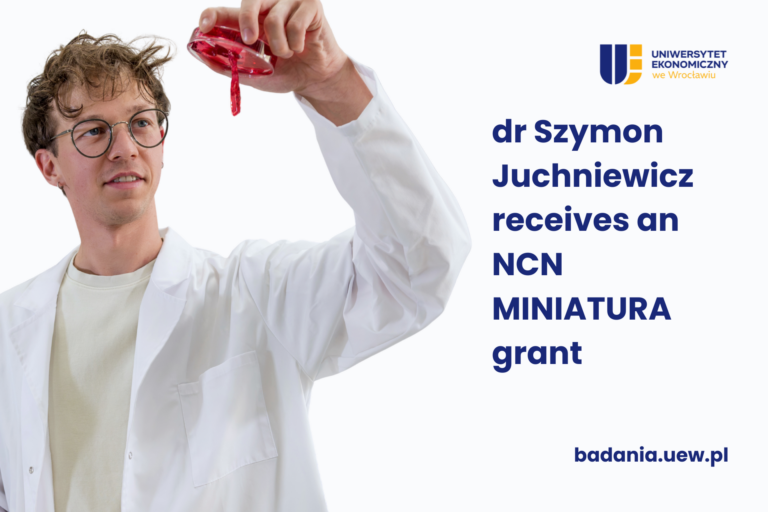
Vitamins C and D in a single plant-based gel: UEW researcher awarded NCN grant

Joanna Radomska of WUEB awarded the title of professor
See similar content
The World Within Wrocław’s Reach. How the PROM research mobilities confirm WUEB’s place on the map of global academia
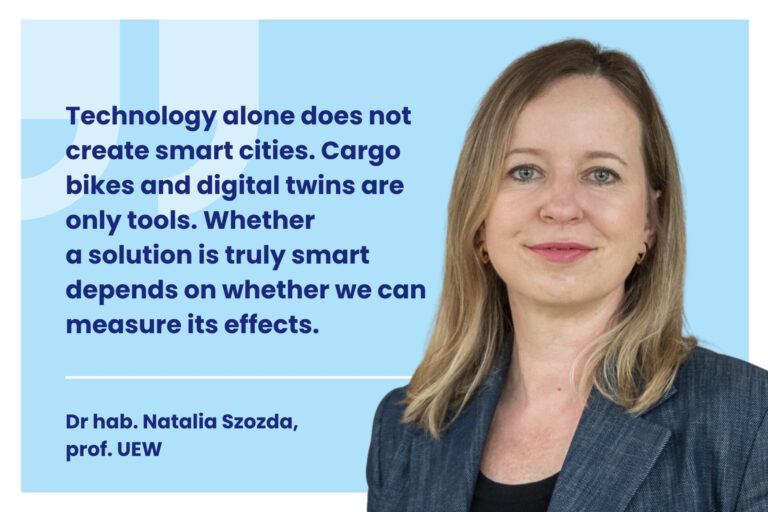
Wroclaw’s micro-hub at the Economic Forum. Natalia Szozda, Associate Professor , on when a city truly becomes smart
Dr hab. Aleksander Mercik, Professor of the WUEB, receives the Andrzej Gospodarowicz Award in Finance from the President of the Polish Academy of Sciences

WUEB Experts Weekly Review. Research, Projects and Academic Successes (5–11 October 2026)
Wroclaw University of Economics and Business researchers among the world’s leading scientists: six included in the 2026 World’s Top 2% Scientists database
WUEB Experts Weekly Review: Research, Projects and Academic Successes (28 September–4 October 2026)
Vitamins C and D in a single plant-based gel: UEW researcher awarded NCN grant