
A team from the Department of Biotechnology and Food Analysis at WUEB, working within the Adaptive Food Systems Accelerator (AFSA) research centre, is launching research into plant-based emulgels and oleogels intended to partially replace fat in sauces, desserts and plant-based products. The researchers will examine their effect on the texture, stability and sensory qualities of food, setting this technological assessment alongside a water footprint analysis of the raw materials used.
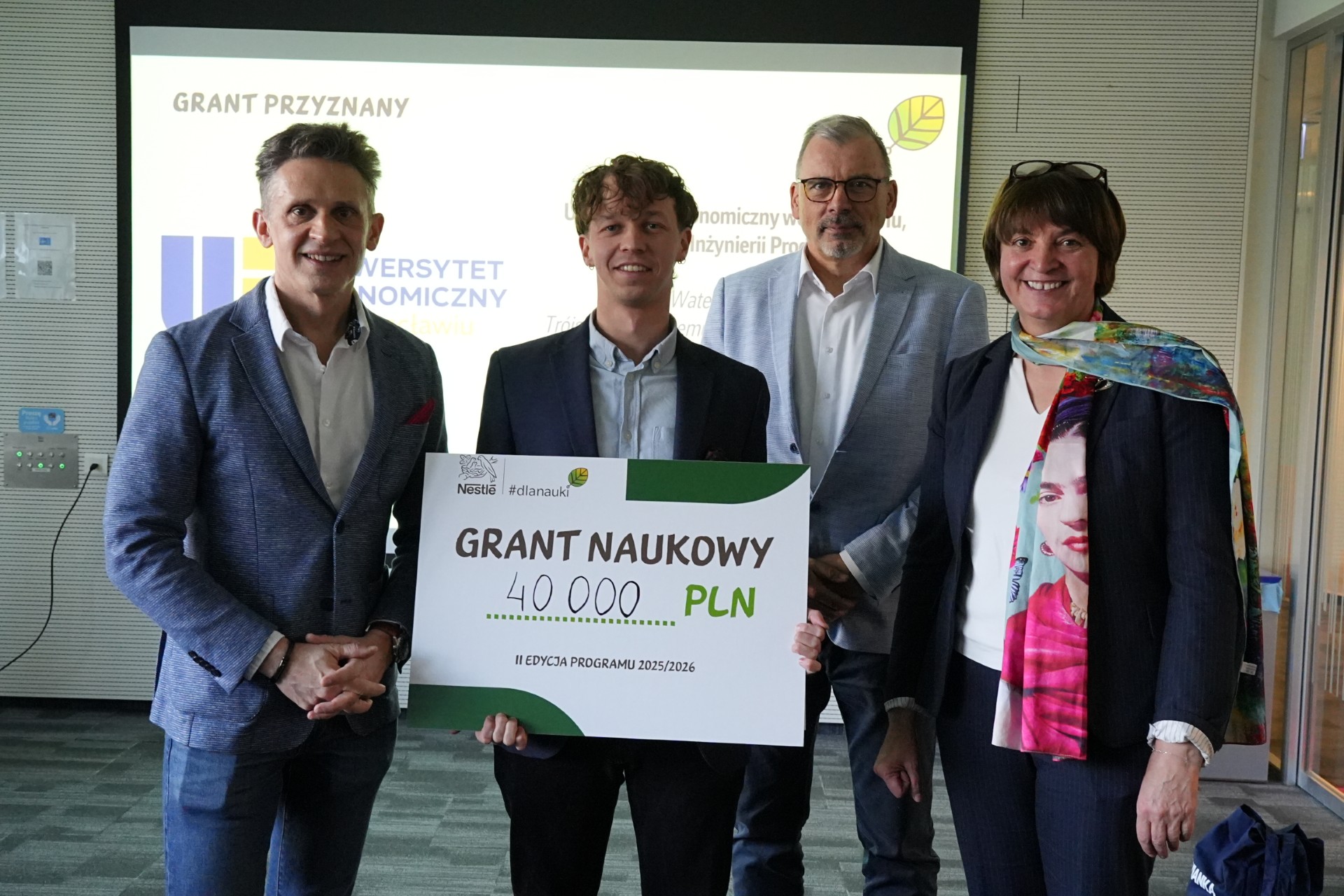
Our researchers’ WaterSmartFat project took first place in the second edition of the #NestleDlaNauki programme (Nestlé for Science) and received PLN 40,000 in funding from Nestlé Polska. The funding launches the stage in which the concept will be translated into formulations and tested in model products.
Oil in a New Form Builds the Product’s Structure
Fat performs a specific job in food: it helps create texture and viscosity, stabilises the system of ingredients, affects how flavour is perceived, and influences how a product behaves in storage. Liquid oil added directly to a formulation does not always take on these functions. A sauce can separate, a dessert can lose its texture, and a plant-based product can turn out unstable during manufacturing.
The WUEB team is therefore looking for a way to organise liquid oil within a structure built from plant-based components. The goal is to partially replace fat while preserving the functions that determine the quality and manufacturability of the finished product. The extent of substitution that proves acceptable will not be fixed in advance: it will be determined by the results of testing individual formulations.
As dr inż. Szymon Juchniewicz explains:
“Even the best composition is not enough if the product stops tasting right or loses the proper texture. Preserving these qualities is a key challenge when reducing fat content.”
From Laboratory Formulation to Product Recipe
In an oleogel, liquid oil is immobilised within a three-dimensional network formed by structuring agents. An emulgel combines an emulsion with a cross-linked matrix that stabilises the dispersed fat phase. In both cases, structuring gives the oil the properties it needs to perform a specific function in the product, without turning it into a conventional solid fat.
The WUEB team will first develop and characterise plant-based formulations, assessing among other things their structure, texture, stability and capacity to hold water and oil. Selected variants will then be tested in model sauces, desserts and plant-based products. The trials are designed to show whether these properties hold up during manufacturing and storage, and how changing the formulation affects sensory qualities. This sequence of work moves from laboratory material to data relevant to a specific application.
Water Footprint in the Technological Equation: How Much Water a Raw Material Costs
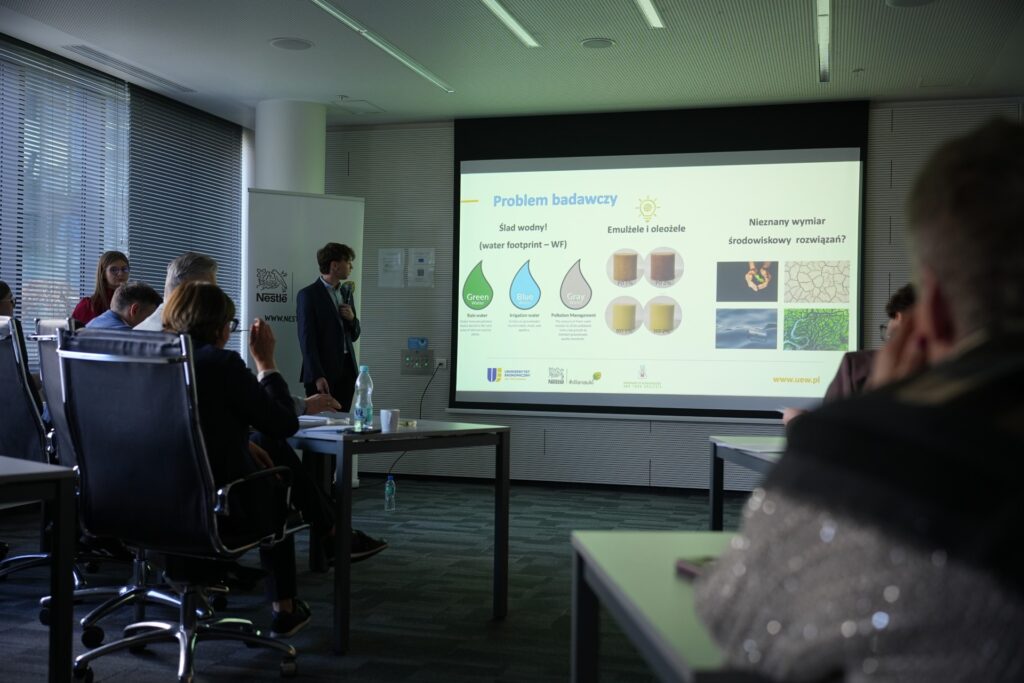
Alongside the technological assessment, the team is pursuing a second, parallel line of research: an analysis of the water footprint of the raw materials used to build the emulgels and oleogels. A water footprint covers the use of water resources at every stage of producing a raw material, so it is a broader measure than water consumption at the production plant alone. Animal fats typically have a markedly higher water footprint than plant oils. The average global water footprint of butter is around 5,500 litres per kilogram, compared with around 2,600 litres for corn oil, a difference of more than 50 per cent. Both figures come from the global estimates produced by Mekonnen and Hoekstra, published in the journals Ecosystems (2012) and Hydrology and Earth System Sciences (2011); the same research underlies the data made available by the Water Footprint Network. This difference is the starting point for the project’s second strand.
A Trade-off, Not a Given
Comparing environmental data with the properties of each formulation will make it possible to assess this technological trade-off: a raw material with a lower water footprint will not be a good choice if the recipe loses stability, texture or sensory acceptability. Only by combining both criteria, assessed according to the established water footprint methodology (the ISO 14046 standard), will it be possible to identify which applications make partial fat replacement sensible from both a technological and an environmental standpoint at once.
Data That Can Support Manufacturers’ Decisions
The results may support manufacturers in selecting raw materials, determining an acceptable level of partial fat replacement, and designing products with the required parameters. Working with a business partner makes it possible to test each research decision against the realities of industrial food design. At this stage, the collaboration serves mainly to establish which parameters and data are needed for selected formulations to move on to further trials. Taking part in the programme does not yet mean that implementation is planned.
A Team That Combines Food Analysis with Industry Experience
The project is being carried out by a team from the Department of Biotechnology and Food Analysis at WUEB’s Faculty of Production Engineering: prof. dr hab. inż. Joanna Harasym as the project’s scientific supervisor, mgr inż. Oliwia Paroń, a doctoral researcher, and dr inż. Szymon Juchniewicz. The research will be conducted within the Adaptive Food Systems Accelerator (AFSA) research centre, of which Professor Harasym is director, using infrastructure that allows the team to develop formulations and assess their properties.
Running the full cycle of applied research, from planning experiments through to analysing results and liaising with the business partner, is also building the methodological competence of the early-career researchers involved in the project.
The Nestlé Award and Its Place in WUEB’s Strategy 2030
For the team, first place in the competition means more than research funding. It also confirms that the direction of their work is of interest to one of the major players in the food sector.
The project fits within two of the strategic directions of WUEB’s Strategy 2030: “Conducting research for social development and a knowledge and innovation-based economy” and “Building valuable relationships with business and with economic and social stakeholders.” The collaboration with Nestlé through competitive research funding is a direct example of delivering on the second of these directions, while the water footprint analysis of food raw materials, carried out alongside the technological assessment, speaks to the first.
The Next Stage
The team’s immediate task is to develop the formulations, characterise them, and trial them in model products. Only the results of this work will make it possible to identify which solutions are worth developing further and to formulate criteria that manufacturers can use when designing their own recipes.
Data sources:
Mekonnen, M. M., Hoekstra, A. Y. (2012). A Global Assessment of the Water Footprint of Farm Animal Products. Ecosystems, 15(3), 401-415.
Mekonnen, M. M., Hoekstra, A. Y. (2011). The Green, Blue and Grey Water Footprint of Crops and Derived Crop Products. Hydrology and Earth System Sciences, 15(5), 1577-1600.
The figures given are global averages for the period 1996-2005 and cover the total water footprint (green, blue and grey).
Author: Justyna Morawska-Płoskonka
See similar content
Bridging V4 Universities and Business through Design Thinking

Microwaves and Silymarin – An Innovative Approach to Enhancing the Health Value of Milk Thistle Sprouts

New photoactive niobium(V)-containing oxide compounds as photocatalysts forthe purification of drinking water from organic micropollutants

Next-Gen Urban Freight Logistics for Net Zero Emissions through Innovative Solutions – NEXTLOGIC
See also
Vitamins C and D in a single plant-based gel: UEW researcher awarded NCN grant

Joanna Radomska of WUEB awarded the title of professor
How can solutions for urban freight transport be co-created? Dr hab. inż. Maja Kiba-Janiak’s, Professor of the WUEB research fellowship in Gothenburg

WUEB Experts Weekly Review: Research, Projects and Academic Successes (21–27 September 2026)
Poland’s demographic crisis: Professor Marek Kośny on the economic consequences

What is Bitcoin and How is it Changing Finance? dr Michał Kisiel on the Future of Money
WUEB Experts Weekly Review: Research, Projects and Academic Successes (14–20 September 2026)