

Photocatalysts of the Future: How Niobium Oxide Can Help Purify Water
Can light purify water? In the latest research project led by Dr. Eng. Bożena Marta Pilarek, we explore how to harness the unique properties of niobium(V) oxide and its compounds with calcium and neodymium to create cutting-edge photocatalytic materials. The goal? Effectively remove organic micropollutants from water that comes into contact with food—in a safe, energy-efficient, and sustainable way.
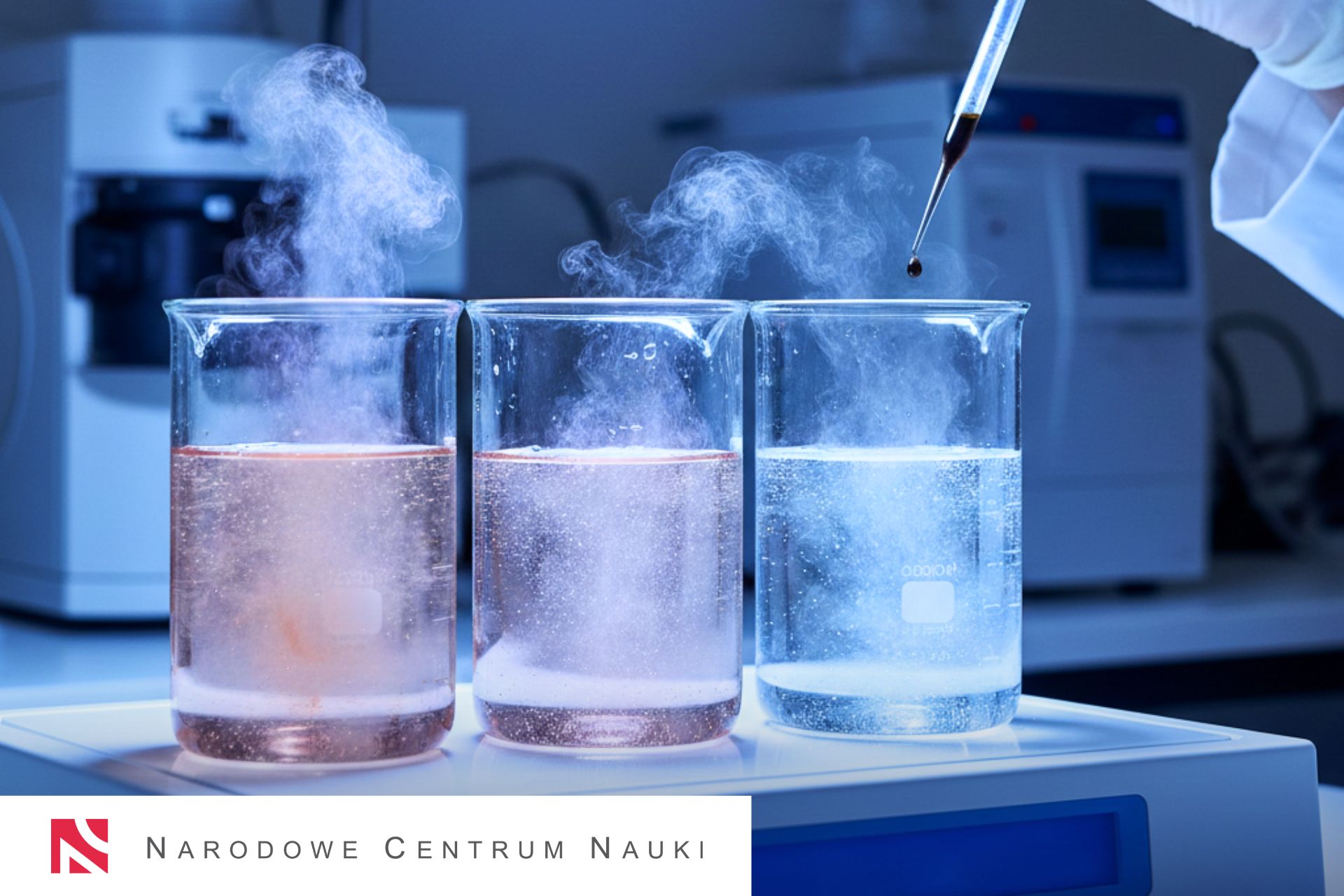
The project bridges modern materials science with real-world needs of industry and society. It’s an example of innovation that aligns with global environmental, health, and regulatory goals—as well as ESG (Environmental, Social, Governance) standards.
Niobium Oxide and Its Compounds – New Champions in the Fight Against Pollution
Niobium(V) oxide (Nb₂O₅) combines exceptional properties: a wide band gap (allowing it to absorb UV light), high chemical and structural resistance, and strong potential for modification—making it an ideal candidate as a photocatalyst. Previous research suggests even greater potential when forming mixed oxides, such as:
- CaO–Nb₂O₅ – with calcium,
- Nd₂O₃–Nb₂O₅ – with neodymium,
- CaO–Nd₂O₃–Nb₂O₅ – a complex three-component system.
These materials not only withstand UV radiation but also offer great flexibility in tuning their surface properties, which is crucial in photocatalytic processes.
Thanks to their modifiable structure, high chemical resistance, and broad band gap, they can effectively initiate the decomposition of pollutants under UV light—without generating toxic byproducts.
Micropollutants – Hard to Detect, but Not Impossible to Remove
Water used in the food industry may contain trace amounts of pesticide residues, dyes, preservatives, or pharmaceuticals—even at very low concentrations, these pose health risks. Traditional purification methods are not always effective and can be costly. In this context, photocatalysis—where UV light activates a material that breaks down pollutants into harmless products—emerges as a promising solution for the future.
How Are These Materials Made?
The project will employ two complementary synthesis methods:
Ceramic Synthesis
A classic method in solid-state chemistry. Raw materials are mixed and heated to high temperatures until a reaction occurs and stable crystalline phases form. This yields high-purity materials with large crystallites—ideal for fundamental research and chemical composition optimization.
Hydrothermal Synthesis
A more advanced and demanding technique. It takes place in a water-based environment under high pressure and temperature. This allows for the creation of nanostructures with controlled morphology, high surface area, and diverse surface structures—enhancing photocatalytic activity. Key parameters like temperature, pressure, duration, and precursor selection will be optimized in the project.
From Structure to Function: Comprehensive Material Analysis
To understand what makes an effective photocatalyst, knowing its composition isn’t enough. We must delve deeper—to the level of crystal structure and atomic surface. Modern research techniques will be employed:
- XPS (X-ray Photoelectron Spectroscopy) – optionally used to identify surface chemical composition and oxidation states affecting photocatalyst mechanisms.
- PXRD (Powder X-Ray Diffraction) – to identify crystalline phases, their purity, and crystallite size.
- SEM (Scanning Electron Microscopy) – to examine morphology: shape, size, and particle uniformity.
- BET (Surface Area Analysis) – crucial for evaluating the number of reactive sites.
- UV-Vis DRS (Diffuse Reflectance Spectroscopy) – to measure absorption capability and calculate band gap width (Eg).
How Is Effectiveness Tested?
To evaluate the effectiveness of the developed photocatalytic materials, the project will focus on two carefully selected model organic pollutants, representing the most common classes of substances found in technological and surface waters:
- Methylene blue – a classic model dye, widely used as a representative of food-related colorants. Due to its chemical stability and strong chromophoric properties, it serves as an excellent indicator for assessing photocatalytic degradation efficiency.
- Atrazine – a commonly used herbicide frequently detected in groundwater and surface waters. It is of particular concern due to its chemical persistence and potential impact on human health and ecosystems.
- Ibuprofen (as an alternative to atrazine) – a representative of pharmaceutical contaminants, often present in wastewater due to widespread use in medicine. It is commonly selected as a model compound in studies on water treatment technologies, given its frequent detection and resistance to biodegradation.
In this project, methylene blue will be used alongside either atrazine or ibuprofen, depending on preliminary testing and analytical feasibility. This strategy allows us to assess the photocatalysts’ performance against both a simple dye molecule and more structurally complex, biologically active compounds with varying degradation challenges.
Sustainability in Action: ESG at the Core of the Project
Environmental:
The project promotes water purification technologies that avoid harmful chemicals. Photocatalysis is low-emission, energy-saving, and environmentally friendly—supporting the European Green Deal and circular economy goals.
Social:
Clean water is a public health essential. The project targets the removal of substances like pesticides, dyes, and pharmaceuticals increasingly found in surface waters. Innovations developed here can improve quality of life and food safety.
Governance:
The project is conducted under high scientific and ethical standards, funded by the National Science Centre through the transparent MINIATURA call. Results could form the basis for future funding applications (e.g., NCN SONATA) and international collaboration under MSCA and COST programs.
Sustainable Development Goals (SDGs) Addressed by the Project:
This research initiative aligns with several United Nations Sustainable Development Goals:
Goal 3: Good Health and Well-Being
By focusing on natural compounds with hepatoprotective, antioxidant, and antidiabetic potential, the project contributes to the development of functional foods and nutraceuticals supporting the prevention of lifestyle-related diseases.
Goal 9: Industry, Innovation and Infrastructure
The project incorporates advanced analytical and physical techniques (microwave treatment, spectroscopy, chromatography) and proposes innovative strategies for enhancing the biological value of plant materials, with strong industrial application potential.
Goal 12: Responsible Consumption and Production
It promotes more sustainable methods for processing and enriching plant-based raw materials—without relying on synthetic additives or genetic modification.
Goal 13: Climate Action
By utilizing energy-efficient technologies such as microwave processing and LED lighting, the project supports low-emission approaches to food production and plant-based innovation.
What’s Next? Where Could This Technology Be Applied?
This MINIATURA 9 project is a major step toward developing advanced water purification materials—for both drinking and industrial water.
The resulting data will provide a foundation for future studies, including the development of doped materials (e.g., with Fe, Cu, La), real-condition testing, and implementation in:
- UV reactors for industrial water purification,
- Membrane-based photocatalytic filters,
- Hybrid water treatment systems for the food industry,
- Possibly even high-end consumer water filters in the future.
Moreover, the project may pave the way for international collaboration within initiatives like COST networks, Horizon Europe, MSCA, and others focused on innovative environmental technologies.
External links:
More information about the project in the WIR Knowledge Base
Principal Investigator:

Funding Agency:

National Science Centre (Poland)
Call:
Miniatura 9
Funding Amount:
41 408,00 PLN
Project Duration:
11/11/2025 – 10/11/2026
Status:
Ongoing
See similar content

Bridging V4 Universities and Business through Design Thinking
A New Form of Fat: A More Sustainable Product Formulation. WaterSmartFat Brings Together Food Technology and Water Footprint Analysis
Microwaves and Silymarin – An Innovative Approach to Enhancing the Health Value of Milk Thistle Sprouts

Next-Gen Urban Freight Logistics for Net Zero Emissions through Innovative Solutions – NEXTLOGIC
See also

WUEB Experts Weekly Review. Research, Projects and Academic Successes (12–18 October 2026)
How can economic fluctuations be smoothed? The 2026 Nobel Prize in Economic Sciences through the eyes of WUEB researchers
The World Within Wrocław’s Reach. How the PROM research mobilities confirm WUEB’s place on the map of global academia
Wroclaw’s micro-hub at the Economic Forum. Natalia Szozda, Associate Professor, on when a city truly becomes smart
Dr hab. Aleksander Mercik, Professor of the WUEB, receives the Andrzej Gospodarowicz Award in Finance from the President of the Polish Academy of Sciences
WUEB Experts Weekly Review. Research, Projects and Academic Successes (5–11 October 2026)
Wroclaw University of Economics and Business researchers among the world’s leading scientists: six included in the 2026 World’s Top 2% Scientists database