

Last week, experts from the Wroclaw University of Economics and Business contributed to public debate on university internationalisation, taxation and finance, as well as the quality of public services. The week also brought publications that helped organise its key themes and showed how academic knowledge can deepen our understanding of real social and economic choices.
How much does a PLN 15,000 loan cost? The best offers differ by only a few grosz
WUEB Expert – dr Dominika Florek-Sapkowska
The article compares the real cost of a cash loan and shows that differences between offers can be small, although the details still matter. Its conclusions help readers assess loan terms in a more economic way, rather than looking only at the monthly instalment.
Polish companies saved nearly PLN 50 billion thanks to the R&D tax relief. The largest share of the tax pie goes to big players
WUEB Expert – dr Dominika Florek-Sapkowska
The article discusses the scale of the R&D tax relief and shows how tax benefits are distributed in practice between companies of different sizes. It opens up a wider discussion about how innovation support instruments should be designed so that they reach beyond the largest businesses.
How much Bitcoin belongs in a portfolio? On the role of cryptocurrencies in diversification and the Czech reserves debate
WUEB Expert – dr Aleksander R. Mercik
This commentary looks at the role of cryptocurrencies in portfolio diversification and at how to read discussions about “reserves” and risk in public finance. A careful distinction between narrative and data makes it easier to judge where strategy ends and speculation begins.
‘Generation Z and the challenges of the modern world’ – young people in English at I LO in Jelenia Góra
WUEB Expert – dr hab. inż. Maja Kiba-Janiak, Associate Professor at WUEB oraz dr hab. Bartosz Bartniczak, Associate Professor at WUEB
This event report shows how WUEB brings expert knowledge into work with young people, including in an English-language format. It is a practical example of public engagement with research and of building the confidence to discuss contemporary challenges.
They earned more in Belgium. They live better in Poland.
WUEB Expert – dr hab. Paweł Dobrzański, Associate Professor at WUEB
This piece shows that decisions to return to Poland are shaped by more than earnings alone. The cost of living, a sense of security and the texture of everyday life matter just as much. It is a useful contribution to understanding how people make work and life choices.
https://badania.uew.pl/zarabiali-wiecej-w-belgii-zyja-lepiej-w-polsce/
Support that misses the problem? The ‘CPN’ package raises controversy
WUEB Expert – dr Iwo Augustyński
In this analysis, the author points to the risk that support instruments may fail to match the diagnosis of the problem, even when they sound intuitive in public debate. It is a good example of thinking about public policy through the lens of side effects and real economic incentives.
Professor Marek Kośny on taxes in Poland: who really pays the most
WUEB Expert – Prof. Dr hab. Marek Kośny, Vice-Rector for Research at WUEB
This commentary brings order to the debate on tax burdens by showing that the answer depends on what we mean by “paying” and which data we compare. It encourages a more careful discussion of the tax system, without shortcuts or easy targets.
https://badania.uew.pl/prof-dr-hab-marek-kosny-o-podatkach-w-polsce-kto-naprawde-placi-najwiecej/
Żurek, sourdough starter and a balcony herb garden. How millennials are rediscovering regional food
WUEB Expert – mgr Paulina Graczyk, doctoral researcher at the WUEB Doctoral School
This piece shows that today’s return to local food is not driven by nostalgia, but by a conscious search for quality, authenticity and control over what ends up on the plate. It is a story about changing habits and about tradition becoming part of contemporary consumer choices.
Polish universities compete for international students. English alone is no longer enough
WUEB
The article shows that internationalisation today is not just about offering programmes in English. It also depends on coherent support systems and on the overall quality of the student experience. This is an important context for WUEB’s efforts to build a competitive educational offer and strong international relations.
Author: Barbara Grzelczak
See similar content

WUEB Experts Weekly Review. Research, Projects and Academic Successes (12–18 October 2026)
How can economic fluctuations be smoothed? The 2026 Nobel Prize in Economic Sciences through the eyes of WUEB researchers
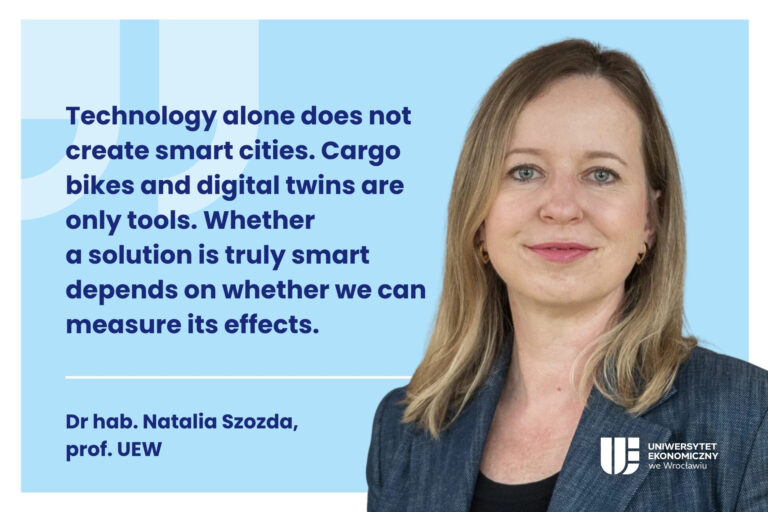
Wroclaw’s micro-hub at the Economic Forum. Natalia Szozda, Associate Professor, on when a city truly becomes smart
WUEB Experts Weekly Review. Research, Projects and Academic Successes (5–11 October 2026)
See also
WUEB Experts Weekly Review. Research, Projects and Academic Successes (12–18 October 2026)
How can economic fluctuations be smoothed? The 2026 Nobel Prize in Economic Sciences through the eyes of WUEB researchers
The World Within Wrocław’s Reach. How the PROM research mobilities confirm WUEB’s place on the map of global academia
Wroclaw’s micro-hub at the Economic Forum. Natalia Szozda, Associate Professor, on when a city truly becomes smart
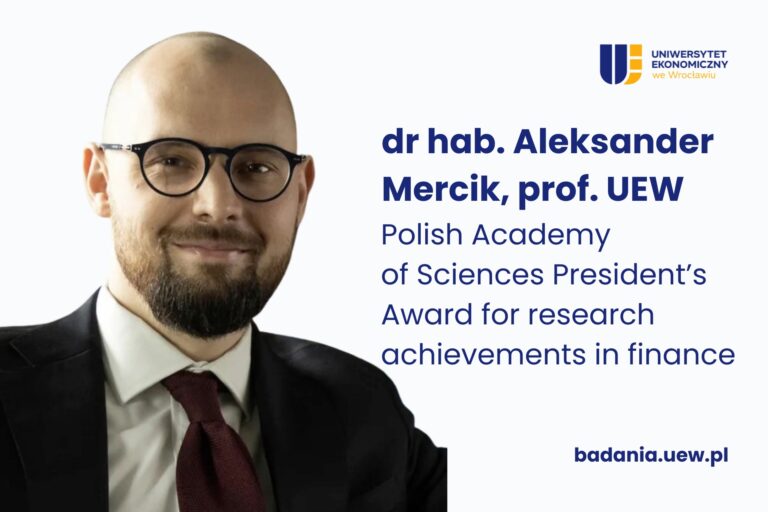
Dr hab. Aleksander Mercik, Professor of the WUEB, receives the Andrzej Gospodarowicz Award in Finance from the President of the Polish Academy of Sciences
WUEB Experts Weekly Review. Research, Projects and Academic Successes (5–11 October 2026)
Wroclaw University of Economics and Business researchers among the world’s leading scientists: six included in the 2026 World’s Top 2% Scientists database