

“Two people do very similar work – they sit next to each other in the same office, but one is on a standard employment contract and the other works on a B2B basis and therefore pays significantly lower levies. It is precisely these kinds of differences that create the conviction that the system is unfair.”
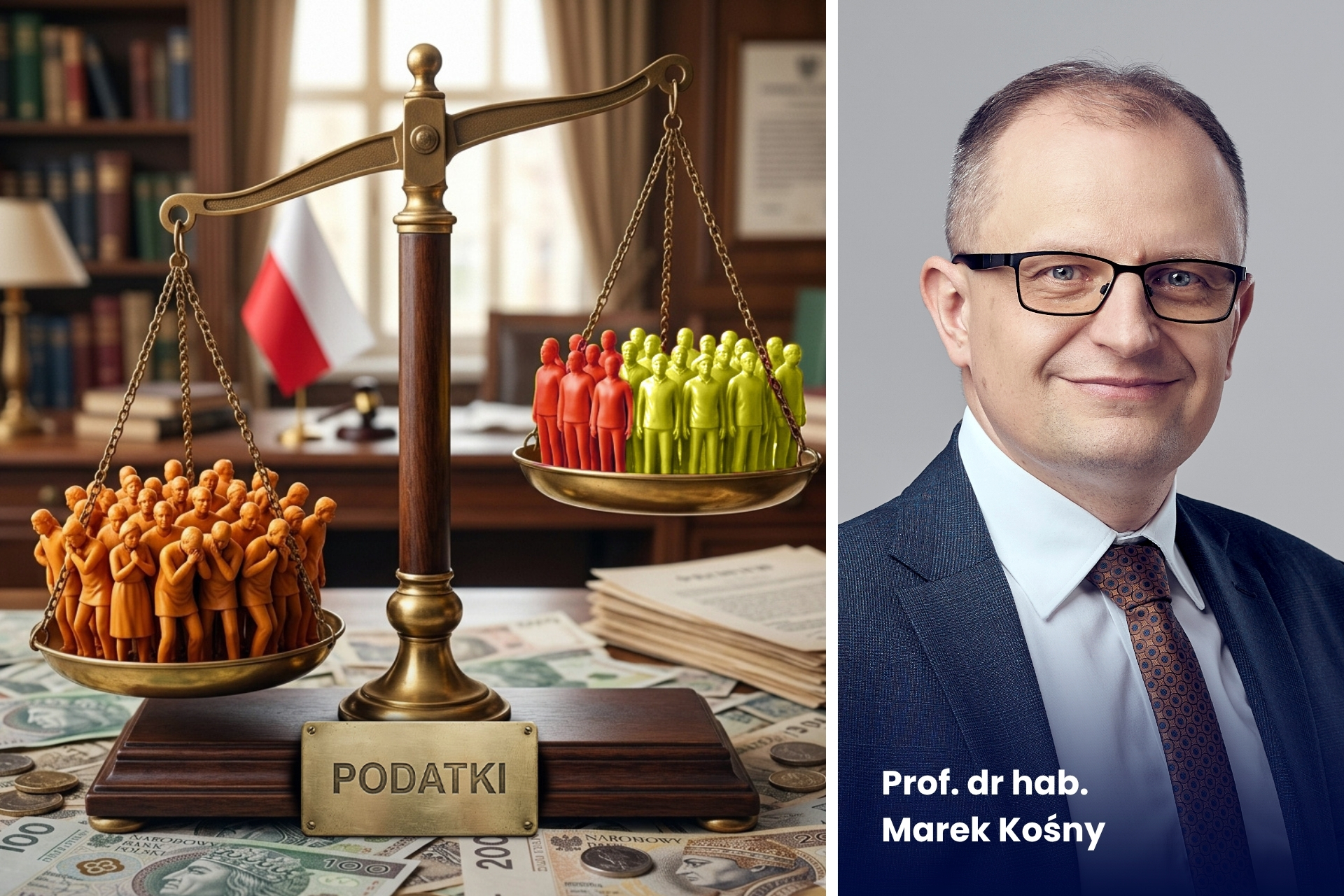
So says Professor Marek Kośny, UEW expert in the social sciences and Vice-Rector for Research at the Wrocław University of Economics and Business, in an interview with Forbes Polska. And he adds something that sounds like a paradox but is a measurable fact: in Poland, the most heavily burdened by taxes and social contributions is neither the lowest-earning nor the highest-earning part of society. It is those earning between approximately PLN 12,000 and PLN 24,000 gross per month – taxed under the general income tax scale. Those in the middle.
Poland’s middle class is systematically and disproportionately burdened by income tax and social contributions. This is neither a new nor an accidental phenomenon – it results from the structure of a system that on one hand protects the lowest earners and on the other leaves room for tax optimisation by the highest earners. People with upper-middle incomes have already crossed into the higher tax bracket (32 per cent), but have not yet reached the threshold beyond which social insurance contributions cease to be levied – the so-called 30x ZUS cap (equivalent to 30 times the average monthly wage). The highest earners, once they cross this threshold during the year, effectively stop paying ZUS contributions on the surplus. The middle group has no such privilege – it pays full contributions and the highest PIT rate simultaneously. Those with comparable incomes running their own businesses and taxed under the flat-rate system fall outside this mechanism entirely. This is not an incidental distinction – it is one of the central arguments of the interview.
The hidden tax: how the failure to adjust PIT thresholds burdens the middle class
This mechanism is worth unpacking. The threshold for the 32 per cent rate has not been adjusted for several years, which means that more and more people are crossing into the higher bracket not because their real situation has improved, but because of inflation and the nominal growth of wages. But what makes this mechanism particularly effective politically is not its scale – it is its invisibility.
A tax rate increase triggers public debate, employer opposition, media coverage. The failure to adjust thresholds triggers nothing – even though the fiscal effect is very similar. Burdens rise, only imperceptibly, year after year, without any decision that could be challenged. As the professor put it:
“This is in essence a form of hidden tax. And importantly – one that is much easier to introduce politically than raising rates.”
The mechanism works all the more effectively because it operates through inaction, not action. There is no law to contest, no rate to compare with the previous year, no moment at which a taxpayer could point to a specific political decision as the source of the deterioration in their situation. Wages rise in nominal terms – so it is hard to speak of a loss. Yet effective burdens rise systematically, and real purchasing power does not necessarily keep pace.
The data Professor Kośny cites are striking: among taxpayers filing under the general tax scale, the share reaching the higher bracket is growing by approximately 2.5 percentage points per year – from just under 3 per cent in 2022 to a projected level approaching 10 per cent for the 2025 filing. At the current rate of nominal wage growth, Professor Kośny suggests that within a few years even people earning around the national average could begin to fall into the higher bracket. When the current threshold was introduced, it corresponded to roughly twice the average wage. Today that ratio is already markedly different.
Every year, the situation of middle-class taxpayers worsens – not because someone made that decision, but because no one made the opposite one.
This is, however, only one dimension of the problem. Equally important is how the system looks when viewed as a whole – not only through the lens of PIT.
Poland’s tax system: progressive in name, linear in practice
The ability to legally reduce effective burdens is not equally available. Professor Kośny notes that people running their own businesses have significantly greater freedom in choosing their form of taxation and method of settlement – which translates into materially lower burdens compared with salaried employees on similar incomes. In the case of the health insurance contribution, this is particularly difficult to justify: access to public health services is the same regardless of employment form, but the level of the contribution is not.
The professor observes that the higher the income, the broader the opportunities to shift it into more favourable forms of taxation. This is one of the reasons progressivity fades as income rises: the highest earners have tools available to them that middle-class individuals – too affluent to receive state assistance, too inflexible to optimise effectively – simply do not.
In the European context, the professor is cautious about generalisations. He does, however, point to a shared logic: large Western economies have not adopted a flat tax because doing so in practice – without reliefs and exceptions – would require setting a rate at a level that would disproportionately burden lower earners. Conversely, high rates for the highest incomes create the risk of capital flight to low-tax jurisdictions such as Ireland or Luxembourg. This tension between fairness and enforceability is, in the professor’s view, a common European problem – not a Polish peculiarity.
Optimisation as privilege – and a systemic problem
The ability to legally reduce effective burdens is not equally available. Professor Kośny notes that people running their own businesses have significantly greater freedom in choosing their form of taxation and method of settlement – which translates into materially lower burdens compared with salaried employees on similar incomes. In the case of the health insurance contribution, this is particularly difficult to justify: access to public health services is the same regardless of employment form, but the level of the contribution is not.
The professor observes that the higher the income, the broader the opportunities to shift it into more favourable forms of taxation. This is one of the reasons progressivity fades as income rises: the highest earners have tools available to them that middle-class individuals – too affluent to receive state assistance, too inflexible to optimise effectively – simply do not.
In the European context, the professor is cautious about generalisations. He does, however, point to a shared logic: large Western economies have not adopted a flat tax because doing so in practice – without reliefs and exceptions – would require setting a rate at a level that would disproportionately burden lower earners. Conversely, high rates for the highest incomes create the risk of capital flight to low-tax jurisdictions such as Ireland or Luxembourg. This tension between fairness and enforceability is, in the professor’s view, a common European problem – not a Polish peculiarity.
Could a wealth tax rebalance the system?
If the income tax system systematically favours those with access to optimisation, a natural question follows: could the taxation of wealth correct this imbalance? Professor Kośny approaches the question with analytical caution – and explains why the answer is not straightforward.
A cadastral tax, most commonly discussed in Polish debate, does not resolve the problem of wealth inequality. Capital is mobile: rather than being taxed, it can change form or location. Wealth does not disappear – it disappears from the reach of the tax. If the tax were to extend to a primary residence, the effect might be to discourage home ownership and – paradoxically – to deepen inequality across generations.
The real target, in the professor’s view, is the narrow group holding a disproportionately large share of resources. But here the limits of any single state’s capacity become apparent: capital at this level is globally mobile, and countries compete through their tax systems. Effective taxation of the wealthiest requires international coordination – which, for now, does not exist. Other low-tax jurisdictions remain a genuine option for those who have the choice.
In the near term, the UEW expert points to a more realistic direction: reducing arbitrage between forms of taxation – so that comparable incomes are taxed in comparable ways, regardless of whether they derive from employment, self-employment, or capital.
The full interview is available at Forbes Polska. Interview conducted by Artur Patrzylas. Published 31 March 2026.
Meet the author of the article
Professor Marek Kośny
Expert in: Socio-economic policy, New technologies and innovation
Author: Justyna Morawska-Płoskonka
See similar content
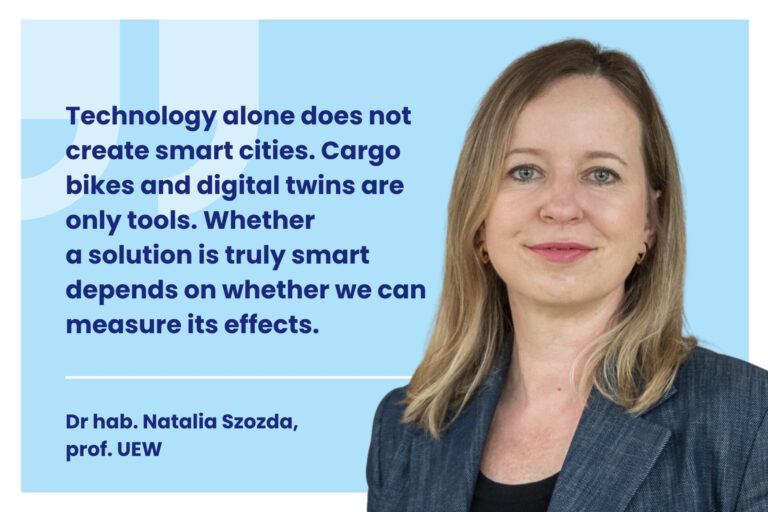
Wroclaw’s micro-hub at the Economic Forum. Natalia Szozda, Associate Professor , on when a city truly becomes smart

WUEB Experts Weekly Review. Research, Projects and Academic Successes (5–11 October 2026)
WUEB Experts Weekly Review: Research, Projects and Academic Successes (28 September–4 October 2026)
WUEB Experts Weekly Review: Research, Projects and Academic Successes (21–27 September 2026)
See also
The World Within Wrocław’s Reach. How the PROM research mobilities confirm WUEB’s place on the map of global academia
Wroclaw’s micro-hub at the Economic Forum. Natalia Szozda, Associate Professor , on when a city truly becomes smart
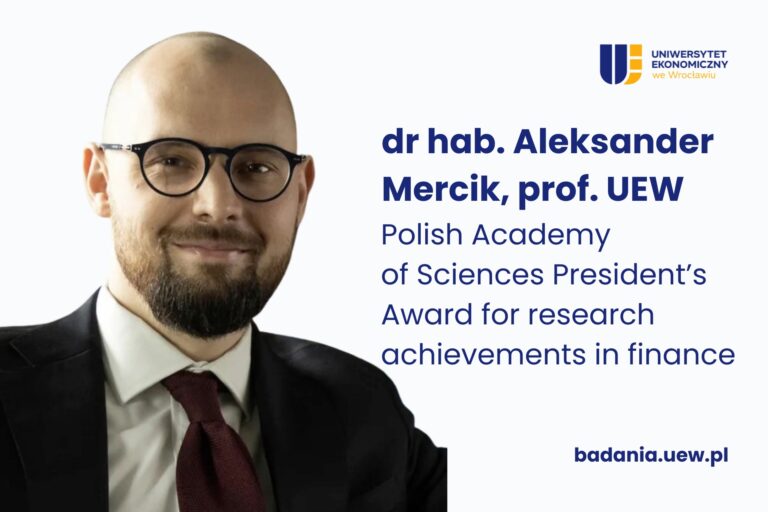
Dr hab. Aleksander Mercik, Professor of the WUEB, receives the Andrzej Gospodarowicz Award in Finance from the President of the Polish Academy of Sciences
WUEB Experts Weekly Review. Research, Projects and Academic Successes (5–11 October 2026)

Wroclaw University of Economics and Business researchers among the world’s leading scientists: six included in the 2026 World’s Top 2% Scientists database
WUEB Experts Weekly Review: Research, Projects and Academic Successes (28 September–4 October 2026)

Vitamins C and D in a single plant-based gel: UEW researcher awarded NCN grant