

A bridge unable to carry a tank can hold up military assistance just as effectively as lengthy procedures. On Radio Wrocław, dr hab. Przemysław Skulski, Professor of the WUEB, explained why European security depends both on suitable infrastructure and on countries’ ability to reach agreement.
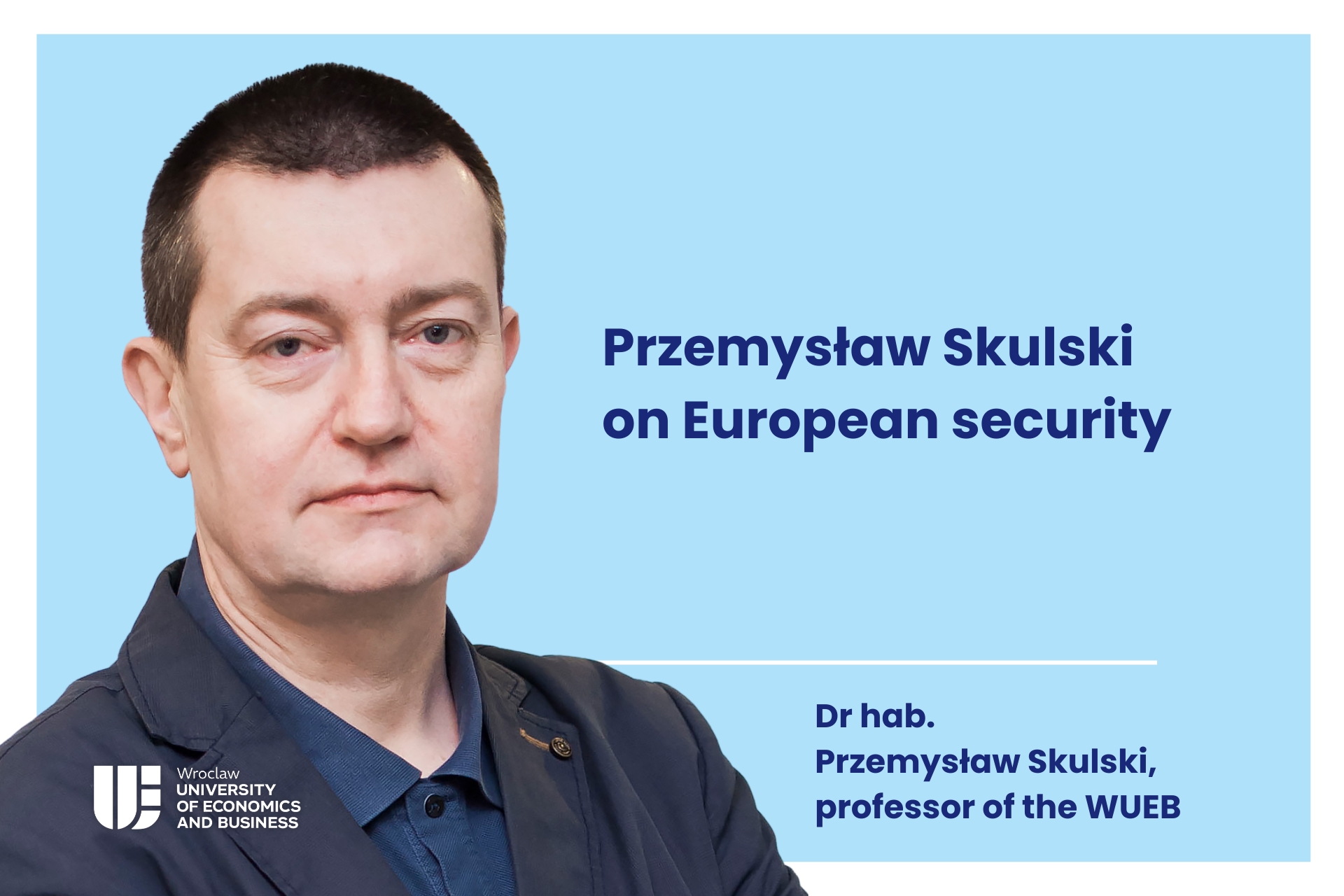
Based in the Department of Macroeconomics at Wroclaw University of Economics and Business, Skulski specialises in international economic relations and the arms and military equipment market. In the programme “Różne punkty słyszenia: Wojna bez granic i procedur. Europa zdąży przed uderzeniem?”, he examined obstacles to cooperation between allies, from competing economic interests to difficulties transporting heavy equipment.
Krzysztof Janoś hosted the discussion. The other guests were dr hab. Małgorzata Michalewska-Pawlak of the Institute of European Studies at the University of Wrocław, and Marcin Pieleszek, a lecturer at WSB Merito University in Wrocław, a Microsoft-certified systems engineer and trainer, and the author of “Bądź bezpieczny w cyfrowym świecie”.
Why countries assess the threat differently
Asked to identify the most important condition for improving Europe’s security,
Skulski replied:
“If we maintain unity, things should turn out well. And that will not be easy at all, because member states have had different perspectives and different interests before, and that has caused many problems.”
In his assessment, the Russian threat is perceived differently in Poland and northern European countries than in Spain or Portugal. Distance from the conflict and different historical experiences influence how urgently people believe action is needed. What appears self-evident from a Polish perspective may remain a distant concern for some European partners.
Economic interests compound these differences in threat perception. In Skulski’s view, some politicians hope to resume economic cooperation with Russia, potentially weakening Europe’s common position.
Military Schengen needs bridges that can carry the load
Much of the discussion concerned “military Schengen”: making it easier for troops and equipment to move between countries. Michalewska-Pawlak explained the distinction between deeper military cooperation and a common European army. Skulski focused on a practical requirement: troops need routes they can use.
He pointed to bridges whose load capacity is insufficient for some tanks, noting that these limitations exist in Poland and elsewhere in Europe. Simpler border-crossing procedures will not be enough if physical obstacles remain along the route. Investment is necessary and needs to begin well in advance.
The war in Ukraine shows the importance of moving units quickly in response to changes at the front. Skulski cautioned, however, that a future conflict could take a very different form. Preparations must also account for threats unlike those Ukraine currently faces.
Allies also need interoperability: the ability of different countries’ armed forces to operate together. Skulski referred to German Patriot systems protecting the airport near Rzeszów. He criticised political reactions questioning an ally’s contribution to security, explaining that cooperation allows partners to address gaps in equipment and personnel.
Deterrence aims to prevent war
Towards the end of the discussion, the host asked about NATO’s capacity to respond decisively to a Russian attack. Skulski cautioned against language suggesting an easy victory. Russia also has substantial capabilities, and even an outcome favourable to the alliance would not mean avoiding losses. He questioned whether European societies were prepared to bear them.
His emphasis was on preventing conflict. This is the purpose of deterrence: a potential aggressor must understand that an attack would prompt a response with severe consequences. In Skulski’s assessment, that awareness could influence Russian strategy. The ability to use force must nevertheless be considered alongside the costs of doing so.
He urged similar caution in an earlier discussion of nuclear weapons for Poland, highlighting costs, alliances and political risks when assessing ways to strengthen security.
Societal resilience also featured in Pieleszek’s comments on disinformation. A related perspective appears in Skulski’s earlier contribution covered in “Panic as a tool of war”, which discussed trust in institutions and resistance to attempts to divide society.
Listen to the full Radio Wrocław discussion, in Polish – https://www.radiowroclaw.pl/articles/view/165200/Rozne-punkty-slyszenia-Wojna-bez-granic-i-procedur-Europa-zdazy-przed-uderzeniem
Author of text: Barbara Grzelczak
See similar content

WUEB Experts Weekly Review. Research, Projects and Academic Successes (26 October–1 November 2026)
WUEB Experts Weekly Review. Research, Projects and Academic Successes (19–25 October 2026)
WUEB Experts Weekly Review. Research, Projects and Academic Successes (12–18 October 2026)
How can economic fluctuations be smoothed? The 2026 Nobel Prize in Economic Sciences through the eyes of WUEB researchers
See also
WUEB Experts Weekly Review. Research, Projects and Academic Successes (26 October–1 November 2026)
What does good social policy cost? Professor Marek Kośny reappointed to the IPiSS Scientific Council
WUEB Experts Weekly Review. Research, Projects and Academic Successes (19–25 October 2026)
Why do some regions of Europe grow faster than others? Dr hab. Paweł Dobrzański, Associate Professor at UEW, wins the PTE Award
WUEB Experts Weekly Review. Research, Projects and Academic Successes (12–18 October 2026)
How can economic fluctuations be smoothed? The 2026 Nobel Prize in Economic Sciences through the eyes of WUEB researchers
The World Within Wrocław’s Reach. How the PROM research mobilities confirm WUEB’s place on the map of global academia