

The Visual Simulation of Business Processes (WSPB) research infrastructure, submitted by Wroclaw University of Economics and Business, has been included in the Polish Roadmap for Research Infrastructures. WUEB develops this work through the Business Process Simulation Centre (CSPB), founded and headed by dr hab. Krzysztof Nowosielski, prof. of the WUEB.
WUEB on the Polish Roadmap for Research Infrastructures
The Polish Roadmap for Research Infrastructures lists facilities, laboratories and systems regarded as strategically important to the development of research in Poland. WSPB appears in the section for social sciences and humanities. The ministerial list names Wroclaw University of Economics and Business as the applicant.
The Ministry received 192 proposals. Following the formal assessment, 183 proceeded to substantive review and the 104 highest-scoring infrastructures were recommended for inclusion. Each proposal was examined by the advisory panel for the Polish Roadmap for Research Infrastructures and two external experts, one of them from outside Poland. The assessment covered the infrastructure’s distinctiveness, the applicant’s staff and institutional capacity, interest from researchers and businesses, the justification of costs and the feasibility of the undertaking.
“Inclusion of research infrastructure in the Polish Roadmap for Research Infrastructures is a recognition of its research potential”
– the Ministry of Science and Higher Education states.
After the new call and the review of earlier entries, the Roadmap contains 165 infrastructures. This figure consists of 104 new entries and 61 retained from the 2020 list.
Inclusion does not award funding. The Ministry has announced a separate assessment for undertakings that seek financial support. This will examine how well an investment has been prepared and the benefits it may bring to Polish research and the economy. The current decision confirms the assessment of WSPB’s research potential and its place on the national list.
Examining a process before a change goes live
A business process is a connected sequence of activities carried out within an organisation. It may concern production, order handling, transport, warehouse operations or cost accounting. A change in one part usually affects what happens elsewhere, making its consequences difficult to judge from a single indicator.
At CSPB, a process can be reproduced in a computer model and run as a visual 3D simulation. Researchers observe how it works, alter assumptions and compare the results of different variants. Before reorganising a warehouse, for example, a team can prepare a model, test several workstation layouts and analyse data generated by the simulation. At this stage, the business can continue operating and does not have to pay for an untested implementation.
The Centre has two areas. The first is used to design models, visualise processes and work on improvements. Its main room has one trainer station and 12 participant stations. The second area contains six virtual-reality booths. Participants can enter a prepared scenario, take a defined role and make decisions while the simulation is running.
CSPB currently provides 30 models covering production, transport and warehouse logistics, administration and retail. Some scenarios concern finance and accounting, including liquidity management, investment appraisal, resource use and cost accounting. The models are used in research, teaching and work with organisations that want to examine their own processes.
A simulation does not produce an answer on its own. Researchers must describe the process accurately, construct the model, select the data and decide what should be measured. An error at any of these stages may lead to the wrong conclusion. The technology supports the researcher, and the reliability of the result depends on their knowledge of the process under study.
Check the Business Process Simulation Centre website: https://cspb.uew.pl/
A concept developed by WUEB
Dr hab. Krzysztof Nowosielski, prof. of the WUEB works in the Department of Process Management. His expertise lies in process management and organisational improvement. He initiated the creation of CSPB and has headed the Centre from the outset.
His work examines how organisations operate, how processes can be measured and how proposed improvements can be tested. CSPB makes it possible to study these questions experimentally. Researchers can repeat the same scenario under different conditions and compare the resulting data. In management research, this helps distinguish an intuitive expectation from an effect that is actually observed in the model.
CSPB opened at the beginning of the 2020/21 academic year as an interactive computer laboratory. Process design, modelling and visual simulation were brought together in one facility for researchers and students. Each participant can work on the same scenario, while the person running the exercise defines its conditions. The Centre was also prepared to carry out projects for WUEB’s business community.
The Centre also works with businesses. An organisation may examine task completion times, resource use, costs or points at which a process slows down. Simulation results provide evidence for a decision. Their interpretation depends on knowledge of the organisation, the quality of its data and the limits of the model.
The ministerial list names WUEB as the applicant for WSPB. For the CSPB team headed by dr hab. Krzysztof Nowosielski, prof. of the WUEB, this places a concept developed at the University among the 165 infrastructures on the updated Roadmap.
Author: Barbara Grzelczak
See similar content
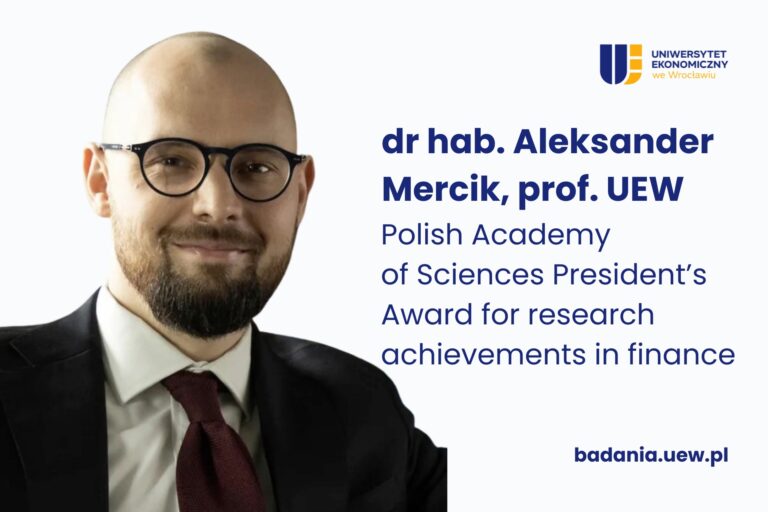
Dr hab. Aleksander Mercik, Professor of the WUEB, receives the Andrzej Gospodarowicz Award in Finance from the President of the Polish Academy of Sciences
Wroclaw University of Economics and Business researchers among the world’s leading scientists: six included in the 2026 World’s Top 2% Scientists database
Vitamins C and D in a single plant-based gel: UEW researcher awarded NCN grant
Joanna Radomska of WUEB awarded the title of professor
See also
How can economic fluctuations be smoothed? The 2026 Nobel Prize in Economic Sciences through the eyes of WUEB researchers
The World Within Wrocław’s Reach. How the PROM research mobilities confirm WUEB’s place on the map of global academia
Wroclaw’s micro-hub at the Economic Forum. Natalia Szozda, Associate Professor, on when a city truly becomes smart
Dr hab. Aleksander Mercik, Professor of the WUEB, receives the Andrzej Gospodarowicz Award in Finance from the President of the Polish Academy of Sciences

WUEB Experts Weekly Review. Research, Projects and Academic Successes (5–11 October 2026)
Wroclaw University of Economics and Business researchers among the world’s leading scientists: six included in the 2026 World’s Top 2% Scientists database
WUEB Experts Weekly Review: Research, Projects and Academic Successes (28 September–4 October 2026)