


Ensuring adequate hospital nutrition, a critical component of patient care, has for many years presented a significant systemic challenge in Poland. Meals served in hospitals were frequently of poor quality, failing to meet established norms and dietary recommendations. In response to longstanding systemic deficiencies, the Ministry of Health launched a nationwide pilot programme, “Good Meal in Hospital” (Dobry Posiłek w Szpitalu), on 25 September 2023. The programme included organisational requirements: hospitals were obliged to employ a dietitian for a minimum of half a full-time equivalent and to ensure full transparency of the nutritional process. Funding was structured as an additional rate of PLN 25.62 per patient per day, paid on top of existing nutrition financing.
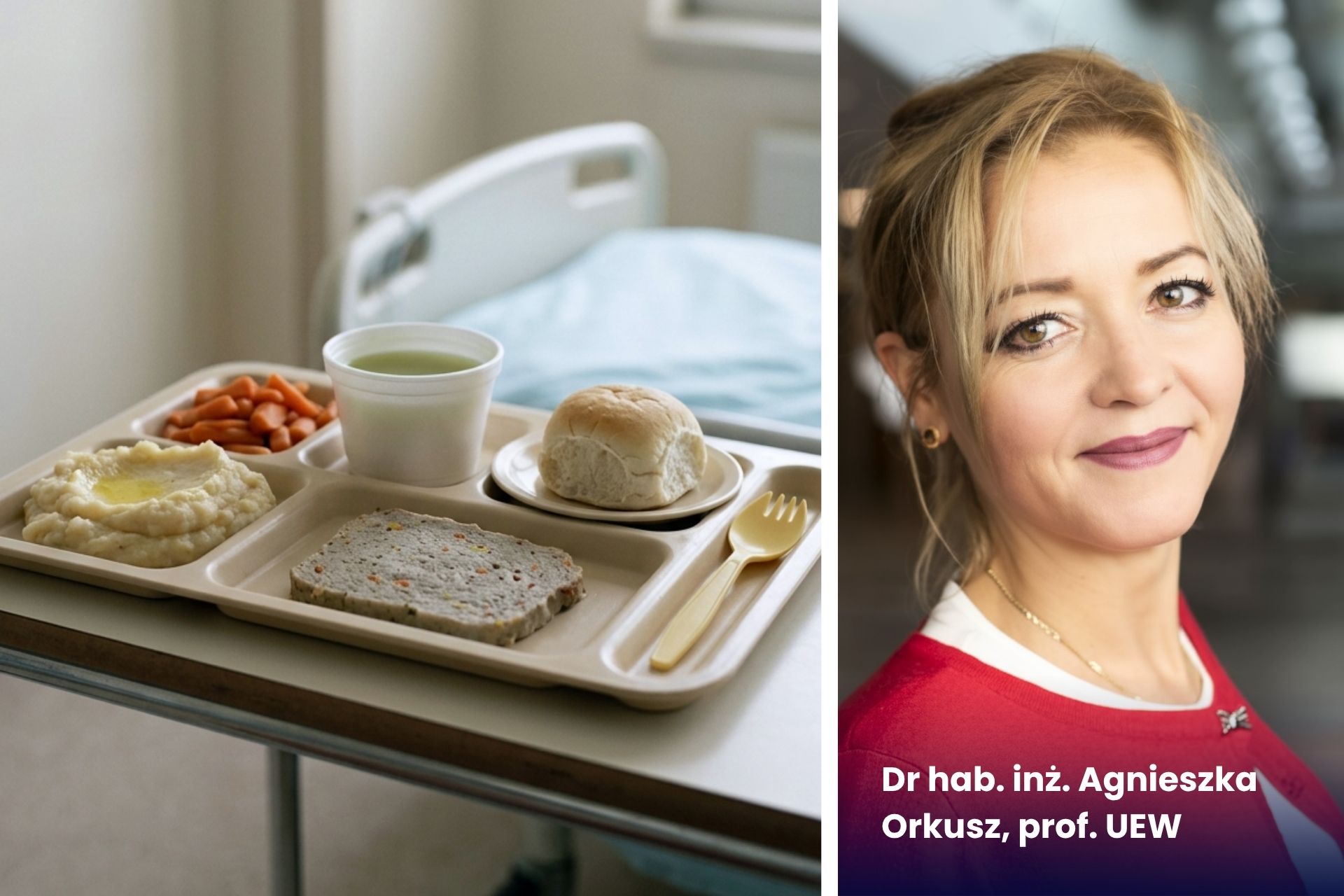
Researchers from Wrocław assessed the compliance of standard hospital diets with the programme’s specifications, which had been developed on behalf of the Ministry. Their findings, published in Nutrients in March 2026, are concerning: not one of the ten analysed institutions simultaneously met all of the programme’s requirements.
Hospital nutrition as a systemic problem
Adequate patient nutrition is not an ancillary element of treatment; it is one of the conditions for its effectiveness. The quality of hospital meals affects patients’ nutritional status, the course of recovery, the risk of complications, and the length of hospitalisation. Despite this, hospital nutrition in Poland remained an insufficiently regulated and inadequately supervised domain for many years.
The scale of the problem was documented in a 2018 report by the Supreme Audit Office (Najwyższa Izba Kontroli), which found that in many hospitals meals were not adapted to patients’ health conditions, were prepared from low-quality ingredients, and had inappropriate nutritional value. The audit identified both deficits in specific nutrients and excessive salt content, which in some institutions reached between 142% and 374% of the recommended norm. The combination of low per-patient catering rates, the absence of detailed legal standards, and no statutory obligation to employ a dietitian confirmed that the problem was systemic rather than isolated.
The programme designed to change this
A significant attempt at systemic improvement was the “Good Meal in Hospital” pilot programme, launched in September 2023. It covered 582 healthcare institutions and introduced both financial support and specific organisational and informational requirements. Participating hospitals received an additional PLN 25.62 per patient per day, were required to publish menus together with information on energy and nutritional value, preparation methods, and allergen content, and were obliged to involve a dietitian in the organisation of nutrition. The programme aimed not only to raise the standard of hospital meals but also to increase transparency and create conditions for ongoing assessment of patient nutrition quality.
Within this context, Agnieszka Orkusz, Ph.D., D.Sc., Associate Professor at the Department of Biotechnology and Food Analysis, Wrocław University of Economics and Business, and Martyna Orkusz, MSc from the Faculty of Biotechnology and Food Sciences, Wrocław University of Environmental and Life Sciences, undertook research into the degree to which the programme’s assumptions were being implemented in practice. The starting point was the question of whether the standard diet menus declared by hospitals genuinely corresponded to the requirements set out in the programme. The study analysed 100 ten-day menus from 10 hospitals representing different regions of Poland, published in November 2025. This research forms part of a broader programme of analysis conducted at Wrocław University of Economics and Business into the quality of collective catering in Poland.
No institution passed both assessments simultaneously
The overall result is unambiguous: none of the analysed hospitals simultaneously met all the quantitative and qualitative criteria of the programme. All institutions achieved compliance in protein and carbohydrate intake, but the most frequent non-conformities concerned excessive content of fat, saturated fatty acids, and salt. In three hospitals, the energy value of the menu exceeded the upper limit of 2,400 kcal per day. In six hospitals, salt content exceeded the recommended 5 g per day. In one of the analysed cases, the mean daily salt content was 12.83 g, equivalent to 256.6% of the recommended value. It should be emphasised that excessive salt intake is a well-documented risk factor for arterial hypertension and cardiovascular complications, which is of particular significance in hospitalised patients who frequently present with concurrent chronic conditions.
The institution with the highest salt content also recorded the highest level of saturated fatty acids across all analysed hospitals: 38.13 g per day, against a recommended limit of 22 to 26.4 g per 2,000–2,400 kcal. A diet high in saturated fatty acids is associated with increased risk of coronary heart disease and certain malignancies, including colorectal and breast cancer.
Fish and legumes: recommended but rarely present
One of the qualitative criteria of the “Good Meal in Hospital” programme was the inclusion of fish and legume seeds at least three times within a ten-day period. Analysis of the menus revealed, however, that this requirement was frequently unmet. Insufficient frequency of legume inclusion was identified in 7 of the 10 hospitals studied; insufficient frequency of fish inclusion was found in 6 of the 10 institutions. These results indicate that one of the most persistent implementation challenges concerned the regular incorporation into menus of products with high nutritional value, foods of particular importance from the perspective of a health-promoting dietary model. The analysis also showed that both fish and legumes appeared in menus in a variety of forms. Fish dishes included, among others, breaded fillets, fish meatballs, fish with vegetables in aspic, tuna and salmon pastes, fish salads, fish in Greek-style sauce, and herrings in tomato sauce. Legumes appeared primarily in the form of soups, pastes, and pâtés, as well as dishes such as beans in tomato sauce (fasolka po bretońsku).
High formal compliance does not indicate a well-balanced menu
One of the study’s most significant conclusions concerns the divergence between the structural assessment of menus and their actual nutritional value. As the authors note, meeting the formal requirements pertaining to menu structure, such as the prescribed frequency of certain food groups, does not in itself guarantee adequate energy and nutrient intake. In one of the analysed hospitals, the menu scored 8 out of 10 points in the qualitative assessment while simultaneously recording the lowest compliance with quantitative criteria across all institutions studied: only 5 of 12 nutritional parameters were met. These results demonstrate that only a combined assessment of both dimensions makes it possible to determine whether implementation of the programme was substantive rather than merely formal.
What the new regulations change and what they leave unresolved
The pilot programme concluded on 31 December 2025, and from 1 January 2026 hospital nutrition became subject to nationally binding organisational standards. This means that the requirements governing patient nutrition ceased to be pilot provisions and were incorporated into the system of guaranteed healthcare benefits. At the same time, nutrition financing no longer operates as a separate mechanism; it has been absorbed into the general pricing of medical services. The authors note that in institutions with weaker financial positions, this may generate competition between nutrition expenditure and other treatment costs. The study’s findings therefore indicate that regulatory changes alone may be insufficient to deliver lasting improvement in meal quality unless accompanied by effective mechanisms for monitoring and enforcing standards.
Recommendations: what needs to change in the healthcare system
The authors emphasise that an effective assessment of hospital nutrition should encompass not only compliance with organisational requirements, but also the actual energy and nutritional value of menus. This points to the need for an integrated monitoring system combining structural menu assessment with nutritional quality analysis.
The study also identifies the need to establish stronger links between nutritional standards and financing mechanisms, and to introduce training and audit programmes for staff responsible for meal planning. As the authors underline, a hospital can play an important role in shaping patients’ health-promoting behaviours, but only if the meals it provides genuinely reflect current nutritional recommendations.
Source: Agnieszka Orkusz, Martyna Orkusz, Policy vs. Practice: Nutritional Quality and Menu Structure in Polish Hospitals During the Good Meal in Hospital Pilot Program, Nutrients 2026, 18, 1034. https://doi.org/10.3390/nu18071034
Authors: Agnieszka Orkusz, Justyna Morawska-Płoskonka
See similar content

Video games are more than entertainment. WUEB researchers on cooperation between game developers and the cultural and creative industries

Space Logistics, Interplanetary Supply Chains and Interdisciplinary Research and Educational Projects Related to Space at UEW in Jelenia Góra

Wrocław has FinTech potential. A WUEB expert argues it is time to turn that potential into advantage
Academic Entrepreneurship as Architecture of Impact. The New Issue of „Impakt Dolny Śląsk” (2/2025)
See also

How can economic fluctuations be smoothed? The 2026 Nobel Prize in Economic Sciences through the eyes of WUEB researchers

The World Within Wrocław’s Reach. How the PROM research mobilities confirm WUEB’s place on the map of global academia
Wroclaw’s micro-hub at the Economic Forum. Natalia Szozda, Associate Professor, on when a city truly becomes smart

Dr hab. Aleksander Mercik, Professor of the WUEB, receives the Andrzej Gospodarowicz Award in Finance from the President of the Polish Academy of Sciences

WUEB Experts Weekly Review. Research, Projects and Academic Successes (5–11 October 2026)

Wroclaw University of Economics and Business researchers among the world’s leading scientists: six included in the 2026 World’s Top 2% Scientists database
WUEB Experts Weekly Review: Research, Projects and Academic Successes (28 September–4 October 2026)