

In line with the Wrocław University of Economics and Business Strategy 2030 „Inspiring Development”, the contemporary university does not remain a mere commentator on economic processes but becomes their active co-creator. In this vision, academic entrepreneurship is not „a third mission on the side” but a logic that integrates research, teaching, and engagement with the environment into a single system, which Assoc. Prof. Piotr Bednarek, Vice-Rector for Finance, terms the architecture of impact.
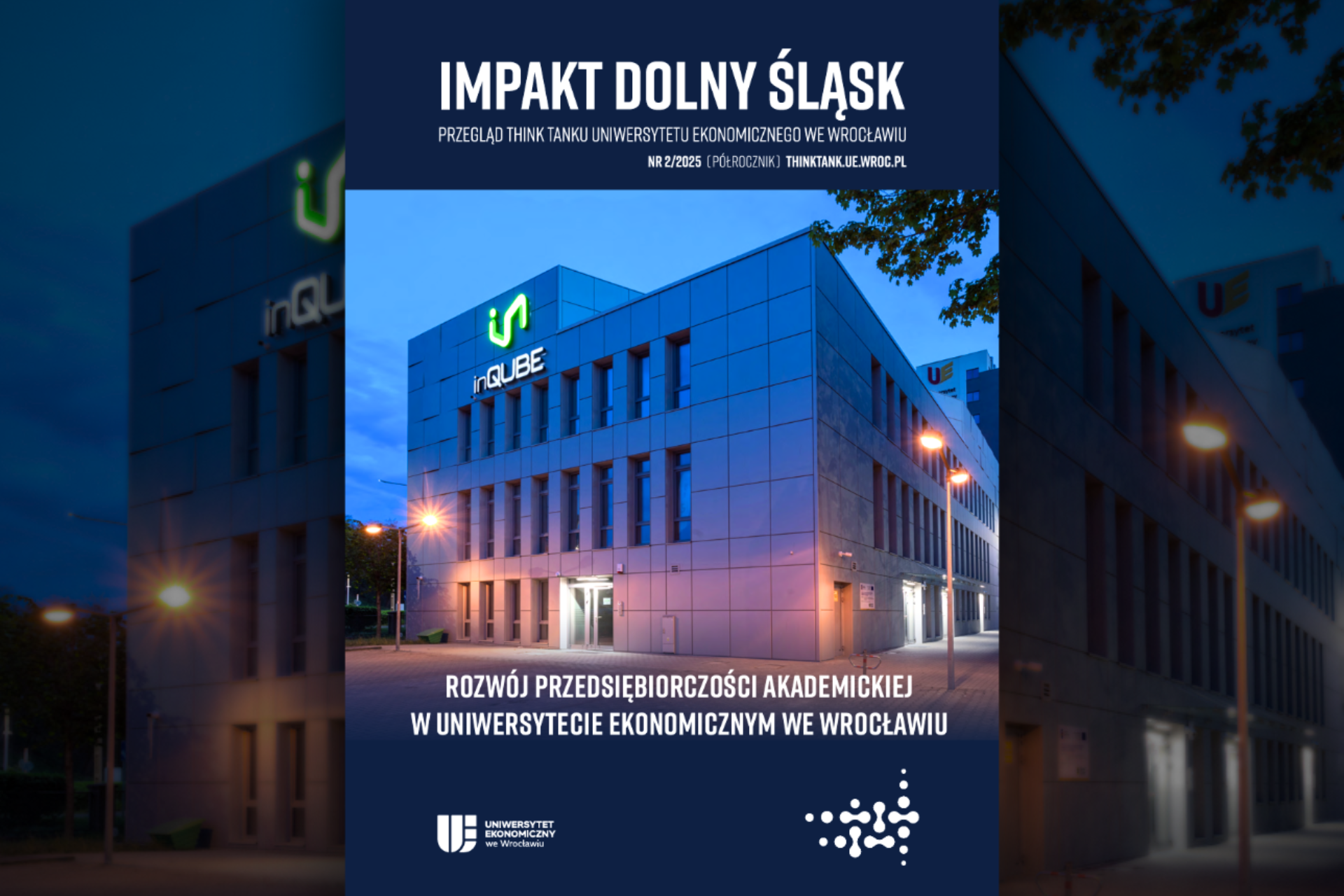
The new issue of „Impakt Dolny Śląsk” (2/2025), the biannual journal of the WUEB Think Tank, documents how this architecture works in practice: from knowledge transfer mechanisms, through social inclusion programmes, to European quality standards in healthcare.
Innovation ecosystem: three pillars
The foundation of WUEB’s activities is the professionalisation of structures supporting academic entrepreneurship, built on three cooperating units.
inQUBE – the University Business Incubator, which has evolved from infrastructure modernisation (Start-up House of over 1,200 m²) into a mature ecosystem managing the risks and opportunities of new ventures. The incubator brings together a community of over two thousand people and runs acceleration programmes, including inQUBE Academy (a three-month incubation programme) and FinTech Academy (a programme for future leaders in financial technology).
The Centre for Knowledge Transfer, Innovation and Commercialisation (CTWiK), responsible for intellectual property management and the commercialisation of research results, including the creation of spin-off companies.
The Centre for Business Cooperation (CWB), connecting the University with companies, financial institutions, local government bodies, and non-governmental organisations.
Together, they form an „idea-to-scale” model, which Assoc. Prof. Bartłomiej Nita, author of the analysis dedicated to inQUBE, describes as a paradigm of university transformation grounded in the triple and quadruple helix concept.
Expert competences in practice
The issue documents three projects showing how this model translates into concrete results.
The Hossa ProCapital Student Fund – the first project in Poland in which students manage real investment capital under academic supervision. The Fund operates within the Hossa ProCapital Capital Markets Scientific Circle, which has been running educational activities continuously for 29 years. The initiative, described by Assoc. Prof. Marek Pauka, Assoc. Prof. Krzysztof Piontek, and Bartosz Kocjan, is supported by the Central Securities Depository of Poland (KDPW), the Warsaw Stock Exchange (GPW), BETA ETF, and Trade Republic.
European Quality Framework for Comprehensive Cancer Centres (EUnetCCC) – WUEB leads two work packages (5.1 and 6.1) in the largest European project to date in medical facility management, with a budget of EUR 112 million and 163 partners from 31 countries. The team led by Assoc. Prof. Witold Szumowski (with Prof. Katarzyna Piórkowska, Prof. Arkadiusz Wierzbic, Dr Michał Organa, and Krystian Olek, MA) is developing an organisational maturity model for Comprehensive Cancer Centres and a certification scheme aligned with Europe’s Beating Cancer Plan.
Freshpod – the first nano-shop network in Poland, founded by Assoc. Prof. Grzegorz Krzos, Head of the Department of Management and Entrepreneurship. The network was launched on the WUEB campus with EU funding and today operates in over 20 locations across Wroclaw, serving more than 7,000 customers. It uses artificial intelligence algorithms to optimise sales, forecast demand, and reduce product waste.
Polycentric impact and social responsibility
The issue also documents the regional and social dimensions of academic entrepreneurship at WUEB.
The WUEB Branch in Jelenia Góra, led since 2025 by Dean Assoc. Prof. Urszula Markowska-Przybyła, runs programmes that shape leadership attitudes and counter regional marginalisation, including „Career Without Borders”, „Leaders’ University”, and the Virtual Student Consulting Firm. The Branch was awarded the title of Fair Trade University as the second institution of higher education in Poland and the first in Lower Silesia (7 March 2024).
Inclusion through competences – in May and June 2025, WUEB delivered a 96-hour e-marketing training course for 10 women with the experience of forced migration from Ukraine. The project was implemented within the „Integration in Poland” programme (FEDS.07.06-IP.02-0035/24), co-financed by the European Social Fund Plus. The lead trainer was Krystian Olek, MA, from the Department of Management and Entrepreneurship.
Invitation to read
Issue 2/2025 also features an analysis of start-up financing in Poland (Marcin Majewski), a discussion of university transformation models (Assoc. Prof. Bartłomiej Nita), case studies on science–business cooperation at the Department of Management and Entrepreneurship, and a presentation of the BORDO.SPACE platform for the creative industries, developed under the supervision of Dr Iwona Czerska from the Department of Marketing Research.
The material documents the transition from a traditional academic model to an impact-oriented university creating measurable economic, social, and environmental value. It serves as a substantive point of departure for anyone seeking genuine fields of cooperation between science and business in Lower Silesia.
The full issue is available at thinktank.ue.wroc.pl.
Author of text: Justyna Morawska-Płoskonka
See also

Video games are more than entertainment. WUEB researchers on cooperation between game developers and the cultural and creative industries

Space Logistics, Interplanetary Supply Chains and Interdisciplinary Research and Educational Projects Related to Space at UEW in Jelenia Góra
Wrocław has FinTech potential. A WUEB expert argues it is time to turn that potential into advantage
Hospital Nutrition Reform in Poland: Between Policy and Practice
See similar content
How can economic fluctuations be smoothed? The 2026 Nobel Prize in Economic Sciences through the eyes of WUEB researchers
The World Within Wrocław’s Reach. How the PROM research mobilities confirm WUEB’s place on the map of global academia
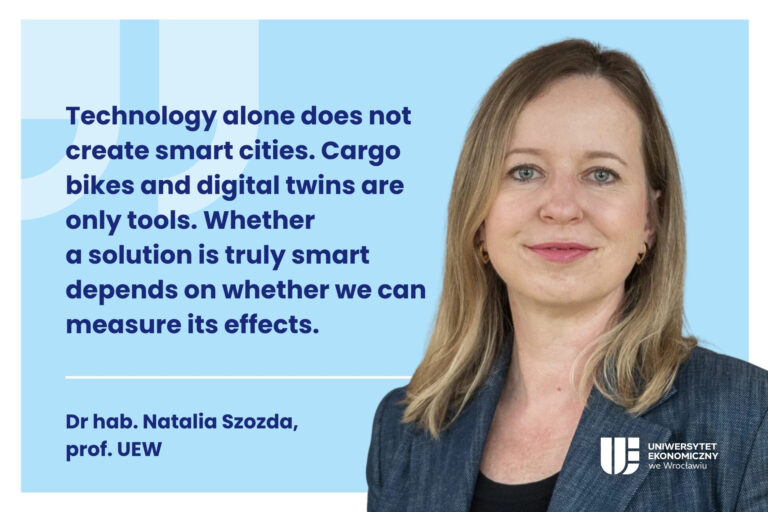
Wroclaw’s micro-hub at the Economic Forum. Natalia Szozda, Associate Professor, on when a city truly becomes smart
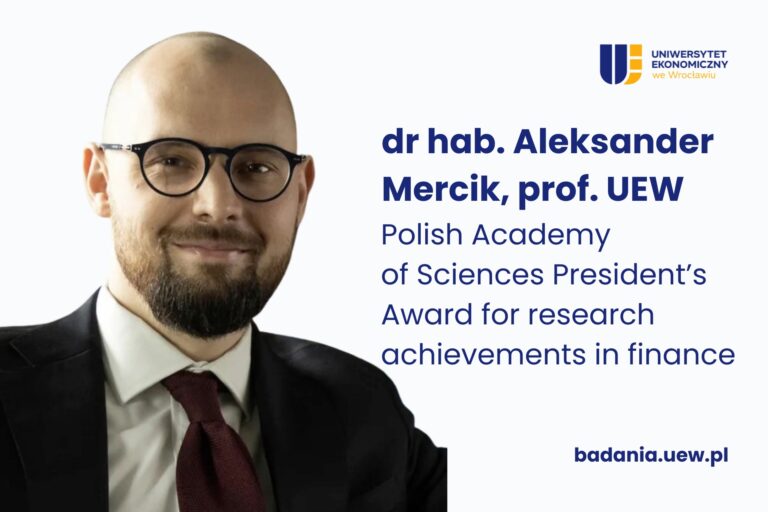
Dr hab. Aleksander Mercik, Professor of the WUEB, receives the Andrzej Gospodarowicz Award in Finance from the President of the Polish Academy of Sciences

WUEB Experts Weekly Review. Research, Projects and Academic Successes (5–11 October 2026)
Wroclaw University of Economics and Business researchers among the world’s leading scientists: six included in the 2026 World’s Top 2% Scientists database
WUEB Experts Weekly Review: Research, Projects and Academic Successes (28 September–4 October 2026)