


Space used to be reserved for state agencies and grand narratives about conquering the Universe. Today it is turning into critical infrastructure for the global economy – powering communication, finance and logistics.
The same technological success, however, may turn against us within a single generation if low Earth orbit starts to resemble a cosmic landfill rather than an enabler of development.
Author: mgr Julia Majewska
Wroclaw University of Economics and Business, expert in the field of space economy and space policy
1. From myth to infrastructure: how space became an economic domain
Since the dawn of civilisation, space has fascinated humanity as a symbol of infinity and mystery. Only in the second half of the twentieth century did we manage to cross the boundary of our own planet, becoming not only observers but active participants in the exploration of outer space. The modern space era began with the launch of the first artificial satellite. From the perspective of cosmic time, it was just a blink of an eye in which we achieved what had long seemed impossible: the ability to leave our home planet. Yet this technological triumph may hide a trap that could become one of our biggest challenges.
In just a few decades, our view of space has shifted. From a metaphor of infinity it has become a very concrete economic domain in which the stakes are data, connectivity and the resilience of systems on which contemporary societies depend every day.
2. New Space Economy: when private companies take over the orbits
Contemporary exploration and use of space fits into the paradigm of the New Space Economy – a new space economy that followed the era dominated by public actors, especially national space agencies. That earlier period, often described as the Old Space Economy, coincided with the Cold War, when the race for primacy in space was not only a technological competition but also a symbol of political supremacy.
Today we are witnessing a radical transformation. The space sector is becoming an arena for dynamic private companies which, thanks to lower entry barriers, are placing megaconstellations of satellites into orbit and reshaping the global economy.
In 2023 alone, private investments in the global space sector reached 6 billion euro. In the same year, private investments in European space start-ups amounted to 942 million euro. These numbers show that we are not dealing with a technological curiosity but with a fully-fledged branch of the economy.
For many industries, space is no longer an exotic direction but an additional layer of infrastructure – alongside energy grids, transport systems and digital networks. In the next 5–10 years, the stability and security of orbital infrastructure will matter more for the success of the New Space Economy than spectacular crewed missions to distant planets.
3. A crowded orbit: space debris as the price of growth
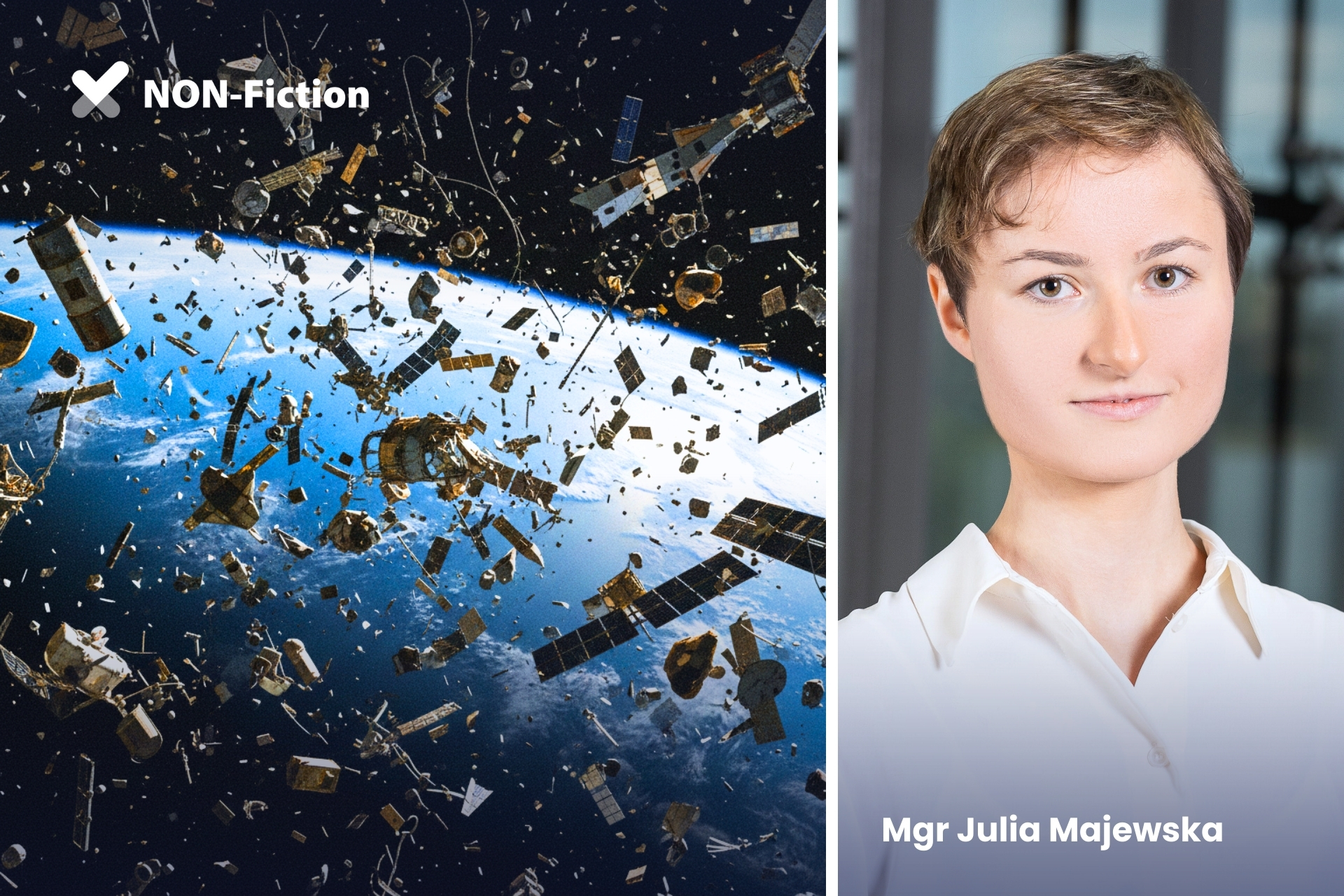
These impressive figures come at a price. Low Earth orbit (LEO) is increasingly crowded with satellites, remnants of previous missions and fragments of debris. Every new object is a potential source of further fragments if a failure or collision occurs.
As a result, the so‑called orbital capacity – the number of safe “slots” that can be used without excessive collision risk – is shrinking. What may look like acceptable risk at the level of a single mission becomes, at system level, a growing threat to all space users.
In economic terms, we are facing a classic problem of externalities: the benefits of new satellites are private, while the long-term costs of an increasingly cluttered orbit are borne by all current and future users of space.
4. The Kessler Syndrome: when our debris cuts us off from space
This dynamic is often captured by a scenario known as the Kessler Syndrome. It describes a situation in which a single major collision generates a cloud of fragments that then hit other objects, triggering a chain reaction.
In an extreme case this could make the use of certain orbits too risky or practically impossible for decades. The consequences would be felt far beyond the space sector: disruptions to navigation, communications and Earth observation would affect finance, transport, precision agriculture and crisis management.
Paradoxically, the more intensively we develop technologies that allow us to leave Earth, the greater the risk that we will build a dense, dangerous barrier of debris above our heads.
5. What next for the space economy? Between vision and wastefulness
Against this backdrop a fundamental question arises: does our ability to leave Earth not, paradoxically, lead to our confinement? Could the infrastructure we are rapidly building above our heads become an obstacle for the next generations of researchers and entrepreneurs?
We therefore need to ask whether visionary exploration is turning into wastefulness that could block future space activity. The answer will determine whether space remains a promise of development and cooperation, or becomes a warning about the consequences of uncontrolled growth – this time not on Earth but in orbit.
In the coming years, it will be crucial to develop rules for responsible use of space: from de‑orbiting standards for retired satellites and active debris removal technologies to new regulatory frameworks at the international level. This is an area where economics, law and space policy meet very directly – and where today’s decisions will shape whether the New Space Economy becomes a durable pillar of development or just a short-lived episode.
Author: Julia Majewska
See similar content

Women raise productivity and innovation in the economy. Yet female managers still earn one-fifth less

Computer and video games: economy, technology, society. Prof. Patrycja Klimas comments

Donald Trump’s presidency, the EU Omnibus package and the climate emergency – how politics shapes the future of ESG

Why doesn’t Poland have its own Spotify? The middle‑income trap and a strategy for the future
See also
How can economic fluctuations be smoothed? The 2026 Nobel Prize in Economic Sciences through the eyes of WUEB researchers
The World Within Wrocław’s Reach. How the PROM research mobilities confirm WUEB’s place on the map of global academia
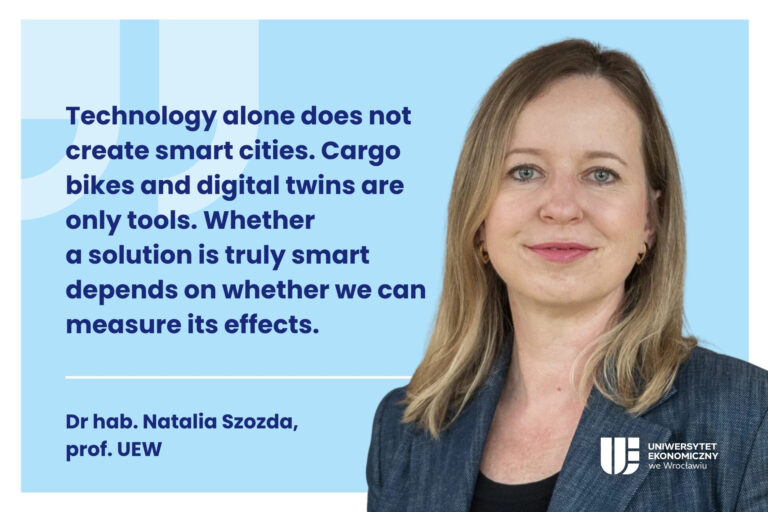
Wroclaw’s micro-hub at the Economic Forum. Natalia Szozda, Associate Professor, on when a city truly becomes smart

Dr hab. Aleksander Mercik, Professor of the WUEB, receives the Andrzej Gospodarowicz Award in Finance from the President of the Polish Academy of Sciences

WUEB Experts Weekly Review. Research, Projects and Academic Successes (5–11 October 2026)

Wroclaw University of Economics and Business researchers among the world’s leading scientists: six included in the 2026 World’s Top 2% Scientists database
WUEB Experts Weekly Review: Research, Projects and Academic Successes (28 September–4 October 2026)