

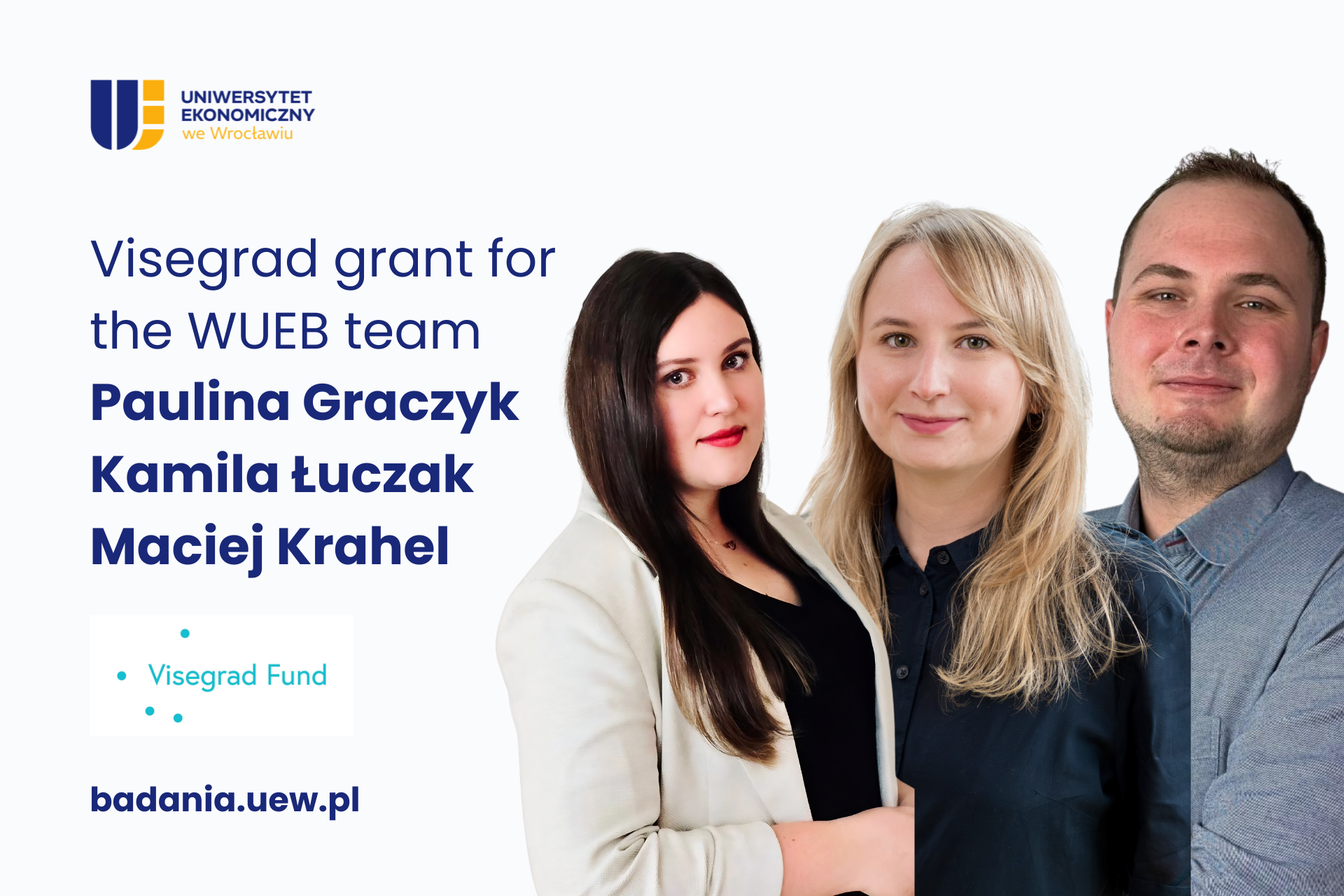
The project is being delivered by an interdisciplinary WUEB team. Mgr Paulina Graczyk coordinates partner cooperation and the integration of findings from the four workshops. Mgr Kamila Łuczak is responsible for the Design Thinking methodology, while mgr Maciej Krahel contributes experience in business cooperation and process facilitation. All three are research and teaching assistants at WUEB and are either undertaking or have completed doctoral training at the WUEB Doctoral School; together, they will examine the gap between the skills developed during higher education and those organisations expect across the V4 countries.
Tertiary education improves employment prospects, but a degree does not in itself mean that a graduate has the skills required for a particular job. Two OECD reports – Education at a Glance 2025 and the OECD Skills Outlook 2025 – show that rising educational attainment does not always translate into stronger skills. Problem-solving, cooperation, communication and the ability to work independently are becoming particularly important.
This is the issue at the centre of ‘Bridging V4 Universities and Business through Design Thinking’, led by Wroclaw University of Economics and Business. The partners are Comenius University Bratislava, Palacký University Olomouc and Edutus University. The project has received EUR 29,250 from the International Visegrad Fund and will run from 1 October 2026 to 1 December 2027.
The team will examine where the gap arises between the skills developed during higher education and those organisations expect from future employees. The researchers will also identify which needs are shared across the Visegrad countries and which reflect a particular national or sectoral context.
The evidence will be collected during four Design Thinking workshops. Students from across the V4 will work in international teams on real challenges submitted by companies and institutions. They will explore user needs, define the problem, develop ideas and produce a prototype response.
Students will assess their skills before and after each workshop. Facilitators will observe the teams and record the skills required to complete the task, while representatives of the participating organisations will assess the proposed responses and provide feedback. A common workshop framework across all four countries will make the findings comparable.
Detailed information about the participating organisations and challenges will be published on the dedicated project website.
Design Thinking: from problem to prototype
Design Thinking structures the process of developing a response: from understanding the needs of a customer, employee or service recipient, through defining the right problem and generating ideas, to building and testing a prototype. Stanford d.school describes five connected modes: empathise, define, ideate, prototype and test. The process is not rigid; feedback may lead a team to revise its assumptions or improve the prototype.
The method has two functions in this project. Students will use it to respond to an organisational challenge, while the researchers will observe which skills are required at different stages: from understanding the problem and working in an international team to presenting a testable response.
The workshops will take place in four cities, with places available to bachelor’s, master’s and doctoral students.
Outcome: a toolkit for universities and employers
After each workshop, the partners will describe the skills expected in the relevant country and sector, then discuss the findings with the organisation that set the challenge. Comparing the four cases will allow the team to identify shared V4 needs as well as national and sector-specific differences.
This work will inform the open-access ‘V4 University-Business Design Thinking Toolkit’. It will include a workshop scenario, methodological guidance, Design Thinking exercises, skills assessment criteria, student self-assessment and employer feedback forms, facilitator observation sheets, case studies and recommendations for adapting the model to different organisations.
The resource is intended to help universities, careers services and employers run similar activities based on real tasks. The findings and toolkit will be presented at the open ‘V4 Design Thinking Bridge’ webinar and made available in open access.
What does the Visegrad grant fund?
The International Visegrad Fund supports cooperation among institutions in Czechia, Hungary, Poland and Slovakia. Visegrad Grants are available to projects involving organisations from at least three V4 countries. Projects may run for up to 18 months, while funding can cover up to 100 per cent of eligible costs. Typical grants range from EUR 25,000 to EUR 35,000.
The EUR 29,250 award will fund the four workshops, student and expert participation from across the V4, and the preparation of the joint toolkit. The project title and award are listed in the official Visegrad Grants call results.
An interdisciplinary WUEB team
All three are research and teaching assistants at WUEB and are either undertaking or have completed doctoral training at the WUEB Doctoral School:
Mgr Paulina Graczyk from the Department of Sociology and Social Policy coordinates the project. She is responsible for cooperation among the partners, the timetable and bringing together the findings from all four workshops. Her experience includes NAWA, Erasmus+ and Visegrad-funded initiatives. Her research and teaching activities cover sustainable development, intercultural education, and social and international cooperation.
Mgr Kamila Łuczak from the Department of Business Intelligence in Management is responsible for the Design Thinking methodology and preparation of the Wroclaw workshop. Her areas of expertise include user experience, Design Thinking, creative problem-solving, artificial intelligence, information and communication technologies, and process modelling.
Mgr Maciej Krahel from the Department of Economics and Business Organization brings expertise in business cooperation, process management and project management. His work explores the integration of Lean Management and Green Management in manufacturing companies and sustainable development. He will facilitate the workshop in Poland and then help prepare the Polish section of the toolkit.
„For us as early-career researchers, this is a strong incentive to develop further, take on new research challenges and represent our university.”
– the WUEB team members emphasise”
The team’s task is therefore not simply to deliver four workshops. It will translate observations of student work and feedback from the organisations into a comparative account of skills gaps and a cooperation model that universities and employers can continue to use after the funding period.
Follow the project and the work of WUEB experts on https://badania.uew.pl/en/scientific-projects/
Author: Barbara Grzelczak
See similar content
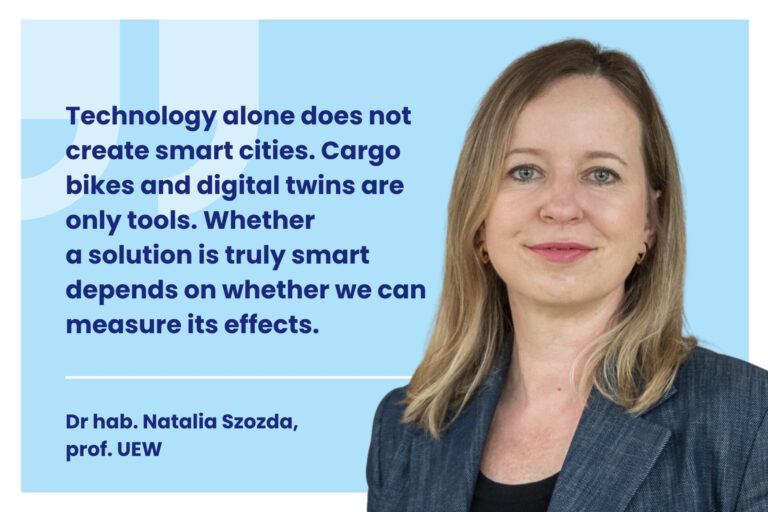
Wroclaw’s micro-hub at the Economic Forum. Natalia Szozda, Associate Professor , on when a city truly becomes smart

WUEB Experts Weekly Review. Research, Projects and Academic Successes (5–11 October 2026)
WUEB Experts Weekly Review: Research, Projects and Academic Successes (28 September–4 October 2026)
WUEB Experts Weekly Review: Research, Projects and Academic Successes (21–27 September 2026)
See also
The World Within Wrocław’s Reach. How the PROM research mobilities confirm WUEB’s place on the map of global academia
Wroclaw’s micro-hub at the Economic Forum. Natalia Szozda, Associate Professor , on when a city truly becomes smart
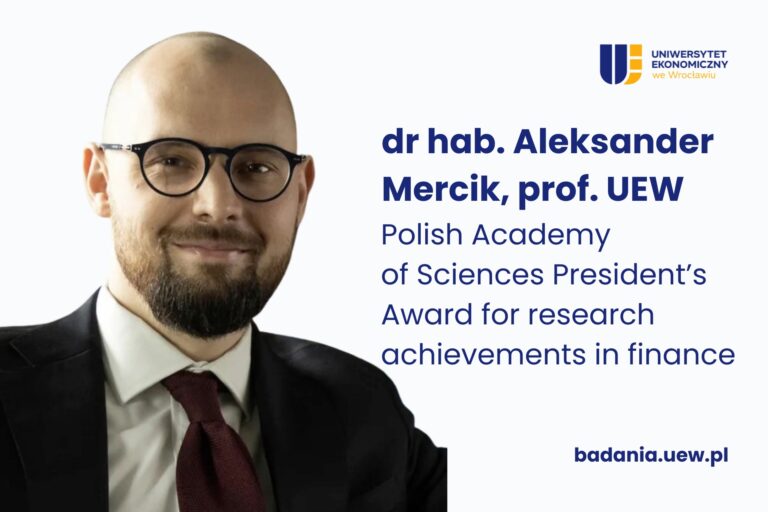
Dr hab. Aleksander Mercik, Professor of the WUEB, receives the Andrzej Gospodarowicz Award in Finance from the President of the Polish Academy of Sciences
WUEB Experts Weekly Review. Research, Projects and Academic Successes (5–11 October 2026)
Wroclaw University of Economics and Business researchers among the world’s leading scientists: six included in the 2026 World’s Top 2% Scientists database
WUEB Experts Weekly Review: Research, Projects and Academic Successes (28 September–4 October 2026)
Vitamins C and D in a single plant-based gel: UEW researcher awarded NCN grant