

Poland’s economy has experienced three decades of strong growth, yet it is now increasingly operating in conditions of uncertainty. Professor Krzysztof Jajuga shows that the response to external shocks, demographic pressure, higher energy costs and tensions in public finance should be resilience built in advance.
A strong economy needs resilience
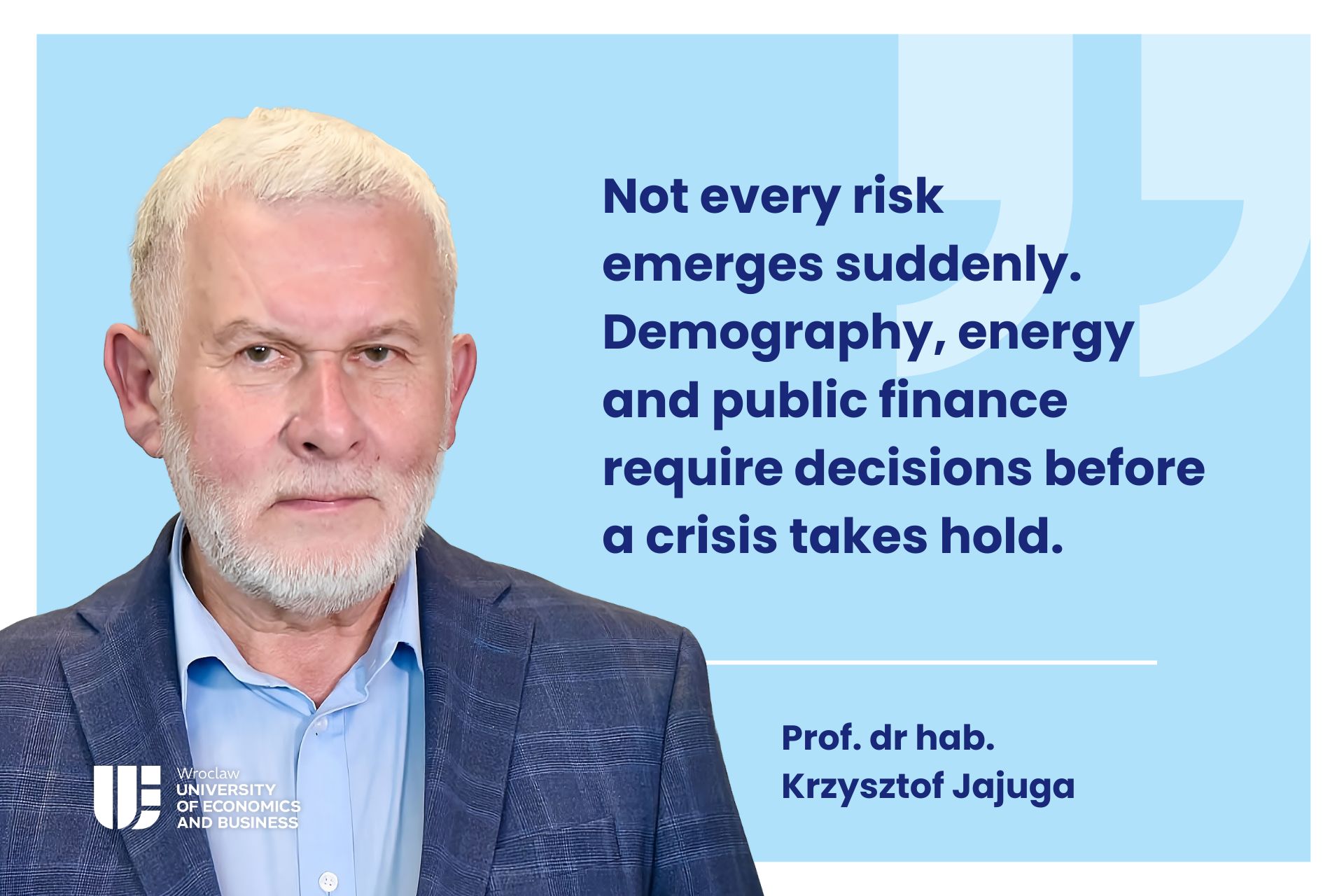
Professor Krzysztof Jajuga, Head of the Department of Financial Investments and Risk Management at Wroclaw University of Economics and Business, spoke to Paweł Jabłoński for BANK Financial Monthly. In the interview, he addresses one of the key challenges facing the contemporary economy: how to develop in a world where risk increasingly comes from outside, appears suddenly, generates high costs and is difficult to predict.
The issue is no longer limited to exchange rates, the stock market, inflation or interest rates. Today, the catalogue of real economic threats also includes cyberattacks, pandemics, war, energy prices, disinformation and geopolitical tensions. Some of these phenomena remain beyond the direct influence of the state. This makes it crucial to prepare the economy for their consequences.
The strongest statement in the interview comes from Professor Jajuga:
“The best response is to build resilience against such situations. These are impulses that come from abroad, and we have only limited influence over them.”
Resilience, understood in this way, means concrete action: stable regulation, digital security, sound public finance, investment in productivity, predictable energy policy and effective institutions.
Without investment, growth loses its foundations
Professor Jajuga points out that Poland has more strengths than weaknesses: dynamic growth over recent decades, a diversified economy, a well-educated workforce and strong links with the European Union. These assets, however, must be strengthened, because past growth alone does not guarantee security in the years ahead.
One of the main challenges remains the low level of investment. An economy driven largely by consumption may perform well in the short term, but without investment in technology, energy, skills and innovation, it loses its capacity for long-term development.
Private business investment is particularly important. Companies make decisions for many years ahead, which is why they need stable law and predictable operating conditions. When regulations change frequently, risk increases and entrepreneurs postpone projects requiring significant capital expenditure. This weakens productivity, competitiveness and innovation.
The interview also raises the issue of financing start-ups and technology projects. Traditional bank lending is not always suited to high-risk ventures. A more effective capital market is therefore needed – one that can finance ideas with high potential but uncertain outcomes.
Decisions are needed before the crisis arrives
The most difficult risk does not always arrive suddenly. Demography, energy, and public finance are areas where consequences build gradually, while delayed responses become costly.
Professor Jajuga identifies demography as one of the most serious long-term risk. An aging society means fewer people in work, greater pressure on the pension system, and growing strain on public finance. Energy presents a similar challenge: high costs weaken the competitiveness of companies, which is why the energy transition requires planning, investment and stable decisions.
Public debt is a separate issue. Professor Jajuga warns against an approach in which debt is treated as a matter that can be postponed without consequences. What matters is not only the level of debt, but also the cost of servicing it, the credibility of the state and its ability to take corrective action.
The conclusion from the interview is clear: Poland’s economic strengths must be reinforced before risk begins to limit its development. What is needed is an economic policy based on risk analysis, investment, and decisions taken in advance.
Read more: Paweł Jabłoński’s interview with Professor Krzysztof Jajuga in BANK Financial Monthly:
https://bank.pl/nasza-gospodarka-ma-wiecej-silnych-stron-niz-slabych/
badania.uew.pl – because the world needs competent voices when noise drowns out reason.
Author: Barbara Grzelczak
See similar content

Women raise productivity and innovation in the economy. Yet female managers still earn one-fifth less

Computer and video games: economy, technology, society. Prof. Patrycja Klimas comments

A new era of space – humanity’s future or visionary wastefulness?
Donald Trump’s presidency, the EU Omnibus package and the climate emergency – how politics shapes the future of ESG
See also

WUEB Experts Weekly Review. Research, Projects and Academic Successes (12–18 October 2026)
How can economic fluctuations be smoothed? The 2026 Nobel Prize in Economic Sciences through the eyes of WUEB researchers
The World Within Wrocław’s Reach. How the PROM research mobilities confirm WUEB’s place on the map of global academia
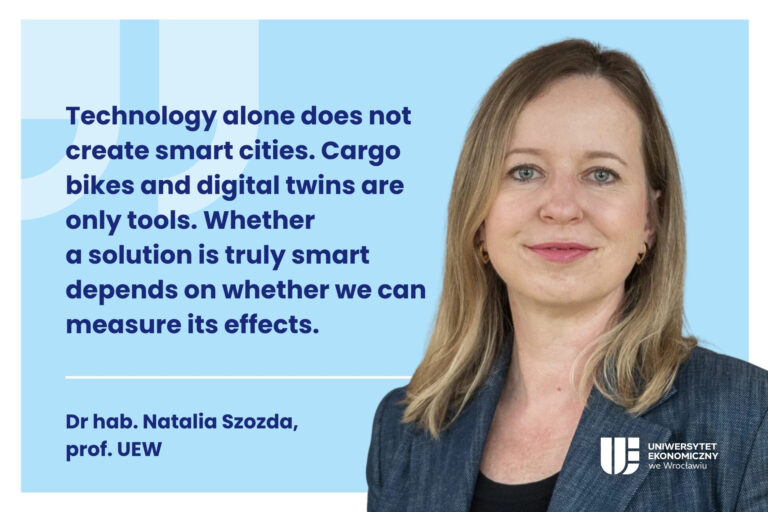
Wroclaw’s micro-hub at the Economic Forum. Natalia Szozda, Associate Professor, on when a city truly becomes smart
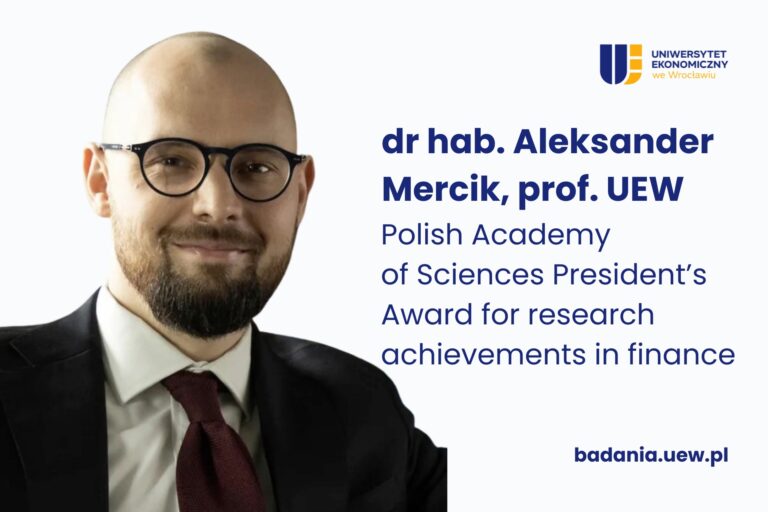
Dr hab. Aleksander Mercik, Professor of the WUEB, receives the Andrzej Gospodarowicz Award in Finance from the President of the Polish Academy of Sciences
WUEB Experts Weekly Review. Research, Projects and Academic Successes (5–11 October 2026)

Wroclaw University of Economics and Business researchers among the world’s leading scientists: six included in the 2026 World’s Top 2% Scientists database