

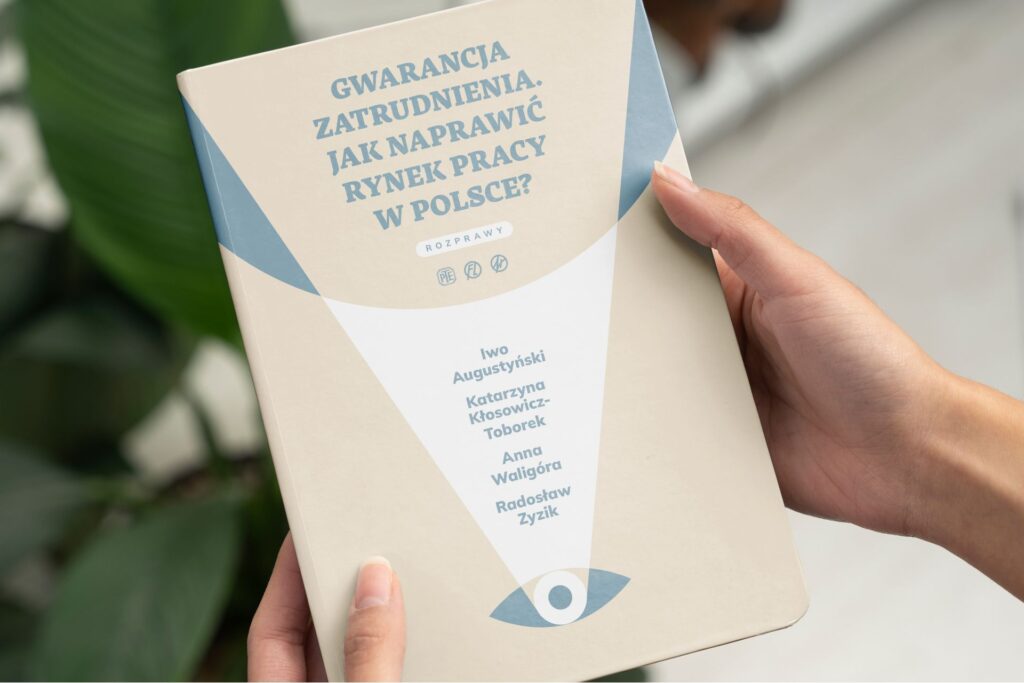
In this book, we examine whether Poland’s labour market could be designed to protect people during crises – without pretending that market forces alone will solve the problem. We explain what a job guarantee programme is and how it could work in Poland, from economic rationale and legal frameworks to delivery models and implementation costs.
What we studied and the real-world problem it addresses
We studied the concept of a job guarantee: a programme in which the state-working with local institutions-provides employment for people who cannot find work in the market. The starting point is unemployment and employment insecurity, set against longer-term shifts such as population ageing, migration, and the energy and digital transitions (changes in how we produce energy and how we work).
Why it matters: who it is for and when
This concerns people who fall out of the labour market or struggle to return to stable employment. It also matters for local governments and civil society organisations, because they are often the first to see how crises affect local communities. A more stable labour market can mean lower social costs and a more resilient economy.
Our idea: one simple example
We propose thinking about a job guarantee as a labour-market “safety valve”: when the private sector slows down, the programme absorbs part of the workforce into jobs with clear social value. For example, a municipality could create roles in care services or environmental projects, rather than leaving people outside the labour market for prolonged periods.
What this could change in the longer term
Over the long term, the aim is to move from “firefighting” to building a labour market that can absorb shocks without deepening exclusion. We also show that without legal foundations and a coherent social policy, such a programme remains a slogan rather than a practical instrument. This is critical if the solution is to work not only in theory, but in the day-to-day reality of people and institutions.
Authors:
- Iwo Augustyński, PhD – Wroclaw University of Economics and Business (WUEB); economics and economic policy,
- Katarzyna Kłosowicz-Toborek, PhD – Cracow University of Economics (CUE); history of economic thought, economic theory,
- Anna Waligóra, PhD – Poznań University of Economics and Business (PUEB); social enterprises, social entrepreneurship, social economy, third sector, NGOs, social responsibility,
- Radosław Zyzik, PhD – Jesuit University Ignatianum in Cracow; political science and public administration.
Reference
badania.uew.pl – because the world needs competent voices when noise tries to drown out reason.
Author: Barbara Grzelczak
See similar content

Video games are more than entertainment. WUEB researchers on cooperation between game developers and the cultural and creative industries

Space Logistics, Interplanetary Supply Chains and Interdisciplinary Research and Educational Projects Related to Space at UEW in Jelenia Góra
Wrocław has FinTech potential. A WUEB expert argues it is time to turn that potential into advantage
Academic Entrepreneurship as Architecture of Impact. The New Issue of „Impakt Dolny Śląsk” (2/2025)
See also

WUEB Experts Weekly Review. Research, Projects and Academic Successes (12–18 October 2026)

How can economic fluctuations be smoothed? The 2026 Nobel Prize in Economic Sciences through the eyes of WUEB researchers
The World Within Wrocław’s Reach. How the PROM research mobilities confirm WUEB’s place on the map of global academia
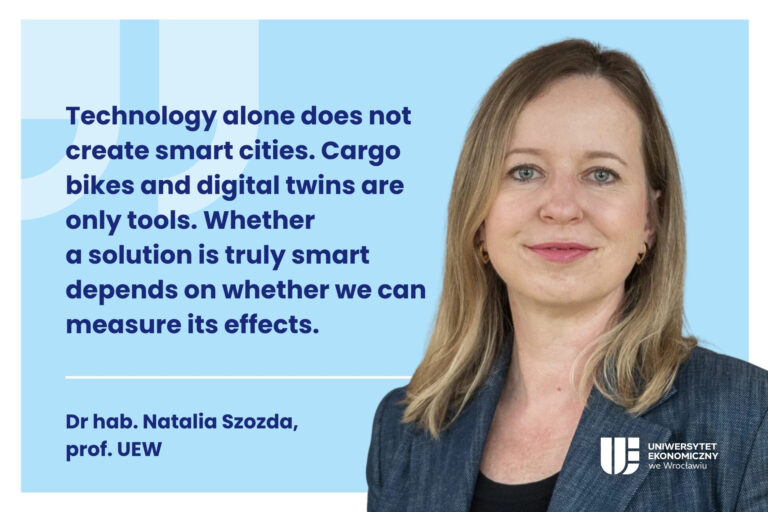
Wroclaw’s micro-hub at the Economic Forum. Natalia Szozda, Associate Professor, on when a city truly becomes smart
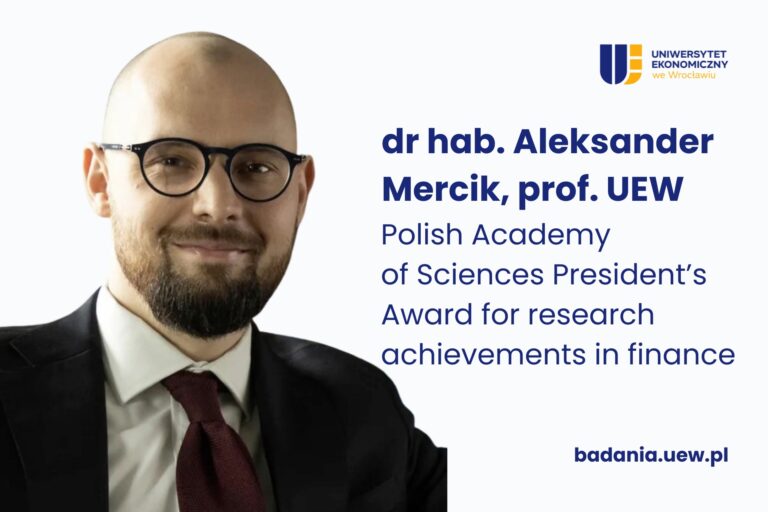
Dr hab. Aleksander Mercik, Professor of the WUEB, receives the Andrzej Gospodarowicz Award in Finance from the President of the Polish Academy of Sciences
WUEB Experts Weekly Review. Research, Projects and Academic Successes (5–11 October 2026)

Wroclaw University of Economics and Business researchers among the world’s leading scientists: six included in the 2026 World’s Top 2% Scientists database