

At Wroclaw University of Economics and Business, sustainable development is one of the pillars on which the university’s identity, strategy and everyday decisions are built – alongside research for a knowledge-based economy, personalised education, cooperation with business, internationalisation, digitalisation and creating a friendly working environment. In 2024 WUEB clearly strengthened its commitment to implementing the Sustainable Development Goals in areas SDG 4, 8, 9, 11 and 13, embedding solutions with a positive impact on society and the natural environment as one of the key strategic directions in the updated WUEB 2030 Strategy.
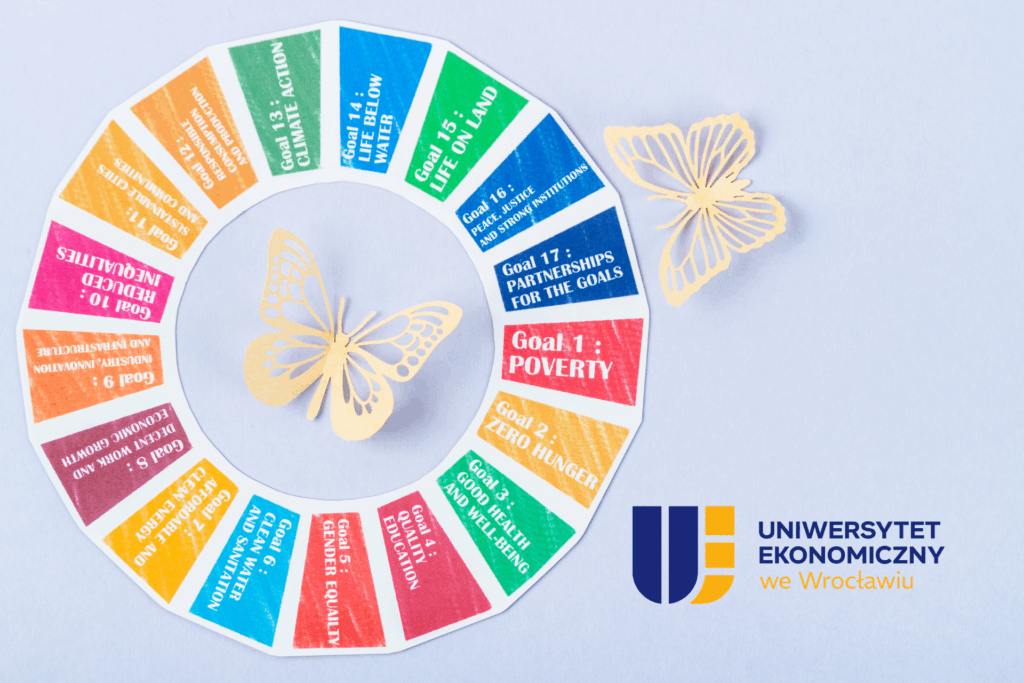
This is not a collection of isolated initiatives, but a coherent development programme for the university: from internal policies and infrastructure investments, through educational projects for children and young people, to partnerships with business, local government and civil society organisations. In this way WUEB demonstrates how the entire community – staff, students, doctoral candidates and external partners – jointly builds a university that combines quality, responsibility and innovation in a long-term perspective.
SDG 4 – Quality Education
WUEB has strengthened its position as a university that cares about high quality education at the international level. The visit of the CEEMAN IQA Accreditation Committee and the positive review of the re-accreditation self-assessment report confirm the high standard of teaching, research and university management, aligning WUEB’s activities with the standards of recognised business schools worldwide.
WUEB is consistently expanding the reach of its educational activities, going far beyond the classic study offer. The Children’s University of Economics (180 pupils and 160 parents), the Young Economist Academy (145 participants) and Nboj Junior – an international mathematics and physics competition with almost 2,300 teams from eight countries – demonstrate the university’s openness to younger generations and its role in co-creating their learning paths already at primary and secondary school level. The series “No grades. WUEB lecturers for pupils” gives high school students a first-hand experience of academic reality and develops their critical thinking, while the digitisation of 112 doctoral theses from the Jelenia Góra branch – made available in the Lower Silesian Digital Library – strengthens open access to the university’s research output.
SDG 8 – Decent Work and Staff Development
In 2024 Wroclaw University of Economics and Business clearly strengthened its role in developing innovation and modern, people-friendly infrastructure for both the campus and the city. DT HUB workshops using LEGO SERIOUS PLAY help teams design new solutions and cooperation models, combining creative tools with real organisational challenges.
The university is also carrying out major infrastructure investments: nearly PLN 1.3 million in funding for the thermal modernisation of Building B, the completed investment in Building D, and the “Equal safe accessible” project with more than PLN 6.7 million in funding for removing barriers for people with special needs in eight key functional areas of the university. Cooperation between WUEB, the city and business is reflected, among others, in the “Partnership for quality of goods delivery services in Wrocław’s historic city centre” and in the “Microhub Wrocław” concept – the first micro-consolidation centre in Poland for low and zeroemission deliveries. This is complemented by success in the “Wrocławska Magnolia” competition, where a master’s thesis on the development of second-hand clothing brands and the circular economy was awarded.
SDG 9 and 11 – Innovation, Infrastructure, Sustainable City
Uniwersytet Ekonomiczny we Wrocławiu w 2024 roku wyraźnie wzmocnił swoją rolę w rozwijaniu innowacji oraz nowoczesnej, przyjaznej infrastruktury uczelni i miasta. Warsztaty DT HUB z wykorzystaniem LEGO SERIOUS PLAY wspierają zespoły w projektowaniu nowych rozwiązań i modeli współpracy, łącząc kreatywne narzędzia z realnymi wyzwaniami organizacyjnymi.
Uczelnia prowadzi także znaczące inwestycje infrastrukturalne: prawie 1,3 mln zł dofinansowania na termomodernizację budynku B, zakończona inwestycja w budynku D oraz projekt „Equal safe accessible” z dofinansowaniem ponad 6,7 mln zł na usuwanie barier dla osób ze szczególnymi potrzebami w ośmiu kluczowych obszarach funkcjonowania uczelni. Współpraca UEW z miastem i biznesem widoczna jest m.in. w „Partnerstwie na rzecz jakości usług dostaw towarów w historycznym centrum Wrocławia” oraz w koncepcji „Microhub Wrocław” – pierwszego w Polsce mikrocentrum przeładunkowego dla nisko i zeroemisyjnych dostaw. Uzupełnia to sukces w konkursie „Wrocławska Magnolia”, gdzie nagrodzono pracę magisterską dotyczącą rozwoju marek odzieży z drugiej ręki i gospodarki obiegu zamkniętego.
SDG 13 – Climate Action
WUEB adopts a broad approach to climate – from youth education and research projects to expert debates and international cooperation. The School Climate Conference engages secondary school students and – for the first time – senior primary school pupils in working together with experts and city representatives on climate challenges, bringing together the perspectives of science, education and urban policy.
Climate Academy (editions 4 and 5) focuses on climate threats and challenges for SMEs and on the biodiversity of the campus and the city, creating a space for dialogue between academics, business and public institutions. The participation of the H2FAST team in EU TalentOn 2024 – crowned with a public award for a hydrogen–photovoltaic installation concept – and the organisation of the Green Region Forum dedicated to energy, digital and green transition, energy poverty and EU funds, show that WUEB is actively involved in the European debate on climate transformation.
Participation, Governance and Cooperation
In the area of participation and governance, WUEB is consistently consolidating its position as a university that opens up to shared decision-making and close cooperation with its environment. The Sustainable Development Forum, launched on 4 March 2024, provides a permanent platform for dialogue with business, public administration, NGOs and international institutions, supporting the shaping of strategic directions and new initiatives in the field of sustainable development.
The first WUEB participatory budget – five submitted projects and 983 votes cast – demonstrates genuine community engagement in shaping the university space; among the winning ideas were “Pink boxes at the university” and new small architectural elements in the “Zaprzegubie” area. Partnerships with business are also being continued and further developed, as illustrated by the extended cooperation with LG Energy Solution, the international CATax project focused on combating corruption and the shadow economy, and World Café cycles devoted to green competences and employers’ expectations.
WUEB demonstrates that sustainable development is a consistently implemented strategic direction – with clearly defined actions, measurable outcomes and a strong foundation in the 2030 Strategy. This narrative makes it possible to see the scale and diversity of the community’s engagement – from projects for the youngest learners, through internal policies and investments, to international collaboration – and to understand how the SDGs are becoming one of the pillars of WUEB’s advantage and quality as a modern, responsible economics university.
A new chapter – the SDG 2025 report is already in preparation
The UEW Sustainable Development Office is working on the next edition of the report, which will be fully integrated with the goals and indicators of the university’s new strategy.
Read full report: https://badania.uew.pl/wp-content/uploads/sites/23/2026/01/RAPORT-SDG_2024_ANG.pdf
Autor tekstu: Justyna Morawska-Płoskonka
Zobacz podobne treści

Video games are more than entertainment. WUEB researchers on cooperation between game developers and the cultural and creative industries

Space Logistics, Interplanetary Supply Chains and Interdisciplinary Research and Educational Projects Related to Space at UEW in Jelenia Góra
Wrocław has FinTech potential. A WUEB expert argues it is time to turn that potential into advantage
Academic Entrepreneurship as Architecture of Impact. The New Issue of „Impakt Dolny Śląsk” (2/2025)
Zobacz również

WUEB Experts Weekly Review. Research, Projects and Academic Successes (12–18 October 2026)
How can economic fluctuations be smoothed? The 2026 Nobel Prize in Economic Sciences through the eyes of WUEB researchers
The World Within Wrocław’s Reach. How the PROM research mobilities confirm WUEB’s place on the map of global academia
Wroclaw’s micro-hub at the Economic Forum. Natalia Szozda, Associate Professor, on when a city truly becomes smart
Dr hab. Aleksander Mercik, Professor of the WUEB, receives the Andrzej Gospodarowicz Award in Finance from the President of the Polish Academy of Sciences
WUEB Experts Weekly Review. Research, Projects and Academic Successes (5–11 October 2026)
Wroclaw University of Economics and Business researchers among the world’s leading scientists: six included in the 2026 World’s Top 2% Scientists database