

Why understanding “how” and “why” innovations work – and whether societies are ready to embrace them – remains central to the future of economies in the age of AI.
What drives long-term economic growth in an era shaped by artificial intelligence, protectionism, and rapid technological acceleration?
This year’s Nobel Prize in Economic Sciences highlights a fundamental challenge: while innovation is widely celebrated, understanding why it leads to sustainable progress – and under what conditions – remains far from obvious.
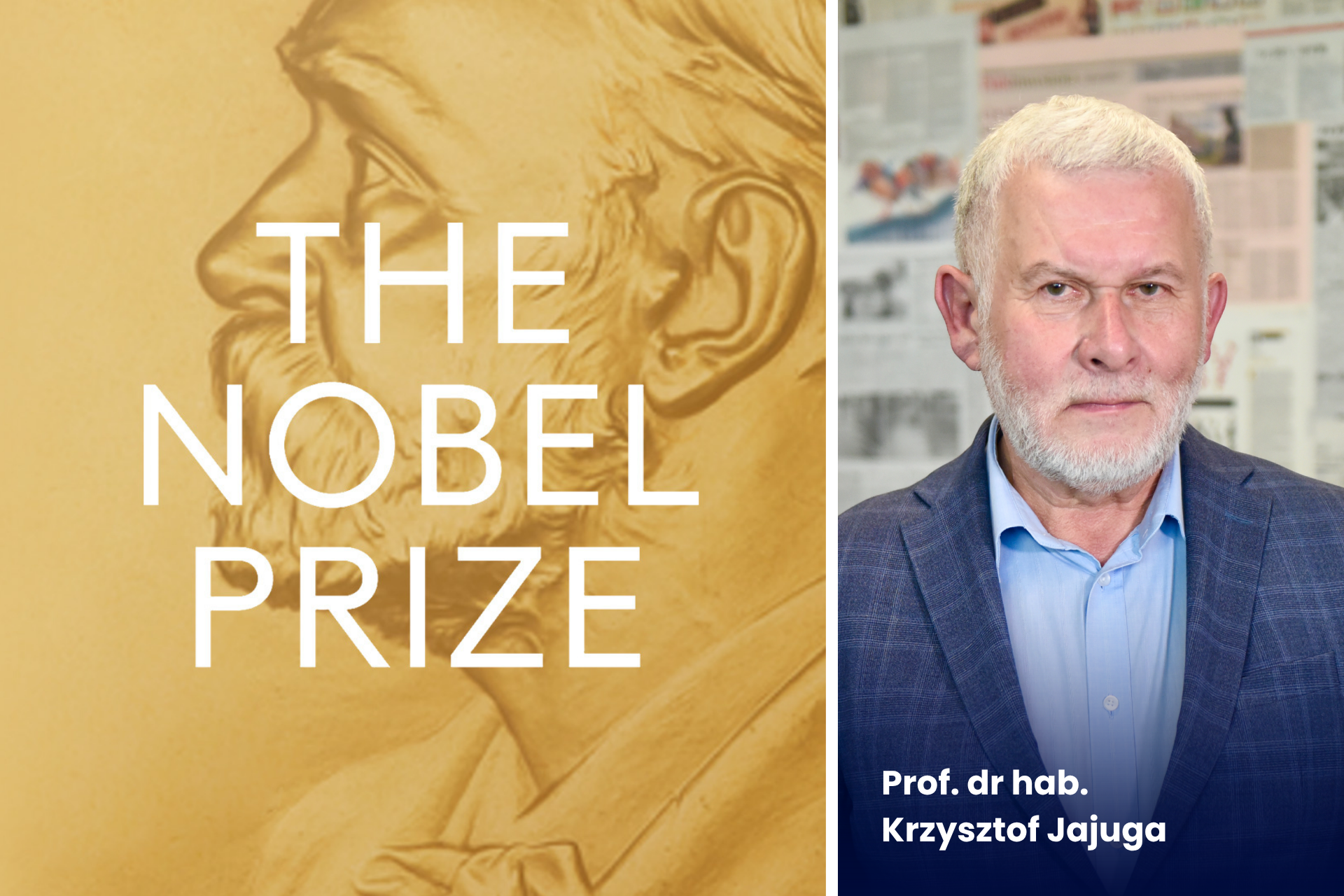
In this commentary, Prof. Krzysztof Jajuga, economist at Wrocław University of Economics and Business, unpacks the 2025 Nobel Committee’s decision, drawing connections between the awarded theories and the structural dilemmas of today’s economies.
Who received the Nobel Prize in Economics this year?
The 2025 Sveriges Riksbank Prize in Economic Sciences in Memory of Alfred Nobel was awarded to:
- Joel Mokyr (Northwestern University / Tel Aviv University) – ½ prize
- Philippe Aghion (Collège de France, INSEAD, LSE) – ¼ prize
- Peter Howitt (Brown University) – ¼ prize
The official citation reads: “for explaining economic growth driven by innovation.”
But as Prof. Jajuga explains, the real significance of this work lies in its long-term implications: how innovation interacts with social structures, institutional openness, and the deeper layers of knowledge.
What’s the difference between “how” and “why” innovation works?
Joel Mokyr, a historian of economic thought, argued that sustaining innovation requires more than knowing how things work (prescriptive knowledge).
What’s equally essential is knowing why they work (propositional knowledge) – a form of theoretical insight that enables adaptation, resilience, and deeper learning.
“This distinction is especially relevant for artificial intelligence,” notes Prof. Jajuga.
“There is widespread excitement about what AI tools can do – but far less understanding of why they work as they do. This gap has serious implications for innovation policy and education.”
What is “creative destruction” – and why does it still matter?
The theory developed by Philippe Aghion and Peter Howitt centres on a key mechanism of growth: creative destruction. New firms and technologies disrupt old ones, reconfiguring the economic landscape.
In 1992, the laureates formalised this concept in a mathematical model, showing how innovation can drive growth if outdated incumbents do not block change.
Prof. Jajuga sees contemporary relevance in this work:
“Protectionism, tariffs, and competition restrictions – increasingly common today – pose a direct threat to innovation-led growth. Societies that resist change will struggle to benefit from the very innovations they produce.”
What are the three pillars of sustainable growth?
As noted during the Nobel announcement, the prize committee identified three conditions for sustained economic development:
- Innovation grounded in scientific research
- Creative destruction as a catalyst for renewal
- An open society willing to embrace change
These pillars not only define the laureates’ work – they also reflect broader tensions in the 21st-century economy: between openness and control, short-term disruption and long-term progress.
Why should this shape how we think about growth and innovation today?
As economies become more digital, interconnected, and politically fragmented, the question is no longer whether innovation will happen – but how it will be shaped, shared and governed.
- Are we building societies capable of integrating new technologies responsibly?
- Do our institutions support experimentation and creative renewal?
- Are we asking the right questions – not just what works, but why it works?
These are not only technical challenges. They are civic, ethical and strategic.
badania.uew.en – because the economics of the future needs knowledge that leads, not just explains.
Author: Justyna Morawska-Płoskonka
See similar content

Video games are more than entertainment. WUEB researchers on cooperation between game developers and the cultural and creative industries
Space Logistics, Interplanetary Supply Chains and Interdisciplinary Research and Educational Projects Related to Space at UEW in Jelenia Góra
Wrocław has FinTech potential. A WUEB expert argues it is time to turn that potential into advantage
Academic Entrepreneurship as Architecture of Impact. The New Issue of „Impakt Dolny Śląsk” (2/2025)
See also

WUEB Experts Weekly Review. Research, Projects and Academic Successes (12–18 October 2026)
How can economic fluctuations be smoothed? The 2026 Nobel Prize in Economic Sciences through the eyes of WUEB researchers
The World Within Wrocław’s Reach. How the PROM research mobilities confirm WUEB’s place on the map of global academia
Wroclaw’s micro-hub at the Economic Forum. Natalia Szozda, Associate Professor, on when a city truly becomes smart
Dr hab. Aleksander Mercik, Professor of the WUEB, receives the Andrzej Gospodarowicz Award in Finance from the President of the Polish Academy of Sciences
WUEB Experts Weekly Review. Research, Projects and Academic Successes (5–11 October 2026)
Wroclaw University of Economics and Business researchers among the world’s leading scientists: six included in the 2026 World’s Top 2% Scientists database