

Social policy is rarely morally neutral. Someone receiving a benefit faces judgement – their own and others’. Someone who gives up a benefit they are entitled to also makes a decision shaped by norms. Between the legal right to a benefit and the willingness to claim it lies a space that researchers from the Department of Sociology and Social Policy at Wrocław University of Economics and Business set out to map and name. That space is described by the concept of benefit morale.
Their findings will be published in June 2026 as the English-language monograph Benefit Morale: Social Attitudes to the Welfare State in Poland by Routledge. The authors are: dr Łukasz Jurek, dr Krystyna Gilga, dr Stanisław Kamiński, dr hab. Associate Professor Joanna Szczepaniak-Sienniak oraz dr Paweł Żuk.
Not just fraud. The researchers also examined those who walk away from their rights
When welfare abuse is discussed, the conversation almost always centres on fraudulent claims and opportunism. The WUEB researchers asked the opposite question too: what about those who simply… don’t claim benefits they are legally entitled to? Not because they don’t need them. Because they are ashamed. Because they feel others have greater needs. Because they fear their neighbours’ judgement. This phenomenon – which the authors call non-take-up of benefits – is just as real as benefit fraud, and far less studied.
The project examined three areas analysed together for the first time: Polish attitudes towards the welfare role of the state, attitudes towards welfare abuse, and non-take-up of benefits. The study was conducted as an online survey on a representative sample of adult Poles, accounting for age, place of residence, financial situation, and previous experience of claiming benefits.
Shame as a mechanism of social policy
Benefit morale as an analytical category had not previously been clearly defined or empirically tested – in Polish or English-language literature. The authors proposed their own definition, starting from the assumption that attitudes towards social welfare cannot be reduced to political or economic questions alone. They are rooted in values and norms that determine what a given community considers fair, dignified, and appropriate. Importantly, the theoretical framework is not limited to the Polish context – the authors designed it as a tool for welfare state researchers in other countries, opening the field to comparative research. Without understanding these norms, it is difficult to assess honestly whether social policy is working as it should.
Findings worth noting
The study shows that Polish society is not uniform in its social attitudes – and that the dividing lines do not fall where intuition might suggest. Tolerance for welfare abuse depends on the type of benefit and the circumstances in which the abuse occurs. Non-take-up is a real and varied phenomenon: its causes and scale differ between groups. The authors argue that the effectiveness of the redistribution system is often limited not by poor legislation, but by moral norms that no regulation can change.
From Polish research to international scholarship
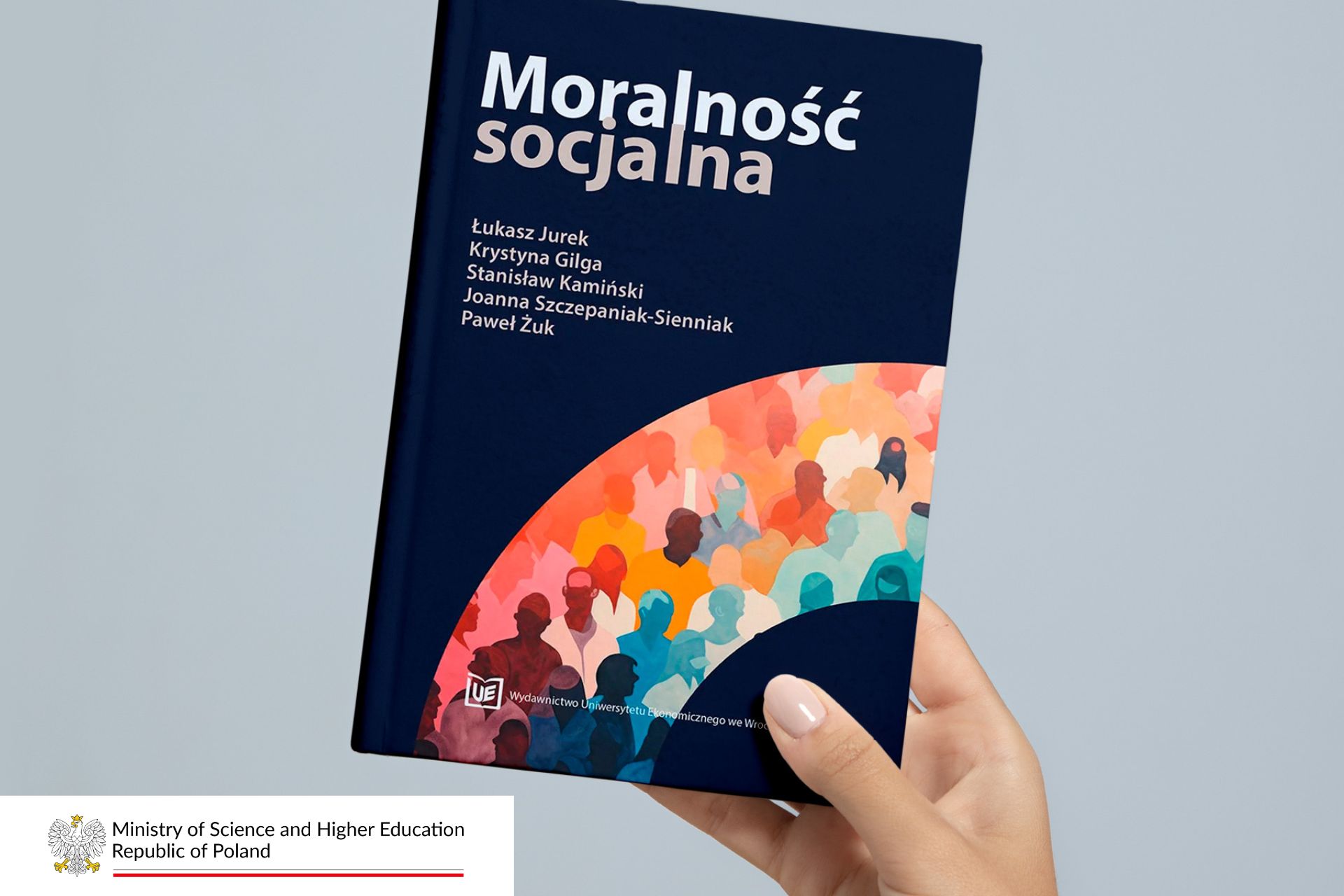
Benefit Morale builds on research initiated by the Polish research team and published as Moralność socjalna (WUEB Press, 2023) – one of the first studies worldwide to address benefit morale systematically. The Routledge volume is not a translation or a direct adaptation. It substantially expands the theoretical framework, deepens the empirical analysis, and addresses an international academic audience. It represents the next – qualitatively new – stage of the same research programme, this time reviewed and published to the standards of one of the world’s leading academic publishers.
The Polish monograph is available via the WUEB Publishing House: wydawnictwo.uew.pl/moralnosc-socjalna
Save the date: 9 June 2026
Benefit Morale: Social Attitudes to the Welfare State in Poland will be published by Routledge on 9 June 2026. Pre-publication information is already available on the publisher’s website. For anyone working in social policy, welfare state sociology, or social behaviour in the context of redistribution – this is a title worth watching. It is the first English-language monograph to systematically examine the moral dimension of welfare benefit uptake in Poland and to propose a theoretical framework applicable beyond the Polish context.
Publication page ob=n routledge.com: https://www.routledge.com/Benefit-Morale-Social-Attitudes-to-the-Welfare-State-in-Poland/Jurek-Gilga-Kaminski-Szczepaniak-Sienniak-Zuk/p/book/9781041281856
This publication was supported by the Ministry of Science and Higher Education under the Doskonała Nauka II – Support for Scientific Monographs programme (contract no. MONOG/SP/0041/2024/02)
Author: Justyna Morawska-Płoskonka
See similar content

Video games are more than entertainment. WUEB researchers on cooperation between game developers and the cultural and creative industries

Space Logistics, Interplanetary Supply Chains and Interdisciplinary Research and Educational Projects Related to Space at UEW in Jelenia Góra
Wrocław has FinTech potential. A WUEB expert argues it is time to turn that potential into advantage
Academic Entrepreneurship as Architecture of Impact. The New Issue of „Impakt Dolny Śląsk” (2/2025)
See also

WUEB Experts Weekly Review. Research, Projects and Academic Successes (12–18 October 2026)
How can economic fluctuations be smoothed? The 2026 Nobel Prize in Economic Sciences through the eyes of WUEB researchers
The World Within Wrocław’s Reach. How the PROM research mobilities confirm WUEB’s place on the map of global academia
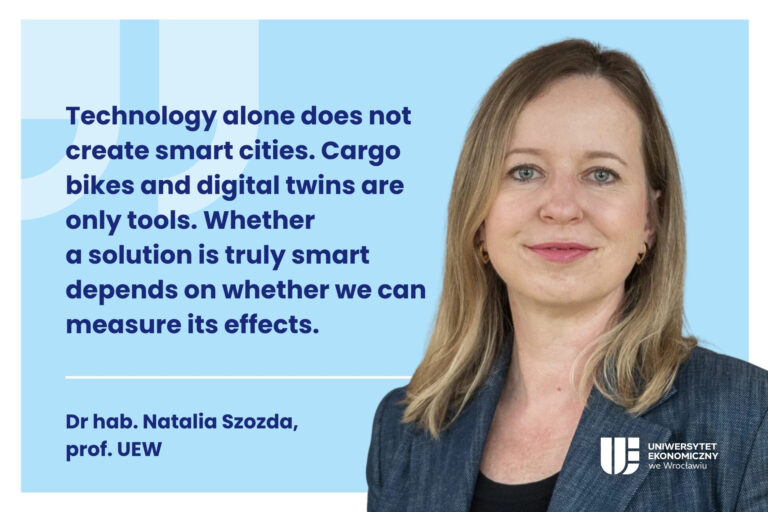
Wroclaw’s micro-hub at the Economic Forum. Natalia Szozda, Associate Professor, on when a city truly becomes smart
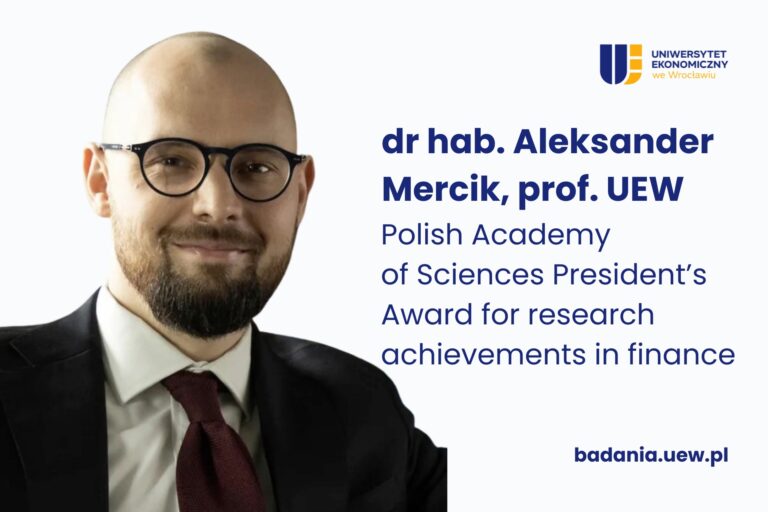
Dr hab. Aleksander Mercik, Professor of the WUEB, receives the Andrzej Gospodarowicz Award in Finance from the President of the Polish Academy of Sciences
WUEB Experts Weekly Review. Research, Projects and Academic Successes (5–11 October 2026)
Wroclaw University of Economics and Business researchers among the world’s leading scientists: six included in the 2026 World’s Top 2% Scientists database