

When international media present Polish solutions in the field of the social economy, they need a voice that can explain more than an individual story of support. Dr Stanisław Kamiński, Professor of WUEB, an expert from Wroclaw University of Economics and Business specialising in social policy, multi-sectorality, state and market failure, and global social issues, appeared in a Euronews report on the Arte cooperative in Bielawa. His commentary shifts the discussion from a single case to the mechanisms behind it: how to design institutions that help excluded people return to work, agency and independence.

Expert profile: Dr Stanisław Kamiński, Professor of WUEB
A Polish example in a European medium
The social economy rarely becomes a first-choice topic for international media. This time, it did. Euronews presented the story of the Arte cooperative in Bielawa, which carries out reintegration activities for men experiencing chronic homelessness, addiction and exclusion from the commercial labour market. The report focuses on the “Butterflies from Lower Silesia” project, 70 per cent funded by the European Social Fund Plus. According to Euronews, the total budget of the initiative is EUR 630,000.
Source: Euronews, “Poland’s social economy: EU-funded cooperative gives people in need a second chance”
Why this expert voice matters
This is also an important moment for Wroclaw University of Economics and Business. The presence of a WUEB expert in a European media outlet shows that knowledge developed at the University does not remain confined to academic circulation. It reaches the places where the language of public debate is shaped: discussions on the effectiveness of social policy, professional reintegration and the design of institutions capable of responding to complex social problems.
“The social economy is not an addition to the economy. It is one way of designing a return to work, responsibility and independence.”
The most important element of this commentary is its change of perspective. The social economy is not presented as a “soft” form of assistance or as an activity secondary to the economy. In the WUEB expert’s commentary, its institutional function comes to the fore: it is a way of organising work, support and responsibility so that people remaining outside the labour market can gradually rebuild their competences, daily rhythm and capacity for independent living.
From assistance to a mechanism of reintegration
This is particularly important for people for whom the regular labour market is too fast, too selective or too inflexible. A commercial company usually expects a ready employee. A social economy entity may operate differently: it creates a transitional environment in which work, training, care and responsibility are combined into one process. It is therefore not only about employment. It is about designing the conditions in which returning to work becomes possible.
This is why the voice of Dr Stanisław Kamiński, Professor of WUEB, is so important in this material. It organises an emotionally powerful story and gives it an economic and social framework. It shows that behind the individual example from Bielawa there is a broader question: how can the state, local government, social organisations, European funds and social economy entities jointly create a system that not only responds to exclusion, but also reduces its persistence?
The social economy as part of the European model
Euronews notes that the social economy is a significant part of the European economy. According to data cited in the material, there are 4.3 million social economy organisations in the European Union, representing 11.5 million jobs, or around 6 per cent of the total workforce. This scale shows that this is not a niche issue, but one of the important segments of the European socio-economic model.
“Behind the individual story from Bielawa lies a larger question: how should institutions be designed so that they not only help, but also reduce the persistence of exclusion?”
For WUEB, the presence of an expert in this type of material has strategic importance. An economics university should not be associated only with the analysis of markets, companies and finance. Contemporary economics increasingly requires answers to questions about the costs of exclusion, the effectiveness of institutions, the quality of public policy and the conditions for participation in economic life. These are areas in which research can strengthen public decision-making and help distinguish symbolic action from solutions with documented impact.
Research that resonates beyond the University
The appearance of Dr Stanisław Kamiński, Professor of WUEB, in Euronews is more than the presence of an expert in an international medium. It is an example of academic knowledge structuring a complex social issue and helping an international audience understand why the social economy is part of the debate on work, dignity, productivity and institutional responsibility.
This is how research from Wroclaw University of Economics and Business should resonate: not as a commentary added at the end of a debate, but as a voice that helps reveal the mechanisms hidden beneath the surface of an individual story.
badania.uew.pl: because the world needs competent voices when noise drowns out reason.
Author: Justyna Morawska-Płoskonka
See similar content
How can economic fluctuations be smoothed? The 2026 Nobel Prize in Economic Sciences through the eyes of WUEB researchers
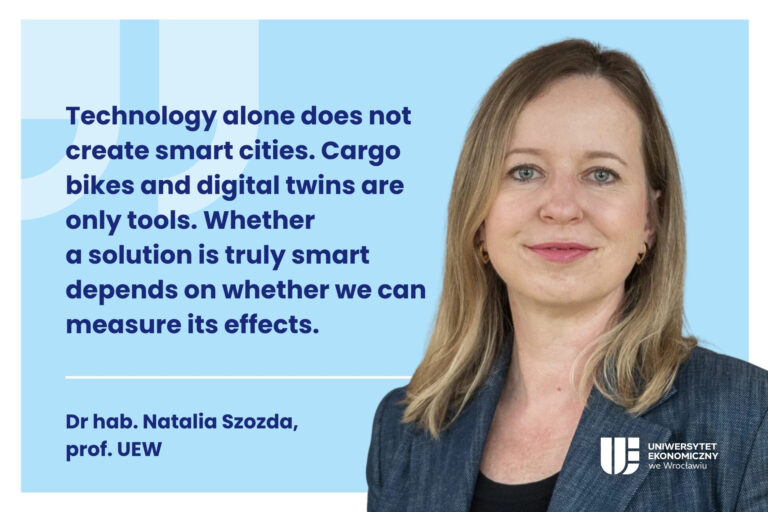
Wroclaw’s micro-hub at the Economic Forum. Natalia Szozda, Associate Professor, on when a city truly becomes smart

WUEB Experts Weekly Review. Research, Projects and Academic Successes (5–11 October 2026)
WUEB Experts Weekly Review: Research, Projects and Academic Successes (28 September–4 October 2026)
See also
How can economic fluctuations be smoothed? The 2026 Nobel Prize in Economic Sciences through the eyes of WUEB researchers
The World Within Wrocław’s Reach. How the PROM research mobilities confirm WUEB’s place on the map of global academia
Wroclaw’s micro-hub at the Economic Forum. Natalia Szozda, Associate Professor, on when a city truly becomes smart
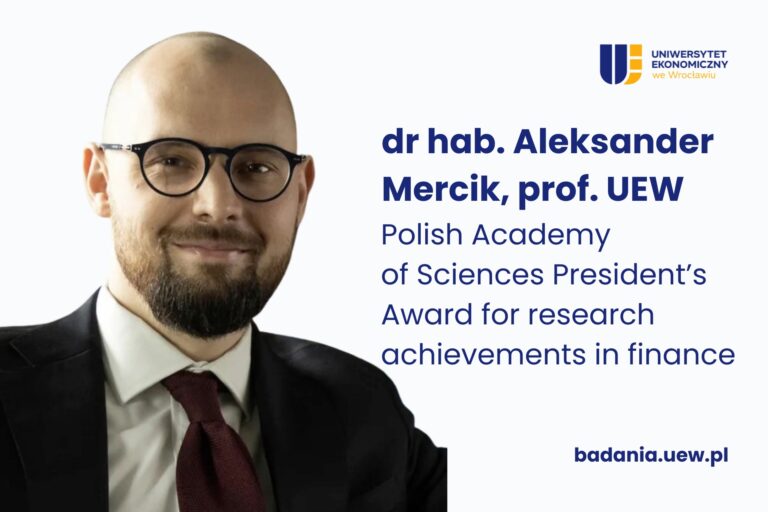
Dr hab. Aleksander Mercik, Professor of the WUEB, receives the Andrzej Gospodarowicz Award in Finance from the President of the Polish Academy of Sciences
WUEB Experts Weekly Review. Research, Projects and Academic Successes (5–11 October 2026)
Wroclaw University of Economics and Business researchers among the world’s leading scientists: six included in the 2026 World’s Top 2% Scientists database
WUEB Experts Weekly Review: Research, Projects and Academic Successes (28 September–4 October 2026)