
When you bid on eBay, you don’t have to sit by the screen and raise your bids. You enter the maximum amount you are willing to pay, and the system bids on your behalf only when it has to. Most often you end up below your limit. You don’t guess others’ strategies, you don’t bid up under the influence of emotions, you don’t watch the clock. The rules of the game are constructed in such a way that your sensible decision is enough.

When the Bank of Italy sells treasury bills, when the British government allocates CO₂ emission allowances, when the state privatises companies or auctions frequency bands for telecom operators, the same logic works in the background. The rules of the game are designed so that individually rational decisions of participants lead to a result that is socially sensible, even if none of the bidders thinks about it.
This logic is called mechanism design. One of its co-creators is Eric S. Maskin, professor at Harvard University and laureate of the 2007 Sveriges Riksbank Prize in Economic Sciences in Memory of Alfred Nobel. On 23 April 2026, the Senate of Wrocław University of Economics and Business awarded him the title of doctor honoris causa.
Mechanism design as reverse game theory
In his Nobel lecture, Maskin called mechanism design “the engineering side of economic theory.” The phrase captures the essence of the field well. Classical game theory starts with rules and asks how rational participants will behave. Mechanism design reverses this order. It starts from a desired social outcome (fair distribution, efficient allocation, stable climate policy) and seeks rules of the game that will lead to that outcome, even if participants act in their own interest and do not reveal all the information they hold.
The monotonicity condition formulated by Maskin in 1977, known in the literature as Maskin monotonicity, is one of the pillars of contemporary microeconomics. It indicates precisely when socially desirable outcomes are at all attainable as a stable result of strategic play. This is a result that changed the status of questions about institutions. It moved them from the domain of intuition and ideological dispute into the domain of formal analysis.
The invisible mechanism: why eBay works
Coming back to online auctions: a well-designed mechanism is most often invisible. From the participant’s perspective it looks like something obvious, while the complexity of the rules that lead to the outcome remains in the background.
Proxy bidding is a good example. The user only declares the maximum amount they are willing to pay. The system places bids on their behalf only when, and only at the level, necessary to maintain the leading position. The final price is most often lower than the declared maximum and results from competition with other participants. The mechanism eliminates emotional bidding, time pressure, and the need to guess others’ strategies. It reduces the participant’s decision to one sensible choice: what is my authentic valuation.
In a broader sense, proxy bidding illustrates the central idea of mechanism design. The rules of the game are constructed so that individually rational, locally sensible decisions of participants lead to the desired outcome without the need for complex strategic thinking. This is not a direct application of Maskin’s theorems, but an accessible example of the same logic. The rules are designed to support the efficiency of outcomes, even if the participants are unaware of the theory behind them.
From theory to public policy
Professor Maskin advised the Bank of Italy on the design of treasury bond auctions, the British government on auctions for greenhouse gas emission allowances, and the Polish government on auctions for the privatisation of state enterprises. He cooperated with companies such as General Telephone and Electronics and AT&T on the design of radio spectrum auctions. His work today shapes the practice of climate policy, market regulation, the allocation of public resources, and institutional reforms in transitional economies.
In recent years, Professor Maskin has devoted increasing attention to the quality of democracy and to electoral systems. He shows that “winner takes all” majoritarian systems, dominant in many countries, foster political polarisation, rewarding candidates with extreme views at the expense of those building broad coalitions. His analyses draw on the concepts of Condorcet and Borda, proposing solutions based on a fuller revelation of voter preferences.
Profile
Eric S. Maskin holds the Adams University Professorship at Harvard University, where he is also professor of economics and mathematics. He has been associated with Harvard since 1985. From 2000 to 2011 he was the Albert O. Hirschman Professor of Social Science at the Institute for Advanced Study in Princeton. Earlier he developed his career at the Massachusetts Institute of Technology and at Cambridge.
He is a member of the National Academy of Sciences, the American Academy of Arts and Sciences, and the British Academy. He served as president of the Econometric Society and the Game Theory Society. From 1984 to 1990 he edited Quarterly Journal of Economics. He has received twenty honorary doctorates from leading academic centres of the world, including the universities of Cambridge, Georgetown, Jerusalem, and Madrid.
Why this honour matters for WUEB
There is one further thread worth highlighting. In his Nobel lecture, Maskin reconstructed in detail the intellectual genealogy of mechanism design. He pointed out that the key impulse for the field was the dispute over the rationality of central planning that took place in the 1930s. On one side of the dispute, Oskar Lange and Abba Lerner argued that a well-designed planned economy could achieve the effects of a free market. On the other side, Friedrich Hayek and Ludwig von Mises rejected this possibility.
The dispute was of enormous intellectual and political weight, but for Leonid Hurwicz, an economist of a younger generation, it was also frustrating. It lacked conceptual precision and the formal apparatus without which arguments on either side could not be fully decisive. Out of this frustration grew Hurwicz’s work of the 1960s and 1970s, and subsequently Maskin’s work, which laid the foundation for the theory of mechanism design. The dispute was not settled by the arguments of the 1930s; it found, however, its extension in the conceptual apparatus that today allows us to analyse precisely when and under what conditions specific social goals can be achieved through appropriately designed institutions. Not as a result of a directive and not as an automatic effect of the market, but as a stable outcome of a well-designed game.
Lange is the only Polish economist whom Maskin invokes in his Nobel lecture. Until 2008 he was also the patron of Wrocław University of Economics and Business. The award of the title of doctor honoris causa to Professor Maskin therefore closes a certain intellectual bracket whose protagonists come from very different traditions but worked on the same question: how to design institutions that genuinely work.
For WUEB, the honour thus has both a scholarly and a symbolic dimension. In its scholarly dimension, it strengthens the position of theoretical research in economics and underscores the importance of institutional analysis. In its symbolic dimension, it is a signal of internationalisation and of a conscious dialogue with our own intellectual tradition.
Author of the text: Justyna Morawska-Płoskonka
See also
Visual Simulation of Business Processes (WSPB) joins the Polish Roadmap for Research Infrastructures

WUEB awarded Visegrad grant to study the skills gap across the V4
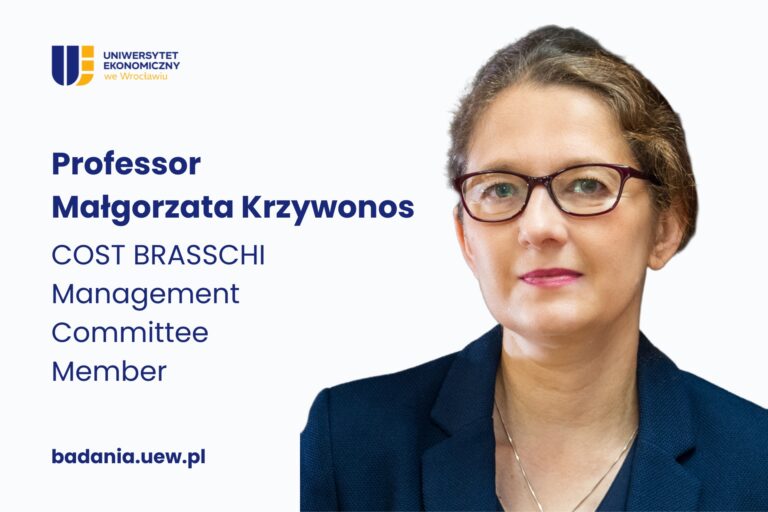
Prof Małgorzata Krzywonos joins the Management Committee of COST Action BRASSCHI
Mgr Julia Majewska reappointed to POLSA Student Council
See similar content

Bridging V4 Universities and Business through Design Thinking

WUEB Experts Weekly Review. Research, Projects and Academic Successes (24 – 30 August 2026)
Visual Simulation of Business Processes (WSPB) joins the Polish Roadmap for Research Infrastructures
WUEB experts weekly rewiev. Research, Projects and Academic Successes (17–23 August 2026)
WUEB awarded Visegrad grant to study the skills gap across the V4
Prof Małgorzata Krzywonos joins the Management Committee of COST Action BRASSCHI
WUEB joins discussions on TEEMA Technology Park in Miękinia