

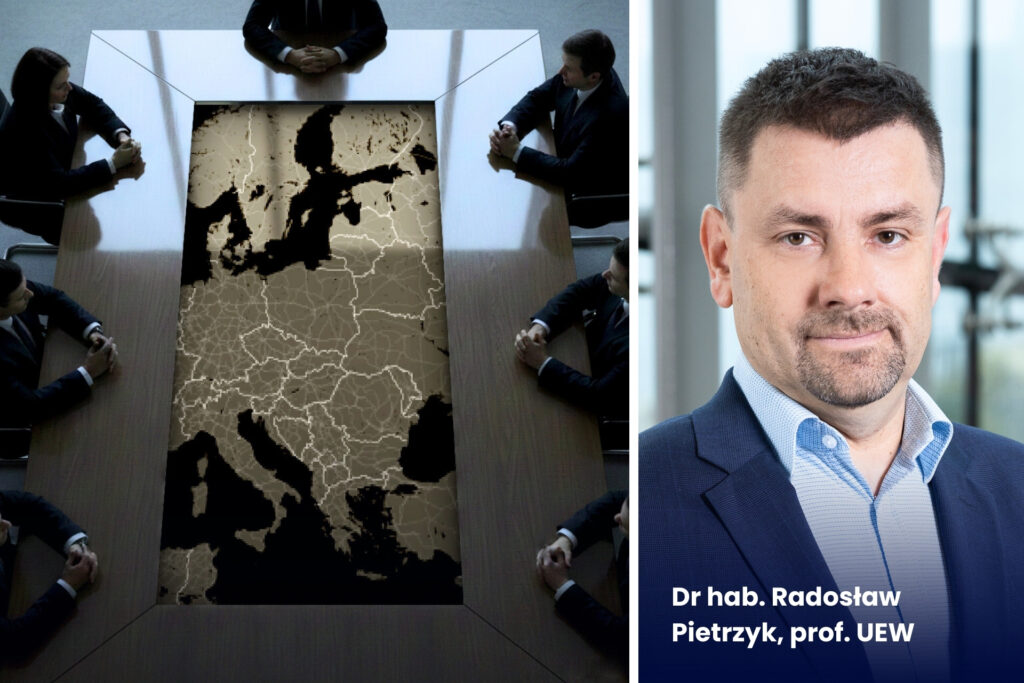
Can Europe defend its agency in a world where the economy is increasingly used as an instrument of pressure rather than a space for cooperation? This question framed the discussion in the Radio Wrocław programme Different Points of View and set the starting point for a conversation on global economic rivalry and its consequences for Europe and Poland. One of the programme’s guests was dr habil. Radosław Pietrzyk, Associate Professor at WUEB. As an expert commentator, he brought analytical clarity to a complex geopolitical situation, identifying mechanisms of pressure, the limits of Europe’s resilience, and the areas in which the European Union retains real capacity to act.
Greenland as a test of unity, not a territorial dispute
The discussion opened with a question about Donald Trump’s demands regarding Greenland. In Professor Pietrzyk’s interpretation, this was not a dispute over territory, but a political test designed to assess how vulnerable Europe is to pressure and internal divisions.
The WUEB expert emphasised that pressure is most effective when states respond individually, seeking short-term benefits or pursuing their own paths. In such circumstances, collective capacity weakens and external pressure intensifies. The opposite occurs when the European Union presents a united position: the cost of exerting pressure rises and the room for manoeuvre on the other side narrows considerably.
“If we do not allow ourselves to be broken apart or divided, we will be a sufficiently strong force to be treated as partners.”
In this sense, Greenland functioned in the programme as a symbol rather than the object of dispute—a shorthand for the question of whether Europe can maintain cohesion in situations that are media-driven, politically uncomfortable, and designed to provoke emotional reactions.
Europe’s resources and its real instruments of influence
While the discussion included comparisons between the economic potential of the European Union and the United States, Dr Pietrzyk shifted the focus from the sheer size of the economy to the quality of the tools Europe actually possesses. One of these is the internal market—one of the largest and wealthiest in the world—whose access can become a genuine instrument of influence, provided it is governed by coherent rules.
As an example, the expert pointed to digital services. If global platforms generate significant revenues in Europe while only a limited share of value added and taxation remains within the EU, questions about the conditions under which they operate arise naturally. This is not an ideological demand, but a consequence of economic logic.
The programme also highlighted the EU’s Anti-Coercion Instrument, which allows for a coordinated response to trade pressure. In an era of intensifying geoeconomic rivalry, the speed of decision-making is equally crucial, as procedural delays translate into real costs in terms of competitiveness.
Who will pay the price of global rivalry?
Dr habil. Radosław Pietrzyk stated clearly that the costs of global economic rivalry are unavoidable and will not stop at the level of states or institutions. In the longer term, households will also feel their effects.
Among the likely consequences, he pointed to pressure on public finances, the need for difficult decisions regarding social spending, and challenges in the labour market, including the requirement for a more conscious and controlled migration policy. These are politically sensitive issues, particularly as electoral cycles are far shorter than the scale of the challenges Europe currently faces.
The discussion also stressed that economic resilience is built not only at the institutional level but through individual decisions as well—savings, investment, and risk management. At the national level, such micro-decisions shape a country’s capacity to finance development, innovation, and security in conditions of growing uncertainty.
The entire interview on this website: https://www.radiowroclaw.pl/articles/view/157603/Rozne-punkty-slyszenia-Kto-zaplaci-cene-za-globalna-wojne-gospodarcza
badania.uew.pl – because the world needs competent voices when informational noise overwhelms reason.
Author: Barbara Grzelczak
See similar content

WUEB Experts Weekly Review. Research, Projects and Academic Successes (12–18 October 2026)
How can economic fluctuations be smoothed? The 2026 Nobel Prize in Economic Sciences through the eyes of WUEB researchers
Wroclaw’s micro-hub at the Economic Forum. Natalia Szozda, Associate Professor, on when a city truly becomes smart
WUEB Experts Weekly Review. Research, Projects and Academic Successes (5–11 October 2026)
See also
WUEB Experts Weekly Review. Research, Projects and Academic Successes (12–18 October 2026)
How can economic fluctuations be smoothed? The 2026 Nobel Prize in Economic Sciences through the eyes of WUEB researchers
The World Within Wrocław’s Reach. How the PROM research mobilities confirm WUEB’s place on the map of global academia
Wroclaw’s micro-hub at the Economic Forum. Natalia Szozda, Associate Professor, on when a city truly becomes smart
Dr hab. Aleksander Mercik, Professor of the WUEB, receives the Andrzej Gospodarowicz Award in Finance from the President of the Polish Academy of Sciences
WUEB Experts Weekly Review. Research, Projects and Academic Successes (5–11 October 2026)
Wroclaw University of Economics and Business researchers among the world’s leading scientists: six included in the 2026 World’s Top 2% Scientists database