

Next-Gen Urban Freight Logistics for Net Zero Emissions through Innovative Solutions – NEXTLOGIC
About NEXTLOGIC
NEXTLOGIC helps cities move from outdated, emission-intensive transport models toward smart, co-designed, data-driven logistics and mobility solutions.
By applying advanced digital tools and proven sustainability practices, the project supports European cities in achieving climate neutrality, using public space more efficiently, and improving citizens’ quality of life.
A key element of the project is the Digital Twin (DT)—a computer-based model of a city or district built on real data. The DT enables testing different delivery and traffic management scenarios “in the model” before implementing them in real life.
The DT is complemented by Extended Reality (XR) technologies—3D visualisation tools (such as AR/VR) that support communication and co-design with stakeholders including city representatives, operators, businesses, and residents.
In brief:
- 8 pilot cities: Dublin, The Hague, Aarhus, Wrocław, Differdange, Heidelberg, Frankfurt, Bergamo.
- Solutions: mobile microhubs, smart loading/unloading zones, 15‑minute multimodal hubs, incentives and rewards schemes, electrification.
- From the start: impact assessment (environmental, social, economic) and preparation of implementation and replication models.
Project goals
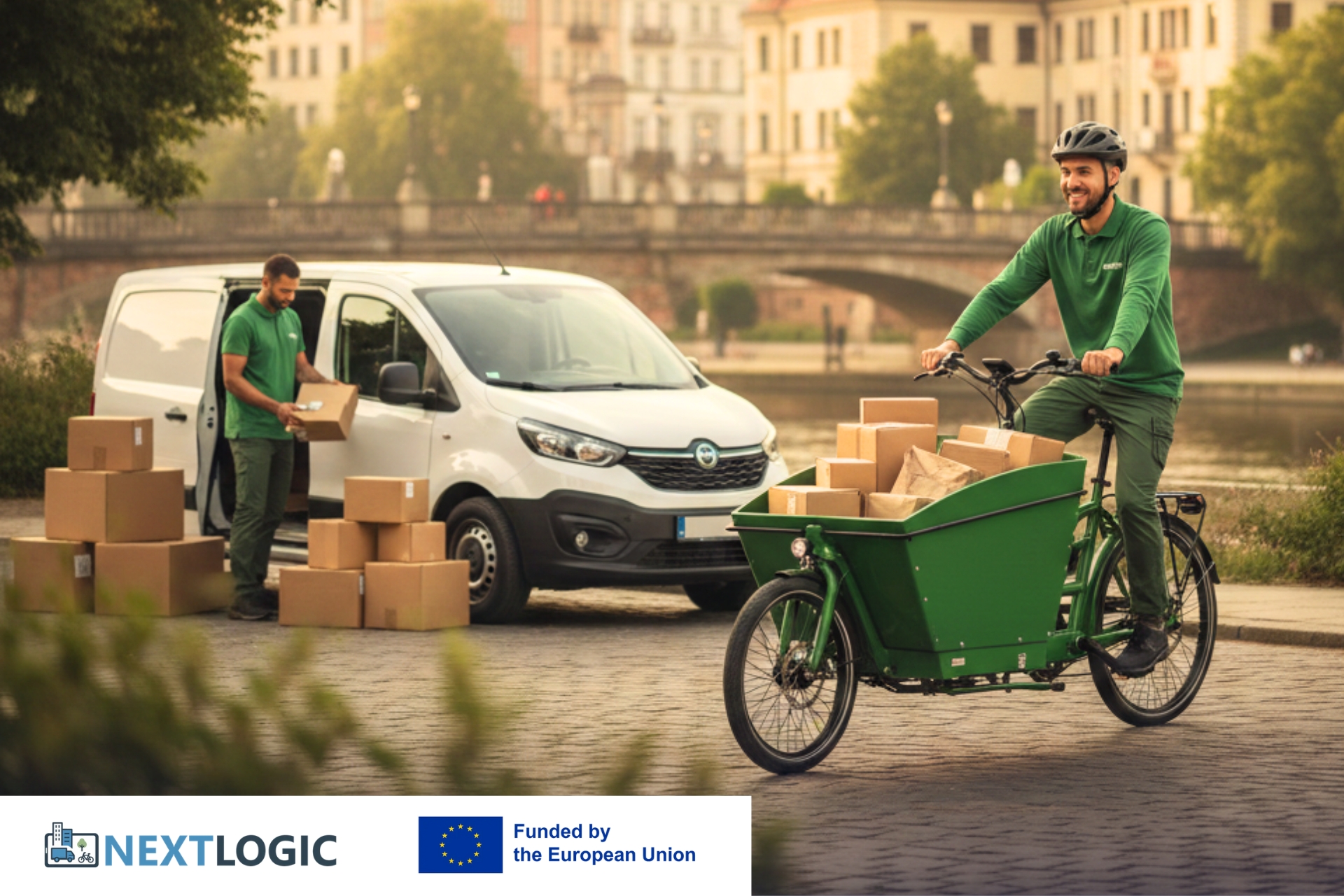
The main goal of NEXTLOGIC is to support cities in transitioning to zero‑emission transport through a new approach to planning and managing people and freight flows. The project promotes a comprehensive system redesign—from infrastructure and loading zones, through mobile logistics microhubs using cargo bikes, to data‑driven, real‑time traffic and logistics management.
A major innovation is the integrated view of passenger and freight mobility—two systems typically competing for the same urban resources (road space, curb zones) while often being managed in separate decision-making “silos.”
Digital tools shaping the city
NEXTLOGIC’s technological core is an advanced Digital Twin enhanced with Extended Reality (XR) and gamification elements.
By integrating real‑time data from vehicles, IoT sensors, and traffic registries, the platform can simulate various urban logistics, last‑mile delivery, or space‑use scenarios before physical implementation.
The project focuses on “street‑level” solutions: mobile microhubs, smart loading/unloading zones, better integration of e‑mobility with existing infrastructure, and support for the 15‑minute city concept—where key services are accessible within a short walk or ride. This approach reduces emissions, congestion, and safety risks while freeing public space for socially valuable uses.
Wrocław and WUEB in NEXTLOGIC
Wrocław is one of eight European pilot cities, alongside Dublin, The Hague, Aarhus, Differdange, Heidelberg, Frankfurt, and Bergamo.
The Wrocław University of Economics and Business (WUEB) leads key research tasks on designing, launching, and evaluating an innovative mobile logistics microhub.
Specific objectives in Wrocław include:
- Mapping needs and expectations of stakeholders (local authorities, courier companies, logistics operators, local businesses, and the FQPW members).
- Developing a decision-support tool for location selection and functional design of the microhub (e.g. using AHP, PROMETHEE methods).
- Implementing and testing the pilot microhub with cargo bikes, along with monitoring impacts (delivery efficiency, emissions, safety, use of public space, active mobility).
- Assessing scalability and replication potential in other European cities.
DT and XR technologies play a key role—not only in monitoring the hub’s performance but also in visualising scenarios for stakeholders, engaging citizens in co‑creation, and assessing impacts before broader rollout.
The project will provide empirical insight into how microhubs influence last‑mile efficiency, emissions, traffic safety, public space use, and active mobility. This makes Wrocław—through WUEB’s contribution—a reference point for other European cities integrating modern technology, sustainable logistics, and participatory urban design.
Measuring impact
NEXTLOGIC assesses impact continuously from the start in three dimensions—environmental, social, and economic—covering emissions, environmental quality (e.g., carbon footprint), safety, accessibility, cost‑effectiveness, and urban deployment conditions.
Scaling and replication
The project develops governance, business, and financial models to support post‑pilot implementation and replication in other cities. Recommendations and practical materials will help local authorities plan and fund follow-up actions.
Key SDGs addressed by NEXTLOGIC
SDG 11 – Sustainable Cities and Communities
Urban logistics and mobility solutions (microhubs, smart zones, passenger–freight integration) improve accessibility, reduce congestion, and optimise public space use.
Eight pilot cities offer replicable models for more liveable, accessible, and efficient urban environments.
SDG 13 – Climate Action
The project targets emission reduction through low‑ and zero‑emission logistics (electric cargo bikes, smarter routing, real‑time data integration, infrastructure optimisation). It supports the EU Mission “100 Climate‑Neutral and Smart Cities by 2030.”
SDG 9 – Industry, Innovation and Infrastructure
By applying digital tools such as Digital Twin, XR, and real‑time analytics, NEXTLOGIC modernises and improves management of urban transport and logistics infrastructure. It also develops new service models and decision‑support instruments for cities, operators, and businesses.
SDG 7 – Affordable and Clean Energy (indirectly)
The project promotes “smart energy solutions” linking green energy production with local consumption (e.g. for e‑mobility), improving renewable energy efficiency.
SDG 8 – Decent Work and Economic Growth (indirectly)
By increasing efficiency in logistics and mobility, NEXTLOGIC supports business competitiveness, stimulates new services (such as cargo‑bike last‑mile logistics), and fosters sustainable business models.
SDG 17 – Partnerships for the Goals
NEXTLOGIC brings together 34–35 partners from 13 countries—cities, universities, research institutes, companies, and logistics clusters—forming a flagship multilateral partnership for climate and sustainability goals.
External links:
More information about the project in the WIR Knowledge Base
Funded by the European Union. Views and opinions expressed are however those of the author(s) only and do not necessarily reflect those of the European Union or European Climate, Infrastructure and Environment Executive Agency (CINEA). Neither the European Union nor the granting authority can be held responsible for them.
Project manager:

Project contractors:
Assoc. Prof. Natalia Szozda, PhD
Assoc. Prof. Krzysztof Nowosielski, PhD
Assoc. Prof. Agnieszka Jagoda, PhD
Prof. Jarosław Witkowski, PhD
Dr Tomasz Kołakowski
Funding entity:

European Union
Contest:
Horizon Europe
Topic:
HORIZON-MISS-2024-CIT-01-01
Type: HORIZON-IA
Grant Agreement No.:
101238585
Amount of funding for WUEB:
800.125,00 €
Coordinator:
Université du Luxembourg
Consortium:
34 organisations
Project duration:
01/01/2026 – 31/12/2029
Status of projects:
Project in progress
See similar content
Bridging V4 Universities and Business through Design Thinking
A New Form of Fat: A More Sustainable Product Formulation. WaterSmartFat Brings Together Food Technology and Water Footprint Analysis

Microwaves and Silymarin – An Innovative Approach to Enhancing the Health Value of Milk Thistle Sprouts

New photoactive niobium(V)-containing oxide compounds as photocatalysts forthe purification of drinking water from organic micropollutants
See also
How can economic fluctuations be smoothed? The 2026 Nobel Prize in Economic Sciences through the eyes of WUEB researchers
The World Within Wrocław’s Reach. How the PROM research mobilities confirm WUEB’s place on the map of global academia
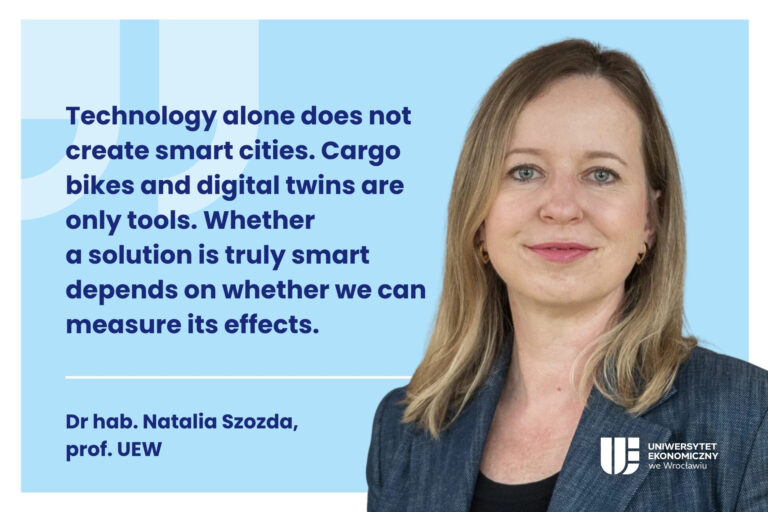
Wroclaw’s micro-hub at the Economic Forum. Natalia Szozda, Associate Professor, on when a city truly becomes smart
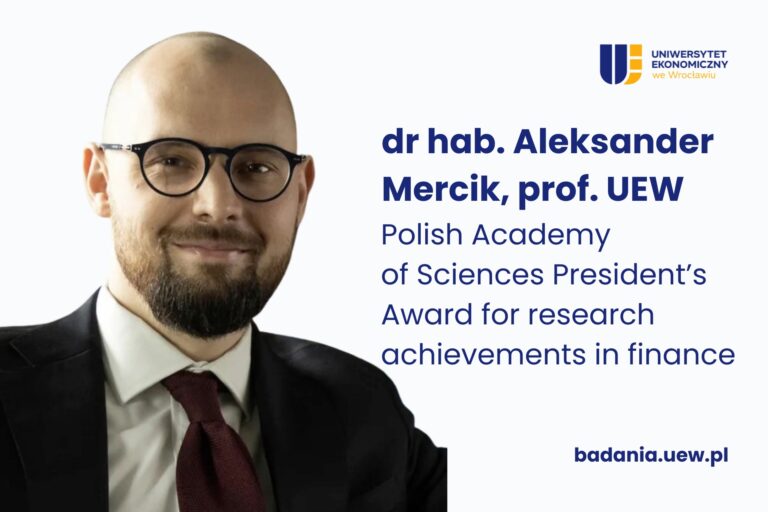
Dr hab. Aleksander Mercik, Professor of the WUEB, receives the Andrzej Gospodarowicz Award in Finance from the President of the Polish Academy of Sciences

WUEB Experts Weekly Review. Research, Projects and Academic Successes (5–11 October 2026)
Wroclaw University of Economics and Business researchers among the world’s leading scientists: six included in the 2026 World’s Top 2% Scientists database
WUEB Experts Weekly Review: Research, Projects and Academic Successes (28 September–4 October 2026)