
A Chinese cargo ship, the threat of an embargo and a European chip producer. “Our relations resemble a plate of spaghetti: we can see both ends of each strand, but not its exact course.” How secure is Europe when ships, raw materials and microchips become tools of geopolitical pressure? Commentary and analysis by Przemysław Skulski, Associate Professor at WUEB, and other experts can be found at badania.uew.pl – a space for clear, competent voices in an increasingly noisy world. A container vessel leaving Ningbo, an embargo on rare earth metals and a dispute over a European semiconductor plant sound like the plot of a geopolitical thriller. Yet they describe the very real situation the European Union faces today. These intertwined international processes are precisely what Dr hab. Przemysław Skulski, Associate Professor at WUEB, an expert in security and international relations, explains.
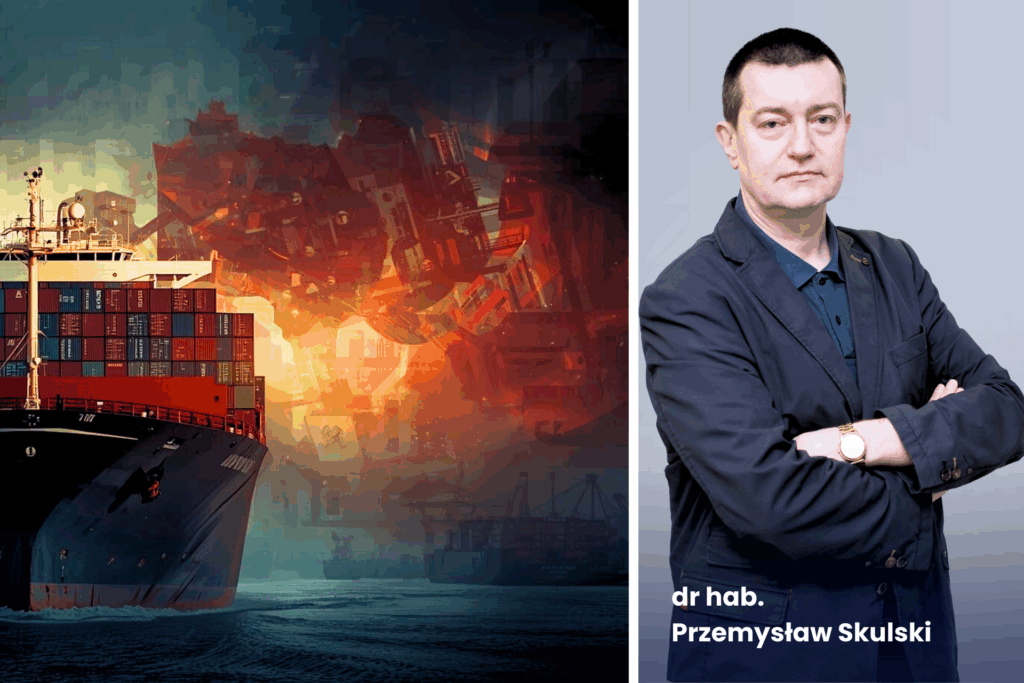
The story begins on 23 September in the port of Ningbo-Zhoushan, where the Istanbul Bridge sets off with cargo worth around USD 200 million – including photovoltaic cells, batteries and textiles. The ship follows a new northern route across the Arctic Ocean, cutting travel time by half compared with the Suez Canal. For Poland and Central Europe, this opens an opportunity to strengthen Gdańsk’s position in global trade. At the same time, the route depends on Russian icebreakers.
Meanwhile, China announces an embargo on rare earth metals – the 17 elements essential for producing magnets, electric vehicle engines, processors, smartphones and modern fighter jets. Beijing’s advantage stems not only from its deposits, but from its control over around 60% of global extraction and 90% of refining capacity.
In parallel, tensions escalate around Nexperia – a European company owned by a Chinese investor and a critical supplier for the automotive sector. US sanctions, decisions by Dutch authorities, resistance from Chinese facilities and the suspension of semiconductor wafer shipments threaten to halt production in EU automotive factories, including those linked to Poland’s supply chain, where roughly 400,000 people work.
A web of dependencies: Associate Professor Skulski on the vice in which Europe finds itself
In a short span of time, two “jaws” of China’s geopolitical vice become visible:
- dependence on critical raw materials,
- dependence on components manufactured in China.
Professor Arkadiusz Kowalski (SGH) notes that Beijing deliberately shifts towards those parts of the value chain that generate the highest margins – design, technology control and strategic components. China no longer aims to be merely an assembly hub, but a place where key technological decisions are made.
At this point, Associate Professor Przemysław Skulski (WUEB) brings the discussion to the security and political dimensions of the economy. He notes that Europe cannot fully “trace” decision-making processes in Beijing from the outside, yet the correlation of events – the Nexperia dispute and the threat of an embargo – is not accidental.
Associate Professor Skulski’s key diagnosis
“Europe’s web of dependencies on China has grown so large that it is genuinely difficult to follow each individual thread.”
This image reaches far beyond a single company or a single ship. Skulski shows that Europe is entangled in a structure where every move – regulatory, commercial, investment-related – has both an economic and a security dimension.
Derisking, not decoupling: how the EU can regain agency
The European Commission speaks of its ReSource EU programme and repeats the formula “derisking, not decoupling” – reducing vulnerabilities rather than cutting ties altogether. Yet the figures on raw materials and semiconductors illustrate how far Europe still is from real autonomy.
According to Associate Professor Skulski:
- the EU cannot simply “cut itself off” from China due to the depth of existing interdependencies,
- China still sees Europe as an attractive market, which gives Brussels at least some negotiating leverage,
- in critical raw materials and technologies, Europe must actively rebuild its competitiveness instead of assuming that Western advantage is permanent.
Losing Nexperia – along with the possible transfer of processes and technologies to China – would be a blow extending far beyond a single sector. It serves as a symbolic test of whether the EU can protect its strategic technological assets while managing risk in relations with Beijing.
Skulski also highlights the implications for Poland: the lack of comprehensive logistics infrastructure around the Port of Gdańsk limits the impact of voyages like that of the Istanbul Bridge today. Yet from China’s long-term perspective, a 20-30-year horizon is not distant at all. It is a reminder that Poland, too, must think strategically – beyond a single political term.
Author: Barbara Grzelczak
See similar content

WUEB Experts Weekly Review. Research, Projects and Academic Successes (12–18 October 2026)
How can economic fluctuations be smoothed? The 2026 Nobel Prize in Economic Sciences through the eyes of WUEB researchers
Wroclaw’s micro-hub at the Economic Forum. Natalia Szozda, Associate Professor, on when a city truly becomes smart
WUEB Experts Weekly Review. Research, Projects and Academic Successes (5–11 October 2026)
See also
WUEB Experts Weekly Review. Research, Projects and Academic Successes (12–18 October 2026)
How can economic fluctuations be smoothed? The 2026 Nobel Prize in Economic Sciences through the eyes of WUEB researchers
The World Within Wrocław’s Reach. How the PROM research mobilities confirm WUEB’s place on the map of global academia
Wroclaw’s micro-hub at the Economic Forum. Natalia Szozda, Associate Professor, on when a city truly becomes smart
Dr hab. Aleksander Mercik, Professor of the WUEB, receives the Andrzej Gospodarowicz Award in Finance from the President of the Polish Academy of Sciences
WUEB Experts Weekly Review. Research, Projects and Academic Successes (5–11 October 2026)
Wroclaw University of Economics and Business researchers among the world’s leading scientists: six included in the 2026 World’s Top 2% Scientists database