

“From lab to market” sounds like a sprint. In reality, it is a long-distance run in which researchers, entrepreneurs, lawyers and investors move at different speeds and often along different tracks. In the Radio Wrocław programme „Różne punkty słyszenia” (“Different points of listening”), one of the key voices was Dr Iwo Augustyński from the Wroclaw University of Economics and Business, who very precisely described what universities are really for – and why this matters for the economy.

From “fatal” indicators to the question that really counts
The starting point for the on-air discussion was a report by the Kraków Foundation for Economy and Public Administration titled “University–business cooperation. Poland compared to selected EU countries”. The host quoted figures that are hard to sweep under the carpet. On a scale from 0 to 1, Polish universities scored:
- research collaboration – 0.19
- commercialisation of research – 0.18
- developing entrepreneurial attitudes in cooperation with business – 0.18
The report’s authors diagnose a basic mismatch between the world of universities and the world of business: the two sides know each other too little, understand each other poorly and, as a result, the role of Polish universities in innovation is often marginalised.
The Radio Wrocław studio brought together all the key perspectives:
- startups and technology firms (Kacper Stasiak, Jan Szajda),
- a lawyer specialising in intellectual property protection (Dominika Fikus Graf),
- an expert in information management (Rafał Czarnecki),
- an economist working on innovation (Dr Adam Karpiński),
- and Dr Iwo Augustyński – economist and researcher at the Wroclaw University of Economics and Business.
This line-up was not accidental. The conversation quickly moved beyond statistics. It focused on why good ideas so rarely end up as good products and services, and where exactly the system “jams”.
Science first, business later
Dr Iwo Augustyński structured the discussion by distinguishing two levels of funding.
First, funding for science itself: basic research, staff, infrastructure, equipment. As the UEW expert reminded listeners, in real terms spending on research is falling, and around 1% of GDP for R&D is far too little for universities to keep up comfortably with the global frontier. It is difficult to expect breakthrough results if researchers have limited access to cutting-edge equipment and technologies.
Second, funding for the transition to business. Here the picture looks very different. Dr Augustyński listed:
- university-based business incubators,
- venture capital funds – public, private and co-financed by the European Union,
- EU programmes in which innovation is a condition for receiving support.
This is where the paradox he talked about becomes visible. Referring to conversations with representatives of investment funds, he noted that they have money – “a lot of money” – but “no one to give it to”: there are too few truly innovative ideas they could finance.
The problem, then, is no longer just “too little funding”, but also the limited number of mature, well-prepared projects that can complete the journey from concept to implementation.
Against this background, one sentence from Dr Augustyński resonated particularly strongly:
“The purpose of funding and of the university is not to do business, but to do science.”
A university – including an economics university – is first and foremost an institution that creates knowledge, not a factory producing ready-made products. This does not mean it should stay indifferent to the economy. It does mean, however, that commercialisation does not replace research. It should be an honest consequence of solid science: first research, then proof of concept with a partner, and only then a licence, special purpose vehicle or broader rollout.
Where are the real bottlenecks in science–business cooperation?
Set against the report’s stark results, the other guests’ contributions complemented the UEW expert’s arguments.
Technology entrepreneurs showed that without researchers it is difficult to build a lasting competitive advantage. Cooperation with universities enabled their companies to develop solutions based on deep learning – from analysing scientific articles, through student projects, to large consortia with universities and grants from the National Centre for Research and Development and the Polish Agency for Enterprise Development.
The condition is simple: delivering results. A prototype, a test with a client, a concrete implementation.
Startup representatives added that in practice it is not “institutions” that work together, but specific people on both sides. A particular research group, a particular business team, particular names. For this cooperation to make sense, everyone needs to speak a shared language: clearly define goals, timelines and milestones, while also talking honestly about risk.
Lawyers and intellectual property experts reminded listeners of the importance of “legal hygiene”. The requirement of novelty for patents, well-structured non-disclosure agreements (NDAs) and conscious management of trade secrets are the absolute minimum. Mistakes are often surprisingly simple: publishing results first and only then thinking about protection – when novelty has already been lost. On top of that come rigid template contracts imposed “from the centre”, which do not fit the reality of specific projects.
Economists working on innovation, such as Dr Adam Karpiński, highlighted yet another key point: risk. By definition, invention and innovation do not always end in success – we “get lost” more often than we win. Funding systems – especially public ones – have to take this into account and give young teams room to iterate, without paralysing them with short-term indicators.
What next? The role of university experts in building bridges
The programme painted a coherent picture: science and business need each other, but for research results to reach the market more often, several simple but demanding steps are needed:
- one clear contact path on each side (named people rather than anonymous “institutions”),
- a shared language of outcomes: alongside publications, a clear description of the problem, users and measurable benefits,
- rapid prototyping and client testing instead of months of correspondence,
- good “legal hygiene” from the first meeting (NDA, mapping IP, a simple research contract),
- acceptance that some projects – from a business perspective – will remain “pure science”, but that they still build the knowledge base.
In such a model, experts at universities have a special role. They combine scientific expertise with an understanding of market mechanisms. They can defend the autonomy of research, while at the same time talking very concretely about funding, risk and business models.
This is why the voice of researchers from the Wroclaw University of Economics and Business is so important today in debates about how science can truly – not just in slogans – power business.
badania.uew.pl – because in a world full of noise, calm and competent scientific voices are particularly needed.
Author: Barbara Grzelczak
See similar content

WUEB Experts Weekly Review. Research, Projects and Academic Successes (12–18 October 2026)
How can economic fluctuations be smoothed? The 2026 Nobel Prize in Economic Sciences through the eyes of WUEB researchers
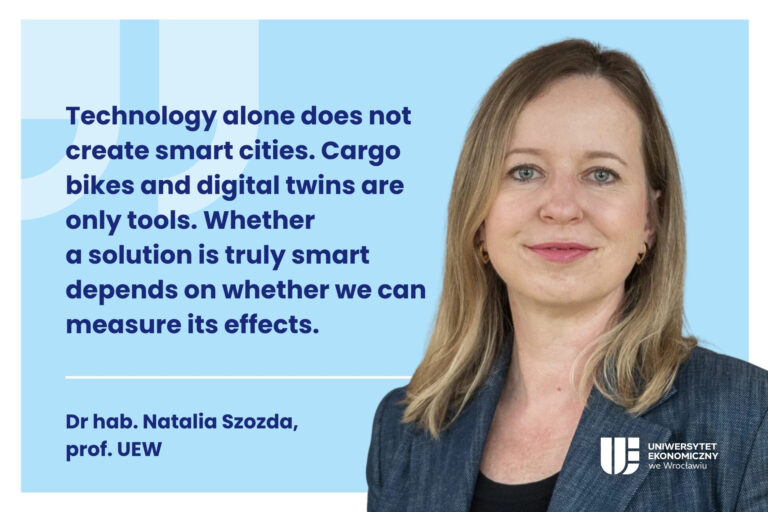
Wroclaw’s micro-hub at the Economic Forum. Natalia Szozda, Associate Professor, on when a city truly becomes smart
WUEB Experts Weekly Review. Research, Projects and Academic Successes (5–11 October 2026)
See also
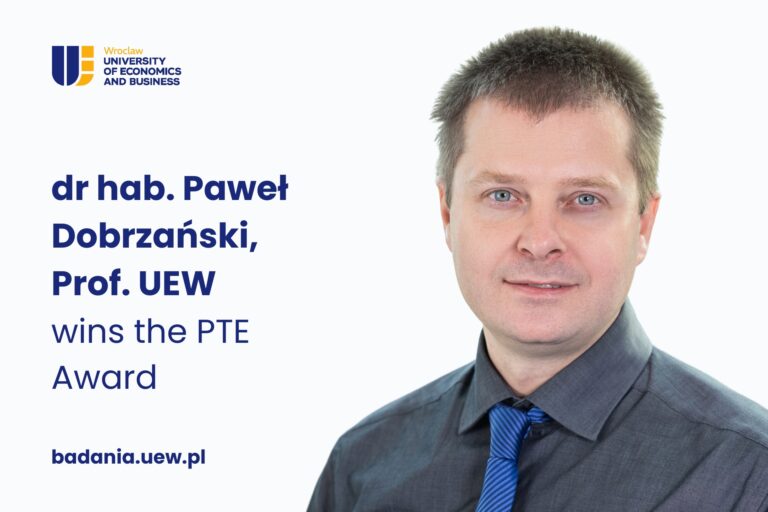
Why do some regions of Europe grow faster than others? Dr hab. Paweł Dobrzański, Associate Professor at UEW, wins the PTE Award
WUEB Experts Weekly Review. Research, Projects and Academic Successes (12–18 October 2026)
How can economic fluctuations be smoothed? The 2026 Nobel Prize in Economic Sciences through the eyes of WUEB researchers
The World Within Wrocław’s Reach. How the PROM research mobilities confirm WUEB’s place on the map of global academia
Wroclaw’s micro-hub at the Economic Forum. Natalia Szozda, Associate Professor, on when a city truly becomes smart
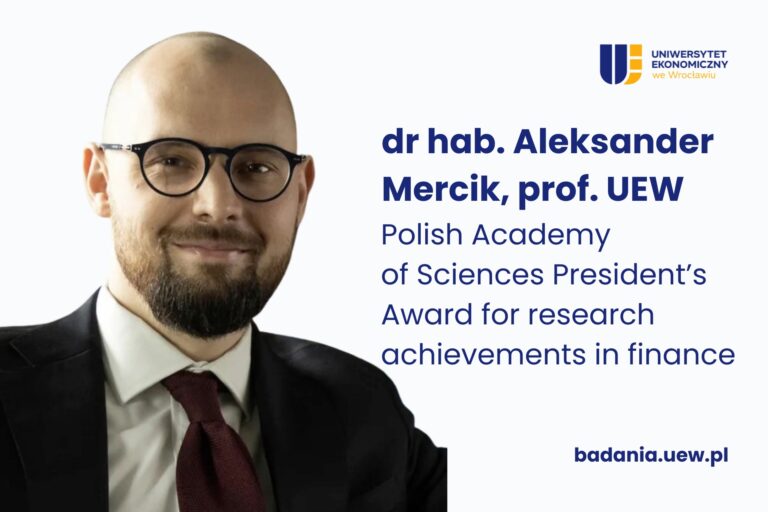
Dr hab. Aleksander Mercik, Professor of the WUEB, receives the Andrzej Gospodarowicz Award in Finance from the President of the Polish Academy of Sciences
WUEB Experts Weekly Review. Research, Projects and Academic Successes (5–11 October 2026)