
This autumn marks one year since Donald Trump began his second term as President of the United States. It is undeniable that his political style has contributed to the turbulence of global markets. But is there a method behind this apparent chaos? This was the central question addressed by Bożena Ryszawska, PhD, Professor at WUEB, in her conversation with Paweł Czuma, Editor-in-Chief of Echo24.
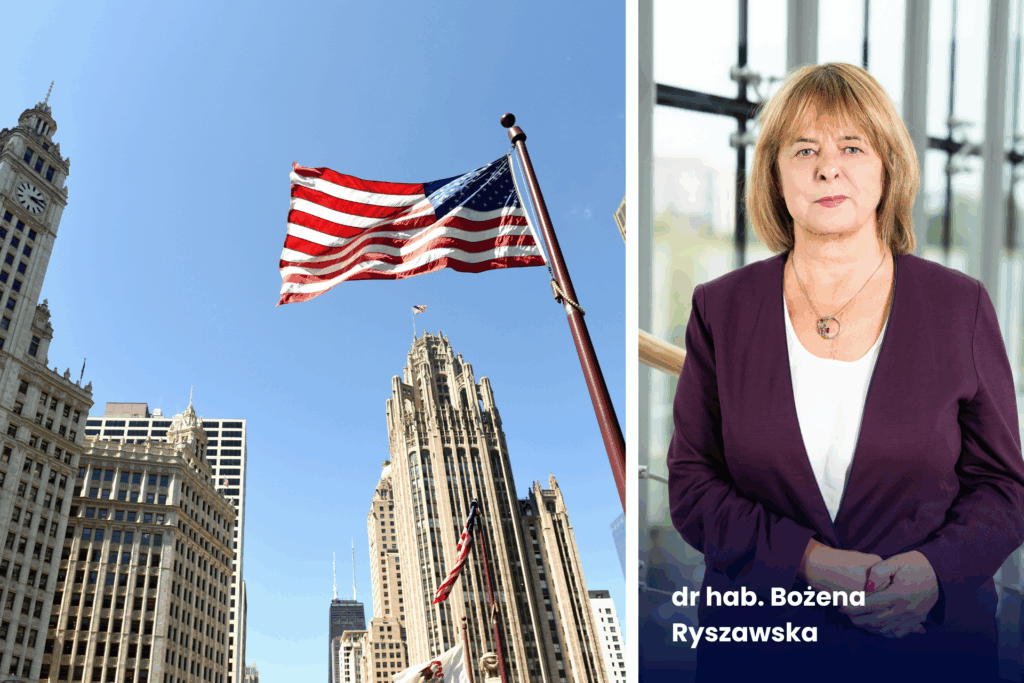
Severe budget cuts, announcements of reducing America’s presence in Europe, an emotional meeting with Volodymyr Zelensky, and the introduction—followed by the withdrawal—of tariffs: these are only a few of the pivotal events of Trump’s second presidency, less than a year into his term. In the “Time for Economics” program, Prof. Ryszawska discussed the underlying principles of Trump’s political style and the deeper causes of his electoral success.
Prof. Ryszawska began by highlighting the economic developments of recent decades that led to Trump’s election as the 45th and 47th President of the United States:
“Over the past 35 years, globalization has been pursued through a neoliberal model of capitalism (with open markets and free flows of capital, people, and services). America’s innovative and technological advantage was harnessed to serve the primary goal of capitalism: ‘it must be cheaper.’ This was achieved through outsourcing to countries offering lower production costs—primarily in Asia. However, the margins generated from this cheap production were captured largely by American entrepreneurs.”
She emphasized the unequal distribution of profits and the structural transformation of the U.S. economy, which became central issues in Trump’s electoral campaign:
“Over time it turned out that the benefits of globalized, low-cost production did not reach all citizens. They were instead concentrated in the financial sector. Many scholars speak of a shift toward financial capitalism, in which the American economy focuses on a handful of sectors—IT, the defense industry, and especially finance—without generating sufficient jobs for technically trained workers. This explains phenomena such as the Rust Belt or the bankruptcy of Detroit. Trump’s main argument, supported by his advisors, was that this trajectory had to change.”
In this departure from classical manufacturing, Prof. Ryszawska also sees the roots of Asia’s rising importance and the growing power of China, which now challenges U.S. dominance both economically and politically:
“After decades of globalization, America’s advantage based on the dollar and military power has diminished. Today, China and Asian countries—once poor subcontractors—have become major economic players with not only manufacturing capacities but also innovation, skilled labor, their own know-how, and technological leadership. Asia’s economic strength is now becoming political strength.”
Against this backdrop, she noted Trump’s focus on America’s domestic agenda—policies intended not only to improve the wellbeing of U.S. citizens but also to restore the attractiveness of the American development model:
“The slogan ‘America First,’ promoted by Trump and his advisors (among them highly educated economists such as Stephen Miran), calls for the reindustrialization of the U.S. Americans should undertake actions that put their country first. Rebuilding industry is meant to raise citizens’ prosperity. At the same time, America plans to retreat from military interventionism—stepping back from being the ‘global sheriff’ financing world order. The priority now is to defend U.S. interests, particularly in opposition to China, which is viewed as both an economic and political rival.”
High tariffs imposed on America’s trade partners—both in Asia and Western Europe—are one of the tools to achieve this reindustrialization. Yet, as Prof. Ryszawska stressed, this is not a straightforward process:
“By introducing high tariffs, the U.S. is trying to curb imports, which today are the primary source of consumer goods. The idea is to push importers to relocate production to America. But this is not just about capital or factories—it also requires skilled workers to operate the machinery. Analyses show that, due to the long abandonment of vocational training, the U.S. currently lacks the workforce with such competencies.”
Despite America’s limited readiness for this transformation, Prof. Ryszawska sees effectiveness in Trump’s approach, stemming largely from his unique political style:
“Through his ‘theatrical’ style of politics—clearly visible in the game of imposing and withdrawing tariffs—Trump achieves results more quickly. He acts unilaterally, intimidates, retreats, but ultimately secures his goals. This entire performance is designed to send a message, and that message has been received not only in China and Asia but also in Europe, especially regarding security financing.”
When asked about the legitimacy of Trump’s methods, Prof. Ryszawska replied:
“Even if we dislike Trump’s politics, we must acknowledge the change that is coming. The most important element is that the existing social contract between politicians and citizens no longer works: a new contract, a new dialogue, and a new definition of goals are needed. Profit generation remains important, but people now also demand justice, redistribution, and the reduction of inequality. This tension divides Democrats, who favor market freedom and globalization, and Republicans, who call for a stronger role for the state.”
She also pointed to the reasons for Trump’s electoral success, highlighting the Republicans’ stronger sensitivity to social moods and their emphasis on the state’s role in addressing challenges:
“Currently it is the Republicans who better diagnose the problems facing Americans and seek solutions—this is fundamental to the social contract. No government can stay in power if it does not serve citizens by ensuring fair wages, opportunities for growth, or access to essential social services. The present situation shows that to tackle today’s challenges—redistribution of wealth, climate change, security—we must involve all actors, including the state. Market mechanisms alone cannot solve them. Paradoxically, Trump, despite being a representative of the wealthiest elites, better recognized that previous governments had failed to uphold the social contract.”
The full conversation can be viewed on Echo24: https://echo24.tv/pl/757_programy/859_rozmowa/86744_czy-w-szalenstwie-trumpa-jest-metoda.html
Author: Sebastian Rogalski
See similar content

WUEB Experts Weekly Review. Research, Projects and Academic Successes (24 – 30 August 2026)
WUEB experts weekly rewiev. Research, Projects and Academic Successes (17–23 August 2026)
WUEB Experts Weekly Review. Research, Projects and Academic Successes (10–16 August 2026)
WUEB Experts Weekly Review: Research, Projects and Academic Successes (3–9 August 2026)
See also
What comes after a PhD? Dr Milena Kowalska at the Economic Forum in Karpacz

Bridging V4 Universities and Business through Design Thinking
WUEB Experts Weekly Review. Research, Projects and Academic Successes (24 – 30 August 2026)
Visual Simulation of Business Processes (WSPB) joins the Polish Roadmap for Research Infrastructures
WUEB experts weekly rewiev. Research, Projects and Academic Successes (17–23 August 2026)

WUEB awarded Visegrad grant to study the skills gap across the V4
Prof Małgorzata Krzywonos joins the Management Committee of COST Action BRASSCHI