
In early June 2025, the first shared transshipment microhub in Poland was launched in Wrocław. Dr hab. inż. Maja Kiba-Janiak, Associate Professor at Wroclaw University of Economics and Business, discussed the idea of the project and its benefits for the city, businesses, and delivery providers in the Echo24 television programme Time for Economics.
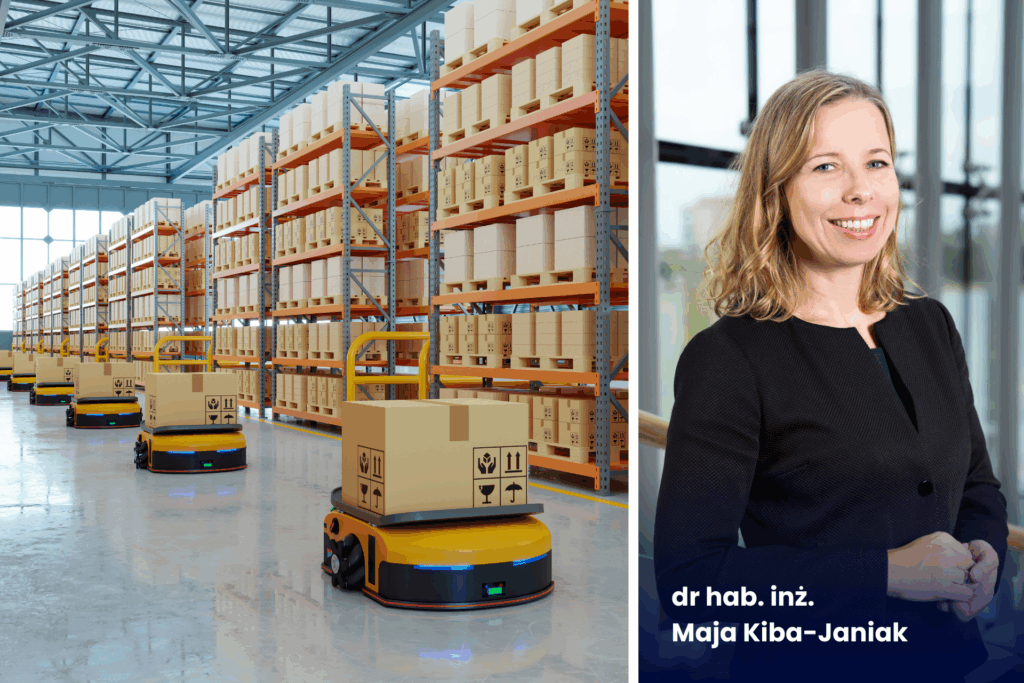
In conversation with editor Jakub Dworzecki, Prof. Kiba-Janiak – coordinator of the agreement on the Partnership for Freight Handling in Wrocław’s Historic Centre – presented the main assumptions of the initiative developed jointly with the City of Wrocław and its partners:
“The road to launching the microhub was quite long. In 2023, as the Wroclaw University of Economics and Business, we signed a letter of intent with the Wrocław City Office regarding a Partnership for the Quality of Freight Handling in the Historic Centre of Wrocław. The idea was to initiate and jointly organize various tasks and projects to implement sustainable urban transport. A year ago, 24 entities joined this initiative: courier companies, foundations, a food distributor, as well as other universities.”
How does the microhub work? The principle is simple: suppliers use designated spaces in the underground car park of the National Forum of Music, from where goods are distributed by cargo bikes to their recipients:
“The idea of the microhub is that courier companies deliver goods with vans up to 3.5 tonnes to their designated storage boxes in the NFM car park. From there, the goods are distributed throughout the day by cargo bikes within the centre of Wrocław.”
Why was the decision made to launch the microhub? The primary reason was the growing concern about traffic in the very heart of the city:
“More and more cities, including Wrocław, are restricting access to their historic centres. The delivery time window is between 6:00 and 10:00 a.m. – after that, no vehicle, not even an electric one, is allowed to enter the inner city. A cargo bike, on the other hand, is only 90 cm wide, which makes it possible to use cycle lanes and continue deliveries throughout the entire day.”
Prof. Kiba-Janiak also highlighted the benefits that all stakeholders involved in the project can expect – from the city itself, through logistics providers, to end customers:
“The European Union has set out specific zero-emission targets that impose various regulations on cities. Wrocław has committed to implementing this objective in its central zone. We are already seeing positive outcomes of the microhub project: one of the companies operating there now sends only three delivery vans (DMC up to 3.5 t) within the permitted morning time window, instead of six. Additionally, a fourth vehicle (DMC up to 7.5 t) is stationed at the microhub, from which goods are continuously delivered to the city centre by cargo bikes. On the one hand, this increases delivery efficiency, and on the other, it helps reduce the number of vans circulating in the city centre.”
Listen to the full interview on Echo24 TV: https://echo24.tv/pl/757_programy/856_czas-dla-ekonomii/87152_czas-dla-ekonomii-centrum-przeladunkowe-w-sercu-wroclawia.html
More about the project: https://uew.pl/mikrohub-przeladunkowy-wroclaw/
Author: Sebastian Rogalski
See also

WUEB Experts Weekly Review. Research, Projects and Academic Successes (24 – 30 August 2026)
WUEB experts weekly rewiev. Research, Projects and Academic Successes (17–23 August 2026)
WUEB Experts Weekly Review. Research, Projects and Academic Successes (10–16 August 2026)
WUEB Experts Weekly Review: Research, Projects and Academic Successes (3–9 August 2026)
Related content
What comes after a PhD? Dr Milena Kowalska at the Economic Forum in Karpacz

Bridging V4 Universities and Business through Design Thinking
WUEB Experts Weekly Review. Research, Projects and Academic Successes (24 – 30 August 2026)
Visual Simulation of Business Processes (WSPB) joins the Polish Roadmap for Research Infrastructures
WUEB experts weekly rewiev. Research, Projects and Academic Successes (17–23 August 2026)
WUEB awarded Visegrad grant to study the skills gap across the V4
Prof Małgorzata Krzywonos joins the Management Committee of COST Action BRASSCHI