
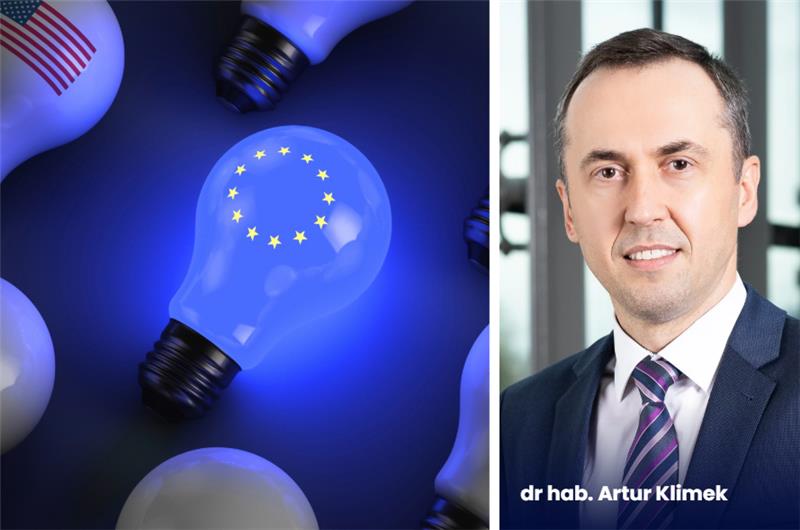
In a recent expert commentary for Dziennik Gazeta Prawna, Prof. Artur Klimek, Ph.D., from the Wroclaw University of Economics and Business (WUEB), analyzes how political and economic shifts in the United States are shaping Europe’s position in the global competition for talent and innovation. The article explores, among other topics, U.S. restrictions on admitting international students and researchers, and how European universities are becoming increasingly attractive to global talent. According to Prof. Klimek, these changes may offer Europe a unique opportunity to strengthen its research and development potential.
A Transatlantic Contest in the World of Science
The restrictive immigration policies introduced under the Trump administration, including limitations on international students and researchers, alongside a decline in the academic climate at American universities, have the potential to weaken the creative research fabric of the U.S. This opens up new opportunities for Europe. For decades, the continent has been losing leading scientists to American institutions. Today, it has the chance to become a compelling alternative for global talent seeking stability, academic freedom, and a supportive environment for innovation.
Europe – A Chance for Scientific Renewal
Europe’s success depends not only on the strength of its universities but also on the development of a robust innovation ecosystem. “In addition to having strong academic institutions, Europe must build an innovation ecosystem where knowledge is actively used by both start-ups and large enterprises. One of the main barriers is mindset – an approach focused on minimizing risk rather than embracing it.”
Europe Returns to the Game: A New Opportunity for Investors
Geopolitical changes, trade tensions, and the growing U.S. national debt are pushing investors to seek alternatives to the American market, long favored under the assumption of TINA – There is no alternative. The European market is regaining relevance – especially defense-sector companies, which are now supported by Germany’s lifting of debt limits and substantial fiscal stimulus packages.
Investments in energy transition and security may further boost the region’s economic outlook. At the same time, Europe must actively compete with rising Asia by offering a combination of stability and innovation. Even a modest increase in the euro’s share of global currency reserves could significantly raise demand, although a stronger euro may pose risks to export performance.
Europe Must Begin with Domestic Reform
What remains lacking is a coherent strategy. Political fragmentation among EU member states continues to hamper effective action. Despite being the EU’s sixth-largest economy, Poland remains on the sidelines of these changes – constrained by a small capital market and limited access to knowledge resources. If Europe wants to seize this moment of global realignment, it must not only capitalize on others’ missteps but also strengthen its own position from within.
The original article was published in Dziennik Gazeta Prawna (GazetaPrawna.pl) and authored by Prof. Artur Klimek, Ph.D., from the Wroclaw University of Economics and Business.
Source: Dziennik Gazeta Prawna, July 3, 2025, available at GazetaPrawna.pl
See also

Video games are more than entertainment. WUEB researchers on cooperation between game developers and the cultural and creative industries

Space Logistics, Interplanetary Supply Chains and Interdisciplinary Research and Educational Projects Related to Space at UEW in Jelenia Góra
Wrocław has FinTech potential. A WUEB expert argues it is time to turn that potential into advantage
Academic Entrepreneurship as Architecture of Impact. The New Issue of „Impakt Dolny Śląsk” (2/2025)
Related content

WUEB Experts Weekly Review. Research, Projects and Academic Successes (12–18 October 2026)
How can economic fluctuations be smoothed? The 2026 Nobel Prize in Economic Sciences through the eyes of WUEB researchers
The World Within Wrocław’s Reach. How the PROM research mobilities confirm WUEB’s place on the map of global academia
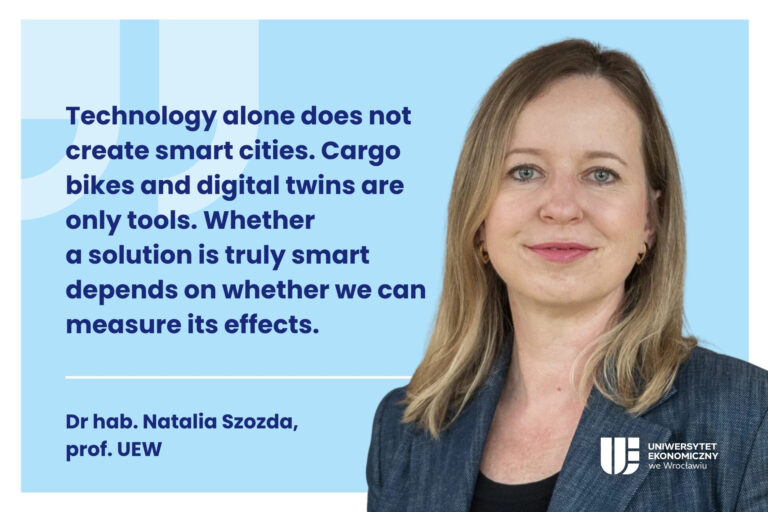
Wroclaw’s micro-hub at the Economic Forum. Natalia Szozda, Associate Professor, on when a city truly becomes smart
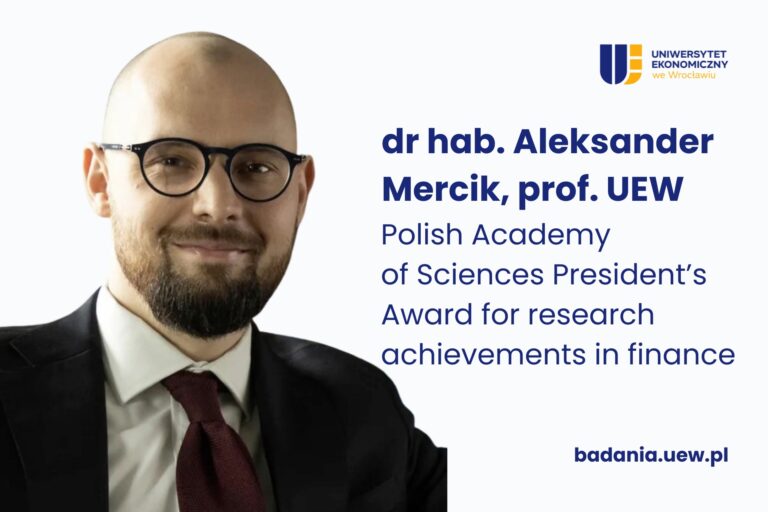
Dr hab. Aleksander Mercik, Professor of the WUEB, receives the Andrzej Gospodarowicz Award in Finance from the President of the Polish Academy of Sciences
WUEB Experts Weekly Review. Research, Projects and Academic Successes (5–11 October 2026)
Wroclaw University of Economics and Business researchers among the world’s leading scientists: six included in the 2026 World’s Top 2% Scientists database