

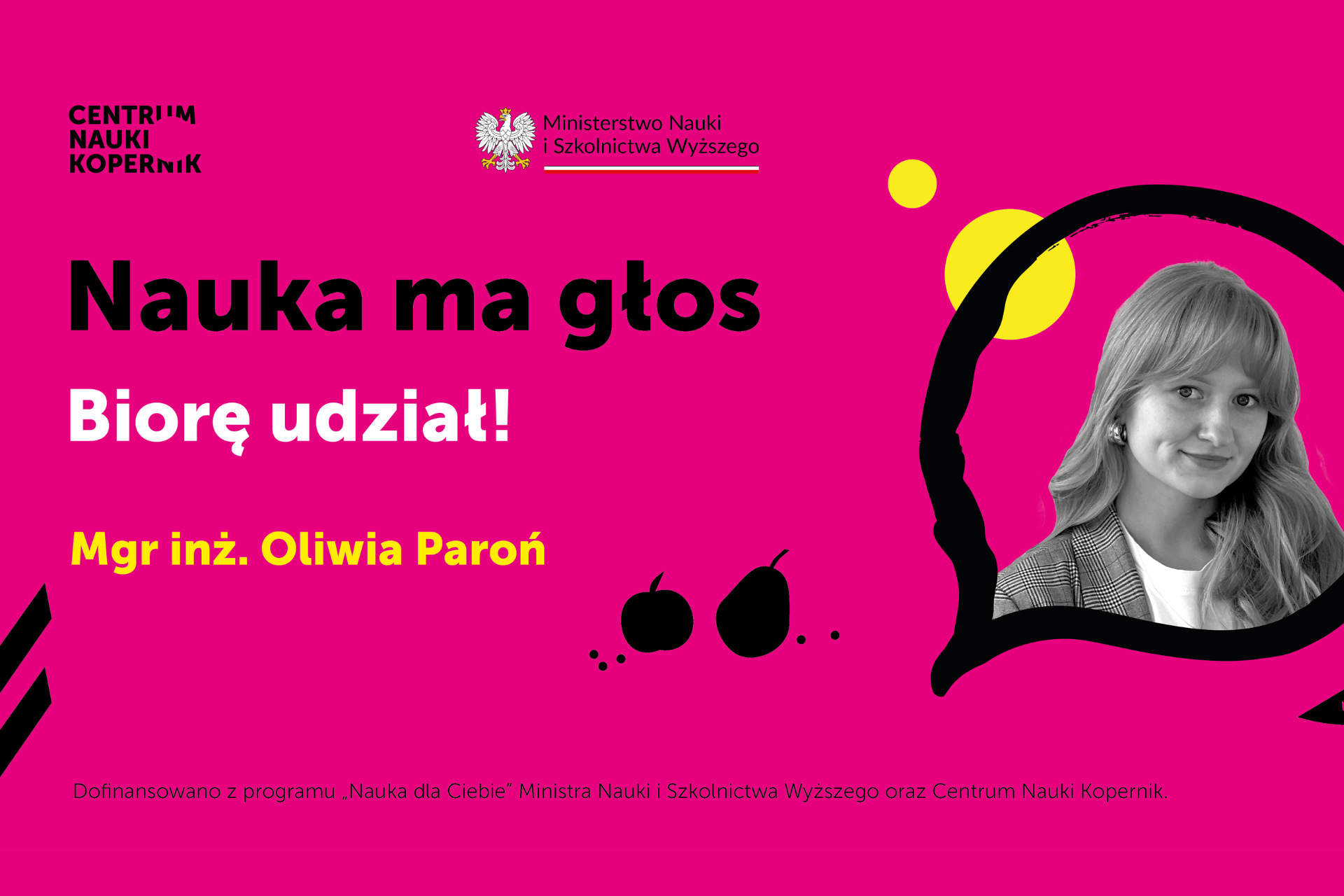
MSc Eng. Oliwia Paroń of the Wroclaw University of Economics and Business is taking part in the nationwide Science Has a Voice project, run by the Copernicus Science Centre and the Minister of Science and Higher Education. Her first session will take place on 19 April at the Copernicus Science Centre and will explore how changes in fat structure affect the properties of food. The project brings together selected researchers from across Poland and is designed around direct public engagement rather than one-way communication.
Science that stays close to people
Science Has a Voice is designed to strengthen trust in science through direct contact between researchers and the public. It is not built around mini-lectures or one-sided presentations. Its value lies in conversation: asking questions, clarifying doubts and creating space for genuine exchange.
Twenty-five researchers from across Poland were selected for the project. Meetings take place both at the Copernicus Science Centre and in SOWA discovery zones across the country.
MSc Eng. Oliwia Paroń’s participation reflects that idea well. Her topic grows out of scientific research, but it leads directly to everyday questions: what determines the properties of food products, why similar ingredients do not always produce the same result, and what really shapes the way food behaves.
How can fat structure be changed without changing composition?
The proposed title of the session, How can fat structure be changed without changing composition?, sits within food technology, a field concerned with designing products that are safe, functional and well received by consumers.
At the centre of the session is a problem that may sound specialised at first, but in practice concerns food encountered every day. Vegetable oils have a favourable fatty acid profile, but they are liquids. That limits their use in many products, including baked goods and creams. Researchers are therefore developing methods of physically structuring oils without chemically altering their composition. Solutions of this kind can make it possible to achieve the required consistency while also improving nutritional value.
Why food structure matters
During the session, the speaker will explain why liquid vegetable oils cannot replace solid fats in many food applications. Participants will be introduced to the difference between liquid and solid fats and will see how strongly material structure affects product properties.
They will also encounter the idea of a product being sensory acceptable: in simple terms, having the right texture, appearance and taste.
This topic shows clearly that food is not simply the sum of the ingredients listed on a label. Its properties also depend on how those ingredients are organised. Two products with a similar composition may behave very differently because their structure is different. Participants will also see, in practice, how structural change affects material properties, why oil and water do not mix, and how a material with solid-like properties can be obtained from liquid oil.
Food science without distance
The central message of the workshop is clear:
“The properties of fats can be shaped by changing their structure, without changing their chemical composition.” – MSc Eng. Oliwia Paroń, Wroclaw University of Economics and Business, participant in the Science Has a Voice project.
This idea captures the point of the session well. It invites people to look at food not only as a list of ingredients, but also as a structure that can be designed deliberately. In this way, food science becomes less distant. It starts to explain things that are very close to everyday life: what we eat, how products are made, and why their properties matter for health and the quality of daily choices.
The first Science Has a Voice session will take place on 19 April at the Copernicus Science Centre. A further session is already scheduled for 29 April at the SOWA Zone of Discovery, Imagination and Activity in Lubin.
Science Has a Voice is delivered and funded under the joint programme of the Minister of Science and Higher Education and the Copernicus Science Centre, titled Science for You. The Science for You programme is financed through a grant from the Minister of Science and Higher Education under the agreement of 23 October 2023, No. MEiN/2023/DPI/3079.
badania.uew.pl – because the world needs competent voices when noise drowns out reason.
Author of text: Barbara Grzelczak
Zobacz podobne treści
Dr hab. Aleksander Mercik, Professor of the WUEB, receives the Andrzej Gospodarowicz Award in Finance from the President of the Polish Academy of Sciences
Wroclaw University of Economics and Business researchers among the world’s leading scientists: six included in the 2026 World’s Top 2% Scientists database
Vitamins C and D in a single plant-based gel: UEW researcher awarded NCN grant
Joanna Radomska of WUEB awarded the title of professor
Zobacz również

WUEB Experts Weekly Review. Research, Projects and Academic Successes (12–18 October 2026)
How can economic fluctuations be smoothed? The 2026 Nobel Prize in Economic Sciences through the eyes of WUEB researchers
The World Within Wrocław’s Reach. How the PROM research mobilities confirm WUEB’s place on the map of global academia
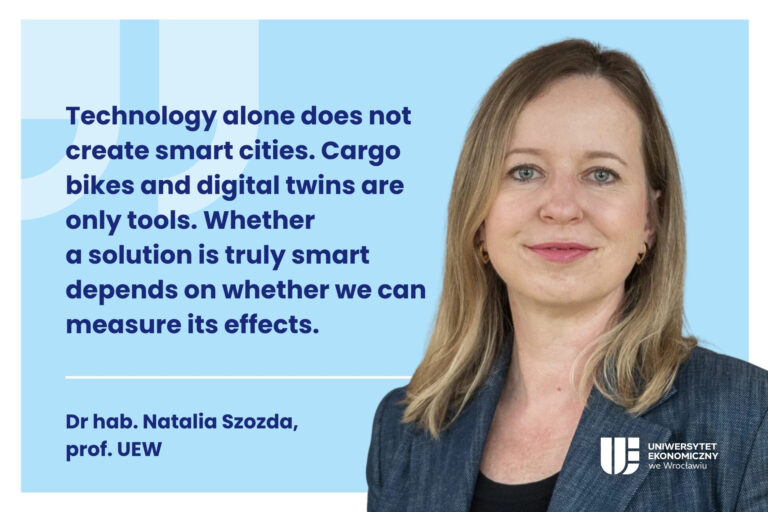
Wroclaw’s micro-hub at the Economic Forum. Natalia Szozda, Associate Professor, on when a city truly becomes smart
Dr hab. Aleksander Mercik, Professor of the WUEB, receives the Andrzej Gospodarowicz Award in Finance from the President of the Polish Academy of Sciences
WUEB Experts Weekly Review. Research, Projects and Academic Successes (5–11 October 2026)
Wroclaw University of Economics and Business researchers among the world’s leading scientists: six included in the 2026 World’s Top 2% Scientists database