

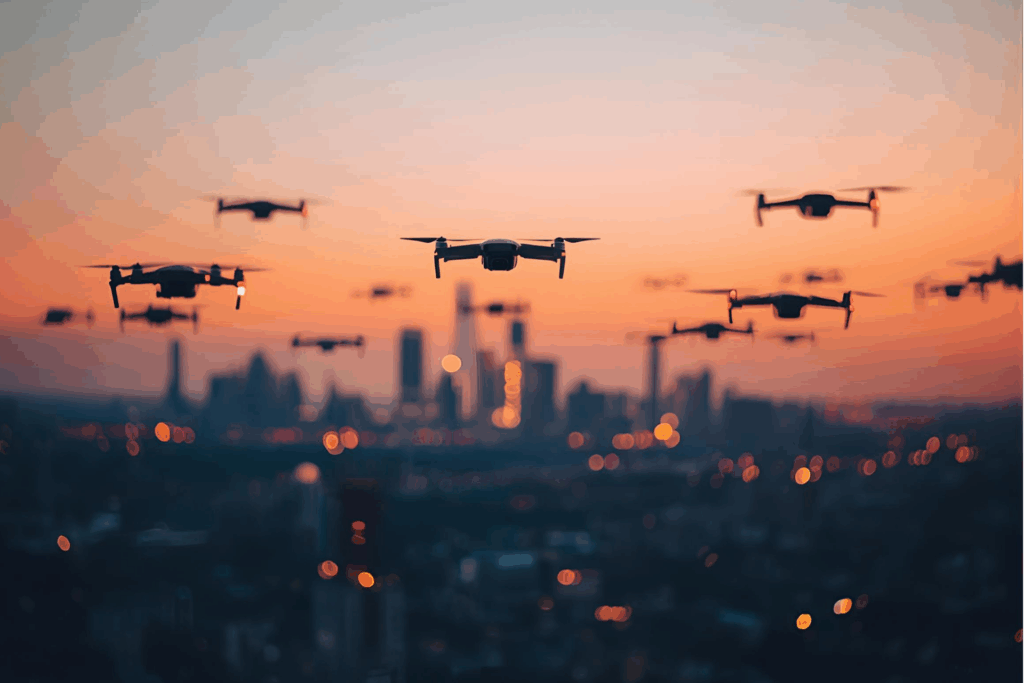
Russian drones over Poland have become a symbol of emerging threats and challenges for the state. In the “Different Points of View” programme on Radio Wrocław, experts from various disciplines discussed security, the economy, and defence strategy. Among them – Phd. Przemysław Skulski, Professor at the Wroclaw University of Economics and Business, whose analysis resonated most strongly.
Lost Potential and the Costs of Security
Professor Skulski reminded listeners that the roots of today’s problems go back to the period of systemic transformation:
“We disarmed ourselves by choice, dismantling a significant part of Poland’s defence industry – above all many research centres. We lost intellectual potential and the ability to conduct international business.”
The lack of institutional continuity meant that Poland forfeited research and export competencies, which are now extremely difficult to rebuild. In the face of new threats, the pressure to purchase armaments has intensified. Yet – as the WUEB expert emphasises – economic limits cannot be ignored:
“This is well-documented worldwide – defence spending exceeding 5% of GDP becomes dangerous. In the long run, it is unsustainable. Security has a price – a very concrete one.”
For Professor Skulski, what matters most is a coherent strategy, ensuring that purchases are not a chaotic reaction but part of a long-term policy.
Technology and Disinformation – Challenges of the 21st Century
Drones have become an indispensable element of contemporary conflicts. Yet Professor Skulski warns against one-sided thinking:
“It is not about discarding drones – absolutely not, because they are the future. But one must remember that in many countries very advanced work is being carried out on anti-drone weapons.”
This means that offensive and defensive systems must be developed in parallel. National defence also requires societal resilience:
“It is crucial to build a wise society, resistant also to fake news, as recent days have shown. This was an unprecedented attack – many people did not expect that information could be manipulated so easily. […] We must not be deceived; we must always verify information through reliable sources.”
For the professor, the fight against disinformation is as vital as the development of defence technologies.
Shared Goals – Different Perspectives
While Professor Skulski’s analyses formed the programme’s central point, other guests added important perspectives.
- Artur Pawlak, President of the National Chamber of Defence Industry Enterprises, called for strengthening private production of drones and ammunition.
- Dr Adam Karpiński (WSB Merito) emphasised NATO and EU alliances as the real guarantees of security.
- Dr Bogusław Węgliński (University of Lower Silesia DSW) underlined the need for education and the preparedness of the civilian population.
The history of Poland’s defence industry – its successes and failures – now shapes the path forward. Rebuilding competences and investing in research are essential if Poland is not only to react to threats but also to consistently build its own security shield.
The interview with Prof. Przemysław Skulski highlights that national security is a complex ecosystem – economy, education, industry, society, and alliances. Poland’s security shield will not be built overnight, but it must be developed consistently, grounded in knowledge and responsible decision-making.
You can listen to the full interview on the Polish Radio website – https://www.radiowroclaw.pl/articles/view/154244/Rozne-punkty-slyszenia-Rosyjskie-drony-nad-Polska-Jak-zbudowac-polska-tarcze-bezpieczenstwa
badania.uew.pl – because the world needs competent voices when noise drowns out reason.
Author: Barbara Grzelczak
See similar content

WUEB Experts Weekly Review. Research, Projects and Academic Successes (12–18 October 2026)

How can economic fluctuations be smoothed? The 2026 Nobel Prize in Economic Sciences through the eyes of WUEB researchers
Wroclaw’s micro-hub at the Economic Forum. Natalia Szozda, Associate Professor, on when a city truly becomes smart
WUEB Experts Weekly Review. Research, Projects and Academic Successes (5–11 October 2026)
See also
WUEB Experts Weekly Review. Research, Projects and Academic Successes (12–18 October 2026)
How can economic fluctuations be smoothed? The 2026 Nobel Prize in Economic Sciences through the eyes of WUEB researchers
The World Within Wrocław’s Reach. How the PROM research mobilities confirm WUEB’s place on the map of global academia
Wroclaw’s micro-hub at the Economic Forum. Natalia Szozda, Associate Professor, on when a city truly becomes smart
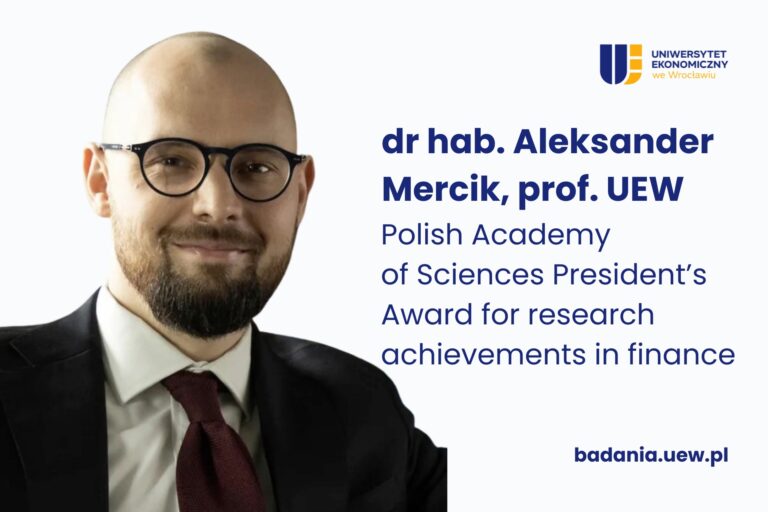
Dr hab. Aleksander Mercik, Professor of the WUEB, receives the Andrzej Gospodarowicz Award in Finance from the President of the Polish Academy of Sciences
WUEB Experts Weekly Review. Research, Projects and Academic Successes (5–11 October 2026)
Wroclaw University of Economics and Business researchers among the world’s leading scientists: six included in the 2026 World’s Top 2% Scientists database