

Planning a holiday was once largely a consumer decision shaped by price, weather and flight availability. Today another question increasingly appears: is the world stable enough to plan a trip months in advance?
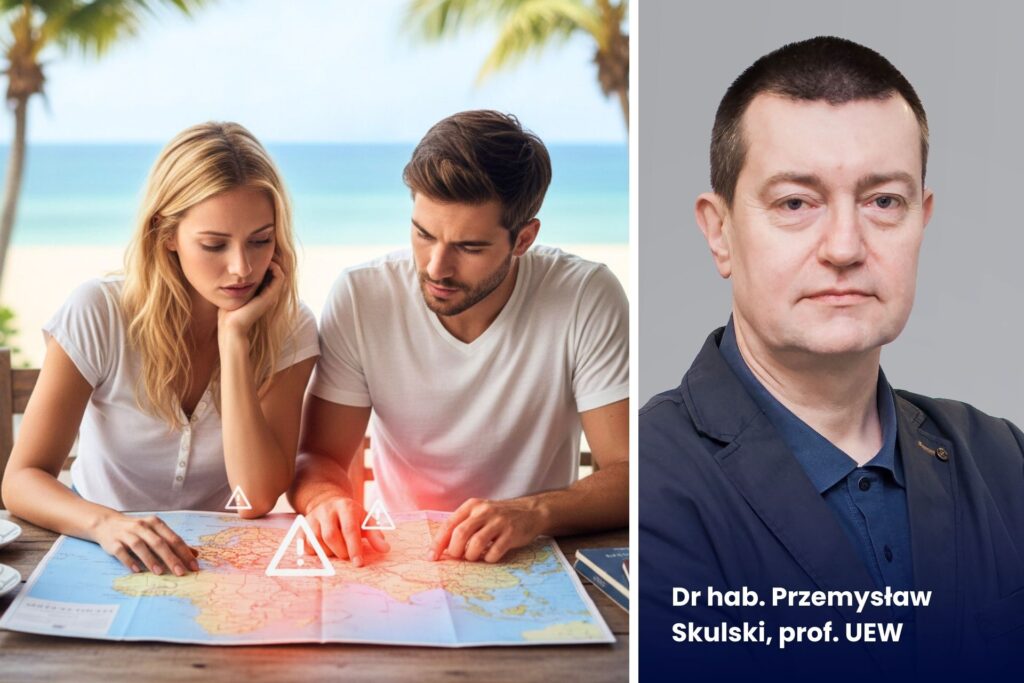
In a conversation on Radio Wrocław, dr hab. Przemysław Skulski, Associate Professor at WUEB, reflects on how geopolitical tensions and security concerns influence tourism and consumer decisions.
The economy does not like uncertainty
In economics there is a simple rule: markets do not like uncertainty. This applies as much to financial investors as to tourists planning their holidays. Armed conflict affects more than the security situation in a region. It also changes the expectations of market participants: airlines, travel agencies, insurance companies and travellers themselves.
According to dr hab. Przemysław Skulski, Associate Professor at WUEB, the first reaction of the market is usually not panic but caution. Travellers begin to analyse offers more carefully, compare destinations and follow official safety advisories.
“Keep a sense of proportion and common sense. (…) It is worth monitoring the situation. Personally, I would wait a little longer.”
This simple conclusion reflects the economic logic of decision-making under risk. When events are volatile, postponing a decision in order to gather more information often becomes the most rational response.
How conflicts reshape tourism
War influences tourism not only through perceptions of danger. It also affects the logistics of travel. Airlines begin to avoid parts of the airspace above conflict zones. As a result, flight routes become longer and fuel costs increase. In practice, this means that even trips to countries far from the immediate area of conflict may become more expensive or time-consuming.
Global aviation hubs also play an important role. Cities such as Dubai have built their position over many years as stable transport centres linking Europe, Asia and Africa. The perception of safety has been one of the key elements of their economic success.
If regional tensions persist, the functioning of the global network of air connections may change. This would affect ticket prices, route availability and, ultimately, the travel decisions of tourists.
Where new tourism emerges
Economic history shows, however, that tourism rarely disappears altogether. More often it changes direction. When some destinations become less accessible or are perceived as risky, travellers begin to choose other parts of the world. A similar pattern could be observed during the COVID-19 pandemic, when interest in domestic tourism increased significantly.
Today some travellers are again considering holidays closer to home, whether elsewhere in Europe or within Poland itself. From an economic perspective, this is a natural process of market adaptation to changing security conditions.
Can Poland benefit from this shift?
Changes in the global tourism market may also create opportunities for countries perceived as stable and safe. As dr hab. Przemysław Skulski, Associate Professor at WUEB, notes, security is becoming one of the key factors influencing the choice of holiday destination. If Poland maintains its image as a predictable and stable country, it may attract travellers who in other circumstances would have chosen more distant destinations.
However, this potential advantage depends on responsible action from the tourism sector. Rapid price increases or an inconsistent offer could weaken this opportunity.
Full interview on Radio Wrocław: https://www.radiowroclaw.pl/articles/view/158779/Rozne-punkty-slyszenia-Bezpieczne-wakacje-Wojna-na-Bliskim-Wschodzie-wszystko-zmienia
The current announcement of the Ministry of Foreign Affairs is available at: https://www.gov.pl/web/dyplomacja/informacje-dla-podrozujacych
badania.uew.pl – because the world needs competent voices when information noise tries to drown out reason.
Author: Barbara Grzelczak
See similar content

WUEB Experts Weekly Review. Research, Projects and Academic Successes (12–18 October 2026)
How can economic fluctuations be smoothed? The 2026 Nobel Prize in Economic Sciences through the eyes of WUEB researchers
Wroclaw’s micro-hub at the Economic Forum. Natalia Szozda, Associate Professor, on when a city truly becomes smart
WUEB Experts Weekly Review. Research, Projects and Academic Successes (5–11 October 2026)
See also
WUEB Experts Weekly Review. Research, Projects and Academic Successes (12–18 October 2026)
How can economic fluctuations be smoothed? The 2026 Nobel Prize in Economic Sciences through the eyes of WUEB researchers
The World Within Wrocław’s Reach. How the PROM research mobilities confirm WUEB’s place on the map of global academia
Wroclaw’s micro-hub at the Economic Forum. Natalia Szozda, Associate Professor, on when a city truly becomes smart
Dr hab. Aleksander Mercik, Professor of the WUEB, receives the Andrzej Gospodarowicz Award in Finance from the President of the Polish Academy of Sciences
WUEB Experts Weekly Review. Research, Projects and Academic Successes (5–11 October 2026)
Wroclaw University of Economics and Business researchers among the world’s leading scientists: six included in the 2026 World’s Top 2% Scientists database