

A paper index book, a formal pledge and the first public speeches – this is how the adventure with the Economic University for Children begins at the Wroclaw University of Economics and Business. For more than a decade, the project has shown pupils in Years 5-6 that finance, entrepreneurship and economic mechanisms can be understood – and even enjoyed.
Why start in Years 5-6?
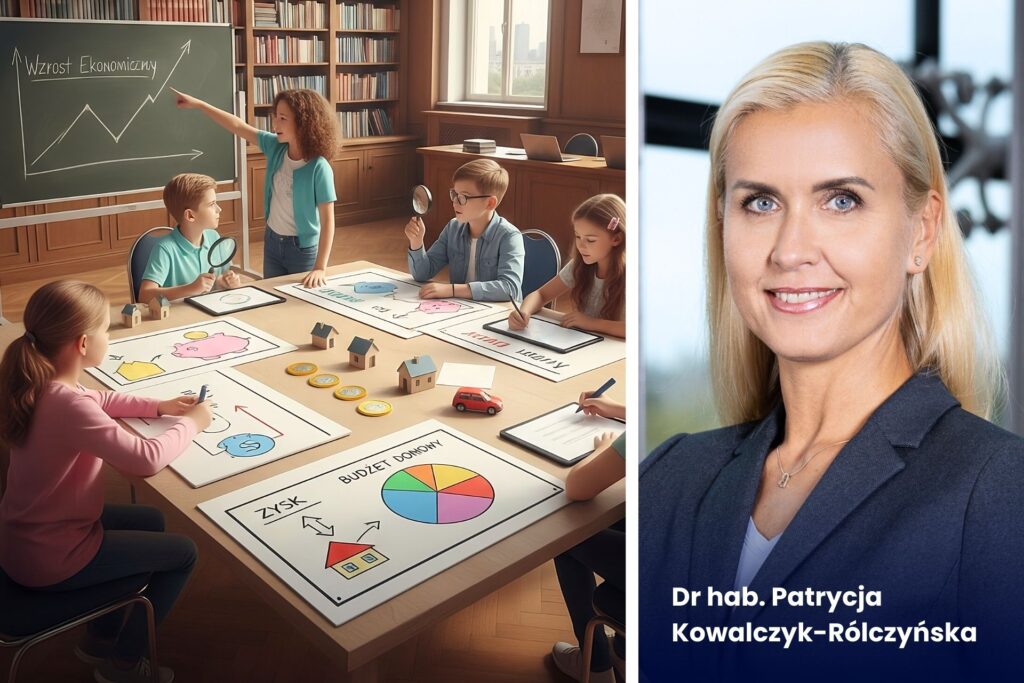
The Economic University for Children (EUD) is aimed at pupils in Years 5 and 6 of primary school. As Patrycja Kowalczyk-Rólczyńska PhD, who leads the programme at WUEB, points out, this is exactly the moment when you can spark children’s interest in economics and offer activities that match their age.
This is also when a natural curiosity about “adult” topics appears: where inflation comes from, what demand and supply are, why we pay taxes. At the Economic University for Children these terms stop being abstract. They are translated into everyday decisions that children and their families make.
A strong strand of the programme is building resistance to misinformation. Children compare what they “read” in social media with reliable academic knowledge. Discussions grow out of the workshops carried out in class, and lecturers explain concepts in an accessible way.
As a result, young participants learn to filter content, check sources and argue their position – digital and civic competences in practice, not just in theory.
What do classes at EUD look like?
The format of the Economic University for Children is simple and ambitious at the same time. Each meeting has three parts:
- Introductory lecture – a short, 20-30 minute talk given in language appropriate to the age group, but without infantilising the audience.
- Team workshop – pupils, supported by WUEB student volunteers, work on a specific task.
- Presentation of results – at the end of the session they present what they have done, practising self-presentation and time management (which is often the hardest part: “we have so much to say!”).
This structure teaches children about roles in a team (leader, analyst, presenter), responsibility for the task and the culture of discussion. It also gives them a first, safe “on-stage” experience – microphone, audience, time limits.
Soft skills are combined with solid economic content on topics such as budgeting, prices, saving and risk.
Each edition of EUD begins with a formal pledge taken in front of the university authorities and ends with a summary test. It is not an “exam for life”, but a clear signal that learning also involves effort; there are results, awards for the best and small gifts for everyone to recognise their persistence.
For many young people, this is their first experience of a full cycle: setting goals, doing the work, receiving feedback, and celebrating the results.
When, where, for whom – and at what cost?
Classes of the Economic University for Children at WUEB traditionally take place on Mondays at 18:00 and last around 90 minutes. Everything is organised in one building, in three rooms running in parallel:
- EUD for children (Years 5–6),
- the sister programme Academy of Young Economist (for slightly older pupils),
- and sessions for parents.
This set-up makes it possible to use the time of the whole family well: children develop their economic competences, while adults talk to experts about everyday financial decisions and about raising children and shaping their attitudes.
A key message for parents: participation is free of charge. The project is run by the Foundation for the Promotion at Accreditation of Economic Education in cooperation with the Wroclaw University of Economics and Business. Institutional funding makes open recruitment possible and supports the high academic standard of the classes.
In each academic year, two editions of EUD are offered. Recruitment takes place at the beginning of February and September – systematically, via the EUD tab on WUEB’s website. Once their place is confirmed, participants receive the timetable and – if it is their first time – an EUD student index book. Those who return bring their index books with them and start a new edition.
Interest is high: parents often write well in advance to ask when registration opens, which is perhaps the best proof of the programme’s value for families and schools.
What does a child gain?
Age-appropriate understanding of the economy: from “why are prices going up?” to “how can I plan spending and invest my savings?”
- Future-ready skills: teamwork, public speaking, selecting information, critical thinking.
- Contact with the university: becoming familiar with the academic environment, meeting student volunteers and lecturers.
- Motivation and a sense of progress: clear goals, a closing test, awards and – above all – satisfaction with their own development.
Listen to the full interview on the EchoTV channel: https://echo24.tv/pl/757_programy/856_czas-dla-ekonomii/88570_czas-dla-ekonomii-ekonomiczny-uniwersytet-dzieciecy.html#goog_rewarded
If you have a Year 5 or 6 pupil at home who asks “difficult questions about finance, economics or management”, this is the programme for them.
badania.uew.pl – because in an age of information noise, competent voices and verified facts matter.
Author: Barbara Grzelczak
See similar content

WUEB Experts Weekly Review. Research, Projects and Academic Successes (19–25 October 2026)
WUEB Experts Weekly Review. Research, Projects and Academic Successes (12–18 October 2026)
How can economic fluctuations be smoothed? The 2026 Nobel Prize in Economic Sciences through the eyes of WUEB researchers
Wroclaw’s micro-hub at the Economic Forum. Natalia Szozda, Associate Professor, on when a city truly becomes smart
See also
WUEB Experts Weekly Review. Research, Projects and Academic Successes (19–25 October 2026)
Why do some regions of Europe grow faster than others? Dr hab. Paweł Dobrzański, Associate Professor at UEW, wins the PTE Award
WUEB Experts Weekly Review. Research, Projects and Academic Successes (12–18 October 2026)
How can economic fluctuations be smoothed? The 2026 Nobel Prize in Economic Sciences through the eyes of WUEB researchers
The World Within Wrocław’s Reach. How the PROM research mobilities confirm WUEB’s place on the map of global academia
Wroclaw’s micro-hub at the Economic Forum. Natalia Szozda, Associate Professor, on when a city truly becomes smart
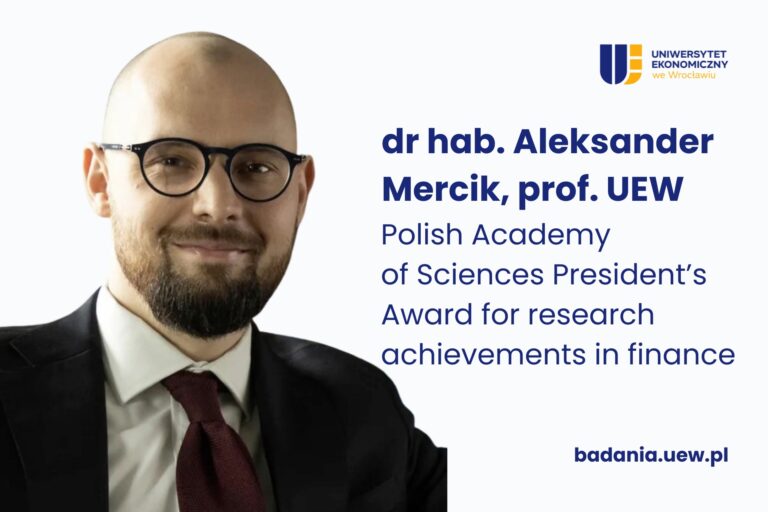
Dr hab. Aleksander Mercik, Professor of the WUEB, receives the Andrzej Gospodarowicz Award in Finance from the President of the Polish Academy of Sciences