

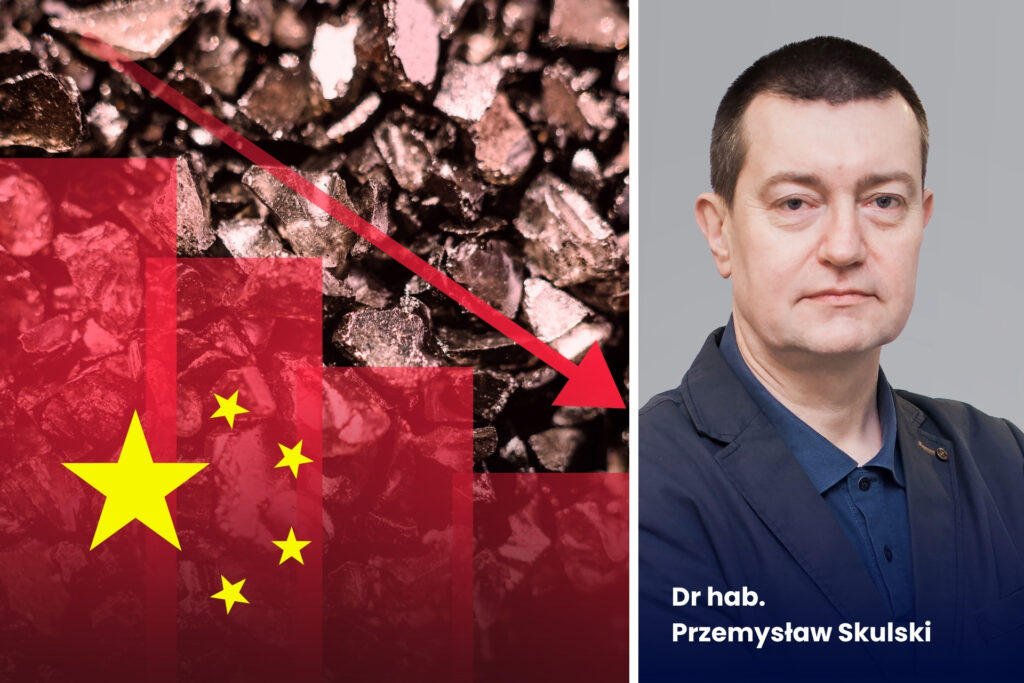
China is tightening controls on rare earth exports — a move that resonates far beyond raw materials. As Prof. Przemysław Skulski of the Wroclaw University of Economics and Business points out, the real chokepoint isn’t mining: it’s refining. Europe’s response will hinge on accelerating the CRMA agenda, scaling recycling, and rebuilding processing capacity at home and with trusted partners.
The bottleneck that matters: refining, not mining
It’s a common misconception that rare earths are “rare” because deposits are scarce. They aren’t. The scarcity lies in the complex, capital-intensive, and environmentally challenging refinement and separation processes. China controls roughly 40% of known deposits — but up to 90% of global refining and separation capacity.
- This asymmetry gives Beijing a decisive lever over downstream industries: EV motors, wind turbines, advanced electronics, defense systems, and high-performance magnets.
- Disruptions in refined oxides or magnet materials cascade quickly into manufacturing timelines and costs across multiple sectors.
“In the longer term we can secure access without China — but it will be neither quick nor cheap,” says Prof. Skulski. The core challenge is not replacing ore; it is replacing the industrial ecosystem that turns ore into high-purity materials at scale.
Diversification in practice: Australia, Canada, Brazil, Vietnam — and recycling
Alternatives exist and are expanding. New and upgraded projects in Australia and Canada, Brazil and Vietnam as well as emerging refining initiatives in allied economies, are rebuilding capacity outside China. At the same time, recycling is moving from a “nice-to-have” to a strategic necessity.
- Priority streams: end-of-life magnets (EVs, wind turbines, HDDs), e-waste, industrial scrap, and — in some geographies — coal ash and red mud as potential secondary sources.
- Reality check: ramping these pathways requires patient capital, specialized skills, reliable feedstock logistics, and environmental permits aligned with best practices.
“We conveniently relied on a single supplier for years. Today is a lesson in diversification and rebuilding processing capabilities,” adds Prof. Skulski. Companies that start now will be better positioned when supply tightens or prices swing.
CRMA as Europe’s framework — but time is tight
The EU’s Critical Raw Materials Act sets clear targets for mining, processing, and recycling by 2030, alongside strategic projects and reduced dependency on single suppliers. It is the right framework — yet execution will decide the outcome.
- What acceleration looks like: fast-track permitting for strategic processing projects, public–private co-investment in separation and magnet value chains, and pan-European coordination on recycling standards.
- Poland’s role: with strong industrial base and research capabilities, Poland is well-placed to host processing projects and build skills pipelines for the rare-earths supply chain.
Tangible results are likely toward the end of the decade — if projects reach final investment decision now.
What business should do now
For manufacturers, the shift from just-in-time to just-in-case is no longer theoretical. Concrete steps:
- Diversify suppliers across ore, refined oxides, and magnets; avoid single-point dependence in sub-tier vendors.
- Secure volume through longer-term offtake agreements, with flexibility clauses for recycled content.
- Build strategic buffers of critical components where feasible and economically justified.
- Invest in design-for-recycling and closed-loop programs with tier-1 and tier-2 suppliers.
- Map sub-tier exposure to refining steps — not just to country-of-origin of the ore.
These measures turn geopolitical risk into manageable operational planning.
Why this matters beyond materials
Rare earths underpin the energy transition, digital infrastructure, and advanced manufacturing. Export controls and licensing regimes are not just trade news — they shape the cost curves and timelines of EV adoption, renewable buildout, and industrial competitiveness. For Europe, reducing structural dependence is not optional; it is a prerequisite for strategic autonomy.
Key takeaways
- The constraint is refining and separation — the hardest part of the chain — where China dominates.
- Diversification is feasible but multi-year; recycling and allied capacity are central to resilience.
- CRMA provides the policy scaffolding — execution speed will determine Europe’s leverage.
- Businesses should shift to long-term sourcing, buffers, and circularity to mitigate shocks.
Interview aired by Polskie Radio Szczecin
https://radioszczecin.pl/276,14653,chiny-nie-chca-sprzedawac-zachodowi-metali-ziem-
More expert analyses from WUEB: badania.uew.pl/en
Author: Justyna Morawska-Płoskonka
See similar content

WUEB Experts Weekly Review. Research, Projects and Academic Successes (12–18 October 2026)
How can economic fluctuations be smoothed? The 2026 Nobel Prize in Economic Sciences through the eyes of WUEB researchers
Wroclaw’s micro-hub at the Economic Forum. Natalia Szozda, Associate Professor, on when a city truly becomes smart
WUEB Experts Weekly Review. Research, Projects and Academic Successes (5–11 October 2026)
See also
WUEB Experts Weekly Review. Research, Projects and Academic Successes (12–18 October 2026)
How can economic fluctuations be smoothed? The 2026 Nobel Prize in Economic Sciences through the eyes of WUEB researchers
The World Within Wrocław’s Reach. How the PROM research mobilities confirm WUEB’s place on the map of global academia
Wroclaw’s micro-hub at the Economic Forum. Natalia Szozda, Associate Professor, on when a city truly becomes smart
Dr hab. Aleksander Mercik, Professor of the WUEB, receives the Andrzej Gospodarowicz Award in Finance from the President of the Polish Academy of Sciences
WUEB Experts Weekly Review. Research, Projects and Academic Successes (5–11 October 2026)
Wroclaw University of Economics and Business researchers among the world’s leading scientists: six included in the 2026 World’s Top 2% Scientists database