

In the EU, the average farmer is 57 and only 12% are under 40. At the same time, agriculture, rural jobs and EU policy are all changing. In the TVP3 programme Z Unią na Ty, Bogusław Półtorak, Associate Professor at Wroclaw University of Economics and Business, talks about who will actually shape the future of rural Europe.
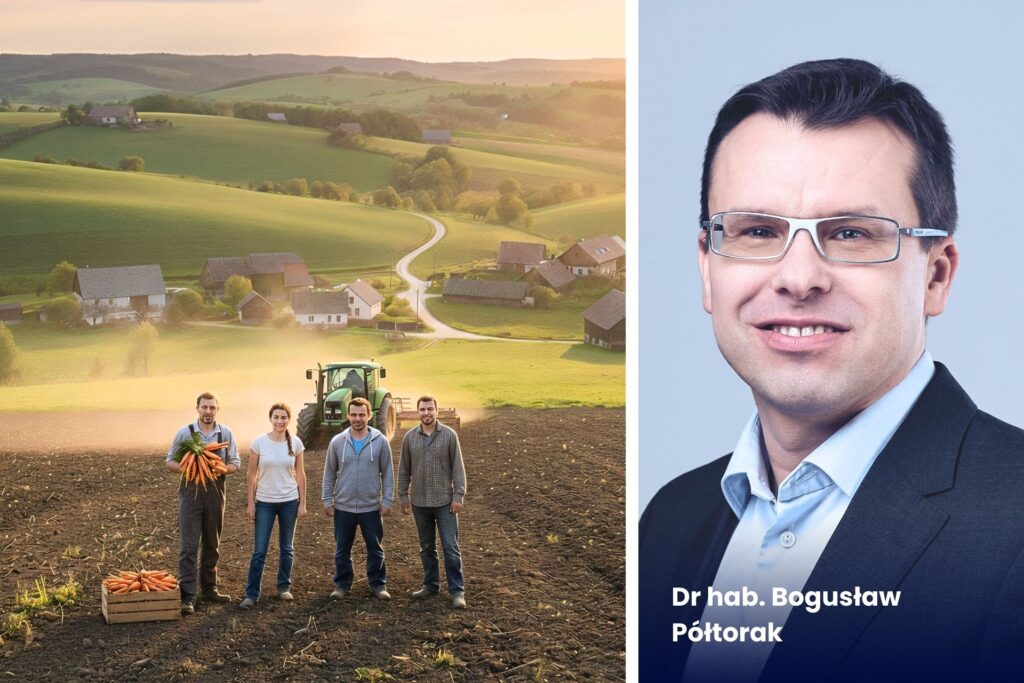
Fifty-seven is not an age we usually associate with a “young, dynamic business”. Yet this is the average age of a farmer in the European Union. Only 12% of farm holders are under 40 – in a sector that underpins something as basic as food security.
So is Europe’s countryside simply ageing, or are the rules of the game changing?
For Bogusław Półtorak, Associate Professor at WUEB, the starting point is clear: the EU faces a generational issue in farming, but also a broader shift in what rural areas are for and who builds their economies.
Young blood in the countryside: real need or statistical anxiety?
The European Commission’s response is the so-called generational renewal strategy. It includes, among other tools:
- a start-up package of up to EUR 300,000 for young farmers,
- sickness benefits,
- and “Erasmus for Young Entrepreneurs” – an exchange and learning scheme with other farm holders.
“If we do not encourage young people to take over farms, our European food security will be at risk. (…) But the growth-oriented economic activity in rural areas today will be different from traditional farming. Traditional agriculture has changed a lot over the last 20 years.” – Bogusław Półtorak
The key shift lies in the question itself. It is not only about whether “someone young comes to the countryside”, but in what role they arrive. As a classic full-time farmer? Or rather as an entrepreneur who combines production with processing, services and online sales?
According to Dr Półtorak, some farms will “rejuvenate” in a natural way – especially where agriculture already operates as a fully fledged business: scalable, profitable and embedded in a longer value chain, from field to online sales. These are the places where young people can clearly see purpose, prospects and room to grow.
For many others, the likely scenario is different: younger generations will look for jobs outside farming, though often still living in rural areas.
Rural areas as a place to live, work and build businesses
In the expert’s comments, the countryside appears as much more than farmland. On the one hand, there is increasingly “industrial” agriculture: large farms, land consolidation and significant investment in modern technologies. As he notes, the average farm in Lower Silesia is now twice as large as 20 years ago. This means higher capital needs, greater specialisation and economies of scale.
On the other hand, real potential often lies not in hectares but in ideas. Growing tourism, wine-making and cheese-making, local premium food brands and the spread of remote work all mean that rural areas are becoming:
- a place to live,
- a place to rest,
- and a place to develop entrepreneurship – not only in farming.
This wider perspective changes how we think about “young people in the countryside”: their careers may be shaped as much by services, creative industries and digital work as by classical agricultural production.
How many people really work in farming?
One clear figure from the interview stands out. Around 40% of Poland’s population lives in rural areas, but only about 10% works in agriculture – compared with an EU average of around 4%. In Lower Silesia, only about 4% of residents are now directly involved in agricultural production.
These numbers force a change in mindset. The future of rural areas is not just the future of farmers, but of an entire network of new services and professions located in the countryside.
The European Union reflects this trend in its new financial perspective, with stronger support for eco-schemes and non-agricultural activities in rural areas. This is where many young people may look for their place: as innovators, service providers or creators of local brands – not necessarily as owners of large farms.
EUR 300,000 for young farmers: breakthrough or first step?
The start-up package of up to EUR 300,000 for young farmers is one of the most visible elements of the generational renewal strategy. The amount sounds impressive, but does it solve the problem?
Dr Półtorak’s answer is nuanced. On the one hand, such funding can genuinely help those who already have a base – for example, a family farm – and want to develop a new idea: processing, tourism, a local product brand or a related business. In these cases, money from Brussels can become a real development impulse.
On the other hand, it is important to be honest: for someone who dreams of building a large, highly mechanised farm from scratch, EUR 300,000 is simply not enough. Modern large-scale farming today means multi-million-euro investments in machinery, technology and infrastructure.
In the discussion, a clear distinction emerges between two pillars:
- a “hard” pillar of food security – large farms, economies of scale and advanced technologies, strongly supported by the Common Agricultural Policy;
- a “soft” pillar of rural development – diverse services, new forms of entrepreneurship and ways of living, where young people can enter with less capital but more creativity.
This leads to a key, somewhat provocative question: should public policy aim to “rejuvenate agriculture” at any price – or rather to create conditions in which young people can make informed choices between farming and other forms of activity in rural areas?
Dr Półtorak leans towards a middle-ground answer. Succession will naturally take place where farms are profitable and run as modern firms. In many other cases, the development of rural areas will be driven by services, tourism, processing and new professions – activities that may, paradoxically, appeal to young people more than traditional work on the land.
You can listen to the programme on the “Z Unią na Ty” on website: – https://wroclaw.tvp.pl/75591713/z-unia-na-ty
badania.uew.pl – because in times of information overload, voices grounded in data and careful analysis are particularly needed.
Author: Barbara Grzelczak
See similar content

WUEB Experts Weekly Review. Research, Projects and Academic Successes (12–18 October 2026)
How can economic fluctuations be smoothed? The 2026 Nobel Prize in Economic Sciences through the eyes of WUEB researchers
Wroclaw’s micro-hub at the Economic Forum. Natalia Szozda, Associate Professor, on when a city truly becomes smart
WUEB Experts Weekly Review. Research, Projects and Academic Successes (5–11 October 2026)
See also
Why do some regions of Europe grow faster than others? Dr hab. Paweł Dobrzański, Associate Professor at UEW, wins the PTE Award
WUEB Experts Weekly Review. Research, Projects and Academic Successes (12–18 October 2026)
How can economic fluctuations be smoothed? The 2026 Nobel Prize in Economic Sciences through the eyes of WUEB researchers
The World Within Wrocław’s Reach. How the PROM research mobilities confirm WUEB’s place on the map of global academia
Wroclaw’s micro-hub at the Economic Forum. Natalia Szozda, Associate Professor, on when a city truly becomes smart
Dr hab. Aleksander Mercik, Professor of the WUEB, receives the Andrzej Gospodarowicz Award in Finance from the President of the Polish Academy of Sciences
WUEB Experts Weekly Review. Research, Projects and Academic Successes (5–11 October 2026)