
Strong universities, a developed IT sector, the presence of large financial institutions, and a growing community of technology companies — Wrocław has considerable assets on which to build a position in FinTech. That, however, is only the starting point. As dr hab. Andrzej Raszkowski, Prof. WUEB, argues, the region’s standing will not be determined by the number of firms and institutions it hosts, but by its capacity to scale solutions, attract investment, develop talent, and translate innovation into practice.
Can Wrocław become one of Poland’s significant FinTech centres? On the surface, the answer seems obvious: the city has universities, specialists, an IT sector, banks, and technology companies. Yet in an analysis prepared by dr hab. Andrzej Raszkowski, Prof. at Wrocław University of Economics and Business, the key question is framed differently — not whether Wrocław has potential, but whether it can convert that potential into genuine market advantage.
The distinction matters. Potential can be described in a report. Advantage has to be demonstrated through results: the number of companies that successfully scale, the value of investment attracted, the quality of talent, the number of implementations within financial institutions, and recognition beyond the region.
A map of the sector is no longer enough
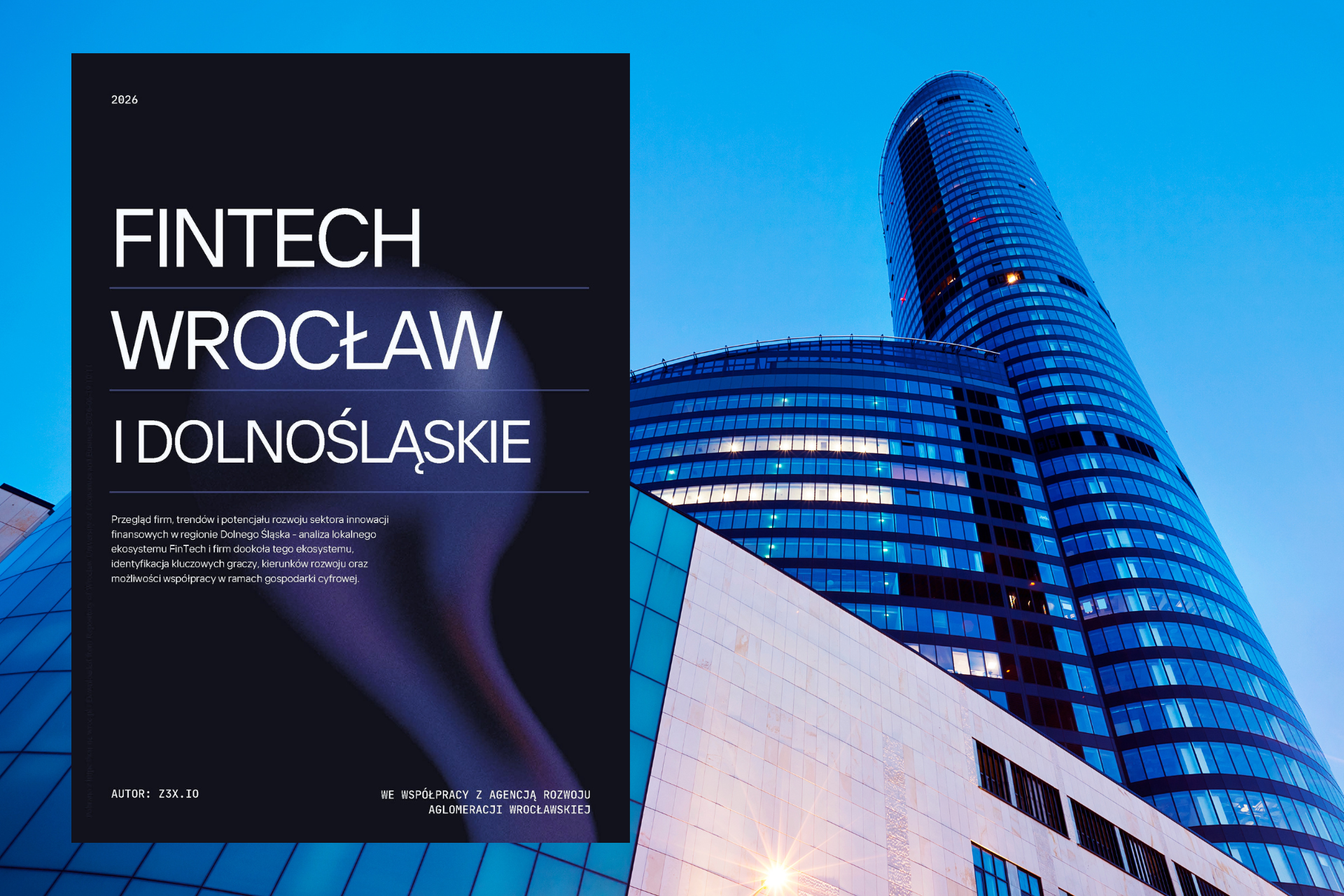
The expert analysis “The Banking Sector, Technology and FinTech in Wrocław”, prepared as a contribution to the report FinTech Wrocław i Dolnośląskie, is not simply a description of who operates in the regional financial innovation market. It documents the presence of FinTech firms, technology partners, major banks, investment funds, and business support institutions — an important baseline for assessing the scale of the sector.
Prof. Andrzej Raszkowski proposes a broader lens. He argues that the local FinTech market should be analysed not merely as a collection of companies, but as a system of interconnected competencies: financial, technological, regulatory, academic, and organisational.
Put differently: Wrocław’s advantage will not emerge automatically from the fact that the city is home to banks, universities, and software engineers. It will emerge only when those resources begin working together — in projects, partnerships, implementations, and investments.
Wrocław does not want to remain purely an operational base
For years, cities such as Wrocław were regarded by the financial sector primarily as good locations for operational centres, shared services, and back-office processing. That model remains relevant, but it does not exhaust the region’s ambitions.
Prof. Raszkowski’s analysis suggests that Wrocław can develop into a place where banking, technology, cybersecurity, data analytics, process automation, and digital services converge. This is no longer simply about processing operations — it is about designing, testing, and implementing solutions for the financial sector.
The presence of large financial institutions is significant in this context: BNY, Santander Consumer Bank, Credit Agricole, BNP Paribas, and Bank Gospodarstwa Krajowego. Their contribution is not limited to job creation. Over time, they can strengthen the local talent market that is indispensable for the development of more advanced financial and technology services.
This direction also matters from the perspective of Wrocław University of Economics and Business. Research conducted at the university does not only describe changes in the economy — it also identifies how the region can make better use of its resources.
Regulation is changing the game
FinTech increasingly means more than fast applications, online payments, or digital financial services. It means operating in an environment in which technology, data, security, and regulation are tightly intertwined.
In Prof. Raszkowski’s analysis, regulation is not a backdrop to sector development — it becomes one of the factors of competitive advantage. DORA strengthens requirements for the operational resilience of financial institutions against ICT disruptions, cyberattacks, and system failures. The PSD3 package and PSR reform the rules of open banking and access to payment services. The AI Act raises the stakes for the responsible use of artificial intelligence, including risk management, algorithmic transparency, data protection, and the prevention of discrimination.
For banks and FinTech firms, this translates into growing demand for specialists capable of bridging several disciplines at once: finance, technology, law, data analysis, and ethics. It is also a challenge for universities. Study programmes, research agendas, and industry collaboration must respond to a sector that is changing faster than traditional disciplinary boundaries.
In this sense, FinTech is more than a fashionable segment of the economy. It is a test of the maturity of the entire regional environment.
The greatest challenge? Scaling
Wrocław has the resources. The problem is that resources alone do not guarantee success. The region’s position will depend on whether it can activate them.
Prof. Raszkowski identifies several barriers that could keep the FinTech sector trapped at the level of promising potential: limited access to growth financing, too few specialist sector investors, competition for talent, and the need for better coordination between local government, universities, banks, start-ups, and investment funds.
This is one of the most important conclusions of the analysis. A region may have companies, universities, specialists, and institutions — and still fail to build a strong position if mechanisms for collaboration, capital, implementation, and consistent measurement of results are absent.
The line between a promising environment and one capable of scaling is thin but decisive. The former looks well in diagnostic reports. The latter produces companies, products, investments, and solutions that are present in the market.
The time has come to move from a narrative of potential to results
The strongest argument in Prof. Raszkowski’s analysis concerns the need to move away from general narratives about potential. As the author states:
“The prerequisite is […] a consistent transition from a narrative of potential to building measurable advantages: the number of companies that scale, the value of investment, the quality of talent, the number of implementations within financial institutions, and international recognition.”
That sentence captures the challenge Wrocław faces. The mere presence of firms and institutions is not sufficient. What counts is what solutions are being created in the region, where they are being deployed, what scale they reach, and whether they strengthen Wrocław’s position beyond the local market.
In the years ahead, Wrocław’s place on the FinTech map will be determined not by the number of declarations made, but by the number of concrete results achieved. The city can be more than an operational base for the financial sector — it can become a centre where financial innovations are designed, tested, and implemented for both the domestic and international market.
That is more demanding than attracting the next wave of companies. But it is precisely on that ambition that the answer depends: whether Wrocław will remain a city with potential, or become a genuine FinTech centre of competence.
Text based on:
Raszkowski A., Sektor bankowy, technologie i FinTech we Wrocławiu, [w:] FinTech Wrocław i Dolnośląskie, research report, z3x.io / ARAW, 2026.
The report is available in the UEW repository: https://wir.ue.wroc.pl/info/report/UEWR17c0970de7b04dd7adce28b1df545d84/
Meet the author of the article
Dr hab. Andrzej Raszkowski, Professor of the WUEB
Expert in the field of: Local government & public administration, Socio-economic policy
Author of text: Justyna Morawska-Płoskonka, Agnieszka Dramińska
See also

Video games are more than entertainment. WUEB researchers on cooperation between game developers and the cultural and creative industries

Space Logistics, Interplanetary Supply Chains and Interdisciplinary Research and Educational Projects Related to Space at UEW in Jelenia Góra
Academic Entrepreneurship as Architecture of Impact. The New Issue of „Impakt Dolny Śląsk” (2/2025)

Hospital Nutrition Reform in Poland: Between Policy and Practice
See similar content
Vitamins C and D in a single plant-based gel: UEW researcher awarded NCN grant

Joanna Radomska of WUEB awarded the title of professor
How can solutions for urban freight transport be co-created? Dr hab. inż. Maja Kiba-Janiak’s, Professor of the WUEB research fellowship in Gothenburg

WUEB Experts Weekly Review: Research, Projects and Academic Successes (21–27 September 2026)
Poland’s demographic crisis: Professor Marek Kośny on the economic consequences

What is Bitcoin and How is it Changing Finance? dr Michał Kisiel on the Future of Money
WUEB Experts Weekly Review: Research, Projects and Academic Successes (14–20 September 2026)