
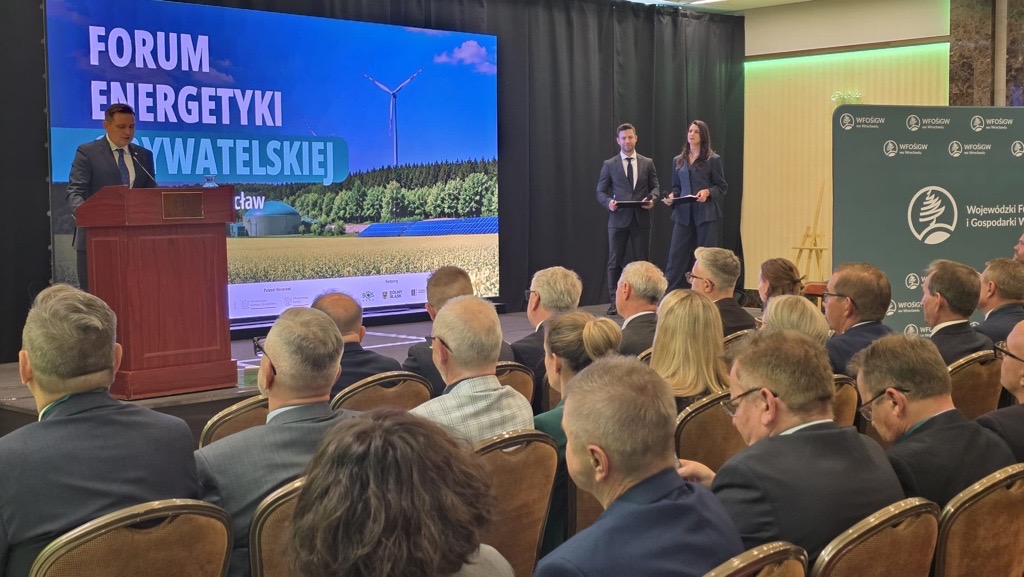
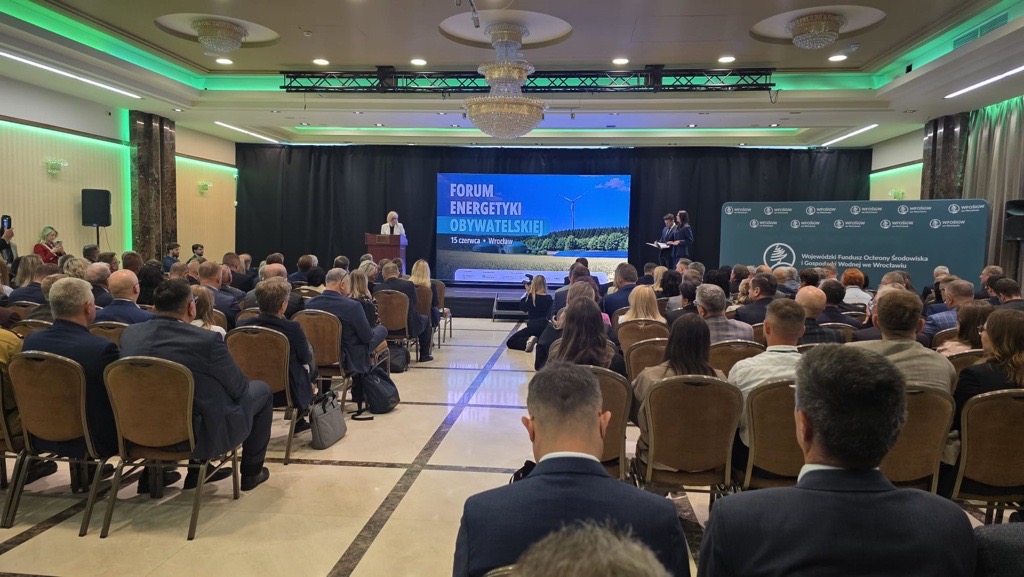
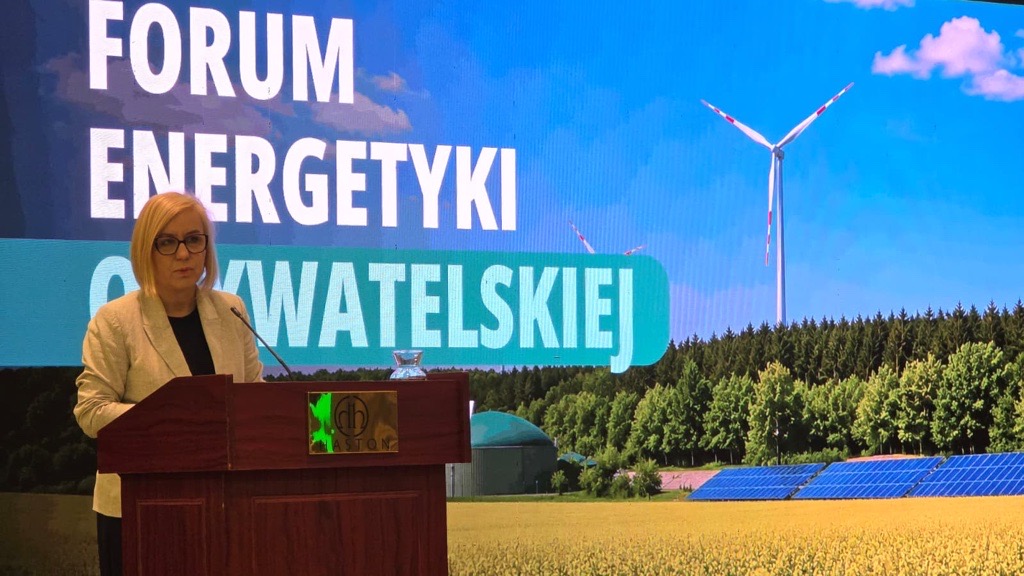
On 15 June 2026 Wrocław hosted the Civic Energy Forum, devoted to the development of citizen, prosumer and distributed energy. It was organised by the Provincial Fund for Environmental Protection and Water Management in Wrocław (WFOŚiGW; forum.wfosigw.wroclaw.pl). Around a single table it brought together representatives of central government, institutions financing the transition, local authorities, the energy sector and academia.
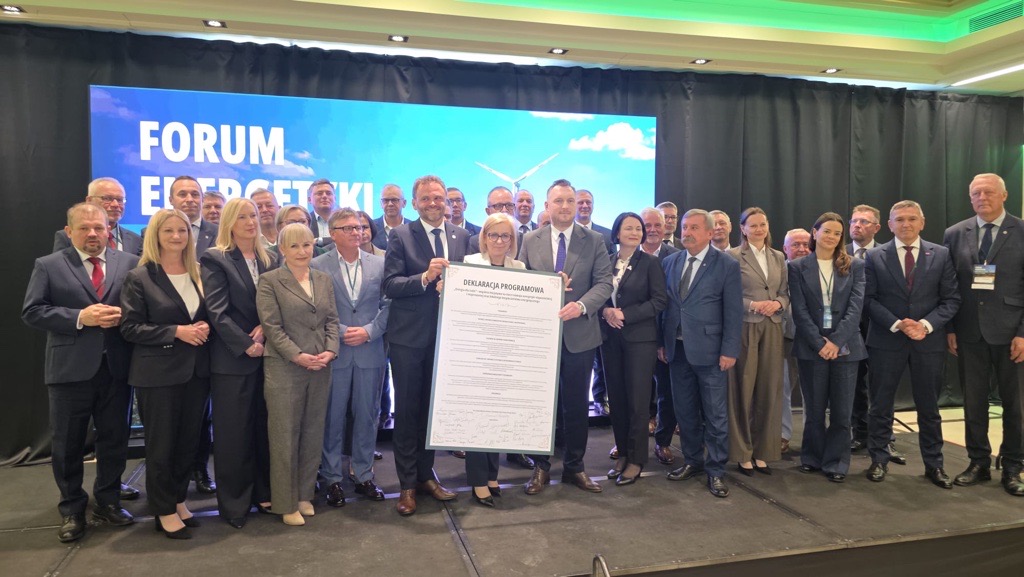
One of the forum’s key moments was the signing of the ‘Energy for People’ declaration. Wrocław University of Economics and Business (WUEB) joined its signatories, with the document signed on the University’s behalf by Prof. dr hab. Andrzej Graczyk, Dean of the Faculty of Economics and Finance at WUEB. For WUEB it marks a shift from a regional conversation about the energy transition into a national process built on cooperation between local authorities, communities, public institutions, the energy sector and both private and public financing.
Who was at the table
The forum’s standing was set by its participants. In the panel on the legal and systemic framework for citizen energy, chaired by Paweł Łapacz, President of WFOŚiGW in Wrocław, the speakers included Paulina Hennig-Kloska, Minister of Climate and Environment, Miłosz Motyka, Minister of Energy, and Dorota Zawadzka-Stępniak, President of the Management Board of the National Fund for Environmental Protection and Water Management (NFOŚiGW). The programme comprised three discussion panels: on the legal and systemic framework, on managing energy within the grid, and on the financing and viability of projects.
Each of these institutions brings a different piece of the same puzzle. The ministries set strategic direction and regulation. The environmental protection funds, national and provincial, decide on financing instruments. Local authorities know residents’ needs. The energy sector and financial institutions provide the technical and investment conditions. Academia, including WUEB, adds analytical, educational and expert competence. The presence of two ministers and the heads of the funds shows that citizen energy has ceased to be a niche topic and has entered the level of national decisions.
Energy that stays close to home
The ‘Energy for People’ declaration addresses a question that recurs in every conversation about the transition: how to build a system that is more resilient, more decentralised and grounded in the activity of local communities. Amid geopolitical instability, rising energy costs and the need to strengthen infrastructure, solutions created close to where energy is produced, stored and consumed are gaining in importance.
Citizen energy means energy communities, cooperatives, energy clusters, self-consumption, storage and local balancing, combined into a well-considered energy mix. These are local systems of cooperation whose effects residents feel directly: in a lower bill, greater resilience to crises and greater agency.
Dorota Zawadzka-Stępniak, President of the NFOŚiGW Management Board, spoke about the importance of cooperation between the National Fund, the provincial environmental funds and local authorities. It is in such partnerships that cooperatives, clusters and energy communities are to grow. Here energy appears not as distant infrastructure but as a good organised closer to people and their everyday needs.
Why now
The forum took place at a particular moment. In June 2026 the Council of Ministers adopted the National Energy and Climate Plan, setting the directions of Poland’s energy transition to 2030 with a perspective to 2040. In this light citizen energy is no longer merely a local initiative; it becomes part of the national conversation about energy security, energy costs, grid modernisation, the growth of renewables and the resilience of the state.
Paulina Hennig-Kloska, Minister of Climate and Environment, noted that energy produced and consumed locally can be cheaper, because it places less strain on the system and reduces the scale of transmission investment. She also stressed that a distributed system withstands crises, failures and potential attacks better. She assigned a central role to local authorities: by creating energy cooperatives and clusters, they can become the engine of citizen energy.
A year on from the agreement with the fund
WUEB’s participation in the declaration continues what began in Lower Silesia. In June 2025 the University and WFOŚiGW in Wrocław signed an agreement on supporting energy communities, and WUEB was the first university in Poland to respond to the need to build the competences of citizen-energy leaders (uew.pl/uew-wfosigw-umowa). Even then the University argued that the transition requires not so much tools as people able to use them.
“Our aim is not only to hand over tools, but above all to build the competences that will make it possible to manage local energy effectively”
— said the Rector of WUEB, Prof. dr hab. Czesław Zając (translation of a Polish-language quote; uew.pl/uew-wfosigw-umowa).
Signing the declaration alongside the ministries, NFOŚiGW, WFOŚiGW, local authorities and the energy sector moves this direction up to the national level. WUEB moves from the role of regional partner to a participant in broader institutional cooperation. What stands out most is what the University can bring together: research, teaching and practice, in the service of decisions that require data, cost accounting, risk assessment and well-designed financing.
Economics enters the conversation about energy
The address by Prof. Andrzej Graczyk, Dean of the Faculty of Economics and Finance at WUEB, showed why an economics university is needed in this conversation. The energy transition rarely turns on technology. More often it is settled on the numbers: what pays off, who bears the cost, where the financing comes from and how the risk is shared.
Graczyk recalled that WUEB has its own commitments in this area, including a goal of emission neutrality by 2030. That means managing energy differently on campus, improving the efficiency of buildings and treating energy as a resource to be managed consciously rather than a line on an invoice.
“Energy cannot be treated solely as a purchase cost. We have to learn to manage it: in buildings, local authorities, businesses and households”
— says Prof. Graczyk.
The theme of education came through strongly. Citizen energy needs people who combine economic knowledge with an understanding of technology, regulation and risk, and who can design a financial model, estimate the viability of an investment and find the money for it.
“The greatest challenge of the transition is not installing the equipment, but preparing the people, institutions and financing models that will let these solutions work durably and profitably”
— [Prof. Graczyk].
Efficiency as advantage, not slogan
A separate strand of the address concerned energy efficiency understood as a source of savings and advantage. Smart homes, smart workplaces and better management of consumption translate into real money. With high energy costs, competitiveness increasingly depends not on the scale of operations or the cost of labour, but on the ability to cut losses.
For local authorities, businesses, housing cooperatives and local communities this yields a practical conclusion: what counts is not single, isolated investments but a well-composed local energy mix, that is, generation, storage, self-consumption, balancing and stable financing. This is precisely where economic knowledge helps answer the questions that decide a project’s success: what pays off, how to distribute costs, how to limit risk and how to arrange cooperation between residents, the local authority, companies and public institutions.
Evidence on the roofs of housing cooperatives
Graczyk also pointed to what WUEB has already done. He recalled the photovoltaic installations on the buildings of a Wrocław housing cooperative, begun almost a decade ago. A solution that initially met with caution is today seen as an effective way of lowering costs for residents. He mentioned the University’s involvement in energy clusters and its cooperation with public institutions and energy-market partners, including WFOŚiGW, the ministries, Orlen and Tauron. He also spoke of a biogas project linked to food production, planned to launch in September in a competition of potentially European scale.
WUEB concentrates this competence in the Institute for Sustainable Energy Management (IZGE), a competence centre of the University that provides advisory services and applied research in the energy transition, photovoltaics and prosumerism, the hydrogen economy, electromobility and energy efficiency (uew.pl/jednostki). It is the base that turns economic analysis into concrete projects for local authorities, companies and organisations.
Research at the table where decisions are made
Citizen energy is an area where academic knowledge works close to public decisions. It joins energy security, the cost of living, community resilience, public and private investment, regulation, education and the long-term policy of the state.
That is why WUEB’s participation in the ‘Energy for People’ declaration means more than the signature itself. It shows that a public university can take part in resolving concrete questions: how to finance the transition, how to prepare local authorities, how to lower energy costs, how to strengthen local security and how to educate people able to manage change. The measurable trace of that knowledge is already visible in installations, clusters and lower bills, not in the declaration alone.
badania.uew.pl – because the world needs competent voices where decisions demand knowledge, responsibility and data.
Author of text: Justyna Morawska-Płoskonka
See also
See similat content
Vitamins C and D in a single plant-based gel: UEW researcher awarded NCN grant
Joanna Radomska of WUEB awarded the title of professor
How can solutions for urban freight transport be co-created? Dr hab. inż. Maja Kiba-Janiak’s, Professor of the WUEB research fellowship in Gothenburg

WUEB Experts Weekly Review: Research, Projects and Academic Successes (21–27 September 2026)
Poland’s demographic crisis: Professor Marek Kośny on the economic consequences
What is Bitcoin and How is it Changing Finance? dr Michał Kisiel on the Future of Money
WUEB Experts Weekly Review: Research, Projects and Academic Successes (14–20 September 2026)