

The debate on Polish nuclear weapons returns whenever the sense of threat grows. In Radio Wrocław’s programme Różne punkty słyszenia, dr hab. Przemysław Skulski, Associate Profesor at WUEB, argued that this question cannot be reduced to a simple “yes” or “no”. It requires a clear assessment of costs, alliances, political risks and the real effectiveness of deterrence.
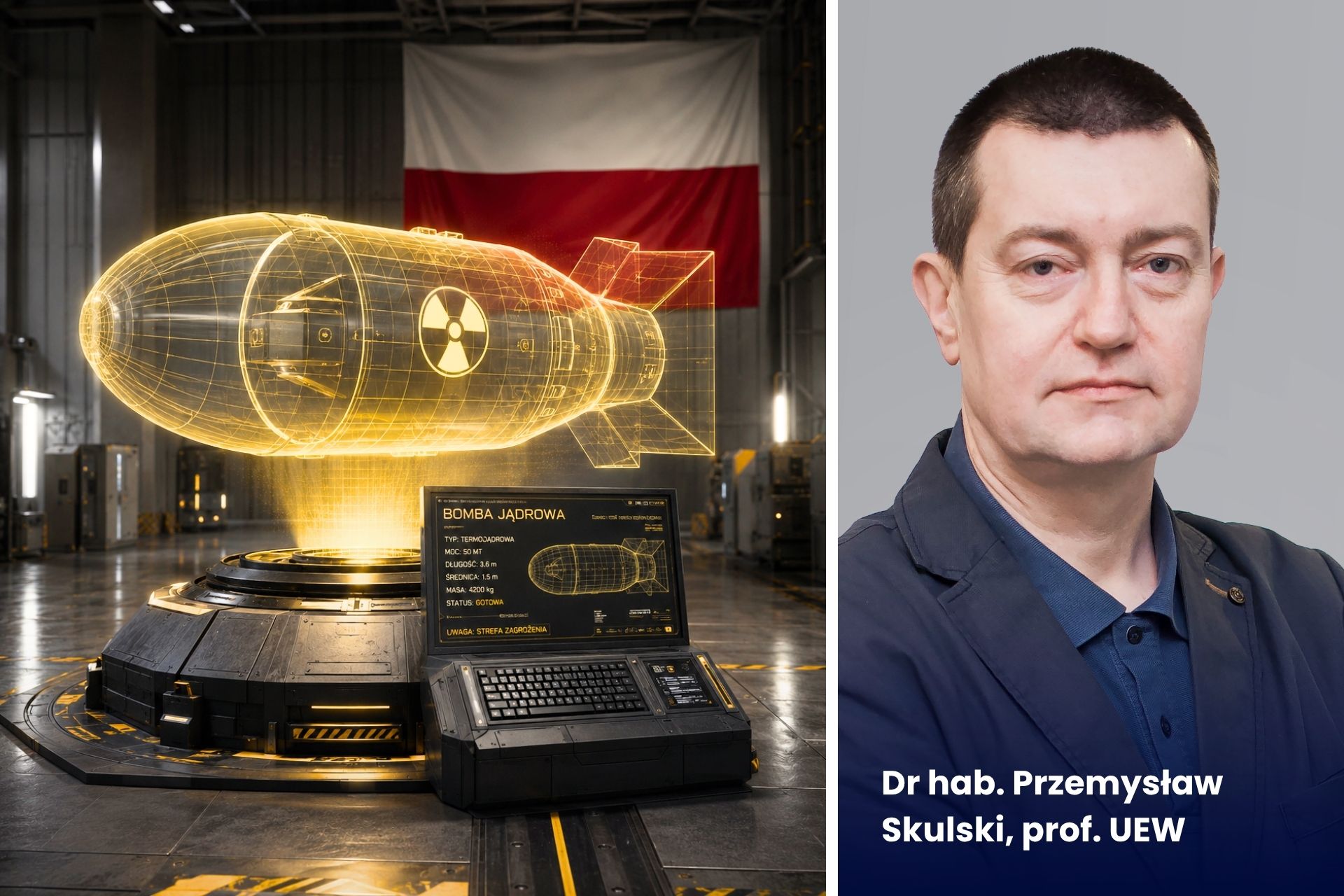
A national nuclear arsenal may sound like the strongest possible security guarantee. In practice, it would be one of the most difficult projects a state could undertake: financially, technologically, militarily and diplomatically. This is why the voice of an economist and expert on the international arms market matters in this debate.
Security does not begin with the bomb
The programme began with the question of whether Poland should acquire nuclear weapons. Prof. Przemysław Skulski’s answer was clear: if we mean Poland’s own nuclear weapons or an independent nuclear capability, then no. This does not mean underestimating the threats. The WUEB expert stressed that Poland must think very seriously about security, because the international architecture is changing faster than many assumed only a few years ago.
This distinction matters. The security debate cannot be reduced to the question of whether Poland should “have the bomb”. The first question is what would genuinely strengthen the resilience of the state: an independent nuclear programme, participation in allied mechanisms, stronger conventional deterrence, development of the defence industry, civil protection, or deeper political and economic ties with partners.
Prof. Skulski noted that nuclear weapons do not automatically make a state untouchable. Possession alone is not enough. A country must maintain and secure the arsenal, have delivery systems, command procedures, technological infrastructure and the political capacity to bear the consequences of such a choice. In Poland’s case, this would mean building almost an entire system from the ground up.
The price of deterrence: money, time and political risk
The economic dimension of the issue was one of the strongest themes in the programme. Maintaining a nuclear arsenal is not a one-off expense. It is a permanent burden on the state budget. The discussion referred to France, where the annual cost of maintaining nuclear capability is counted in billions of euros. For Poland, this would mean redirecting substantial resources from other areas of security and public policy.
Prof. Skulski emphasised that the decision to launch such a programme would only be the beginning. The state would have to face legal constraints, international commitments and the response of its allies. A Polish nuclear weapon would not emerge in a vacuum. Such a step could trigger serious political tensions and even weaken relationships that are currently among the pillars of Poland’s security.
In this context, Prof. Skulski’s words are particularly striking:
“If someone dreams of nuclear weapons, then (…) this is a weapon of last resort, because afterwards there may be nothing left.”
It is a reminder that nuclear weapons belong to a category of instruments whose purpose depends on their non-use. They are meant to deter, but they also require exceptionally responsible policy, stable institutions and cold calculation.
A strong Poland also means strong alliances
One of the key questions in the discussion was whether Poland can build security without its own nuclear arsenal. Prof. Skulski pointed to the importance of political, economic and military ties. The stronger Poland’s position in Europe, the greater its ability to influence allied decisions and the higher the potential cost of aggression against the Polish state.
Security is not only a military matter. It also depends on the economy, industry, resources, logistics, public finances, technology and international standing. A state can invest in deterrence not only through nuclear projects, but also by developing modern conventional capabilities, strengthening infrastructure resilience, improving civil protection and reinforcing cooperation within NATO and Europe.
The programme also referred to Sweden, Ukraine, South Africa, France, Pakistan and South Korea. Each case offers a different lesson: nuclear ambitions are sometimes abandoned, sometimes become part of deterrence, and sometimes create more political problems than real military benefits.
The main conclusion from the discussion is clear: nuclear weapons should be discussed, but without shortcuts or great-power fantasies. Poland’s security does not depend on one symbolic solution. It depends on the combination of strong alliances, a resilient economy and real defence capabilities. Prof. Przemysław Skulski’s contribution brings order to this debate by reminding us that the most difficult strategic decisions must not only be announced. They must first be calculated.
Watch the interview at the link below: https://www.radiowroclaw.pl/articles/view/160155/Rozne-punkty-slyszenia-Czy-Polska-powinna-miec-bron-jadrowa
badania.uew.pl – because the world needs competent voices when noise drowns out reason.
Author of the text: Barbara Grzelczak
See also

WUEB Experts Weekly Review. Research, Projects and Academic Successes (12–18 October 2026)
How can economic fluctuations be smoothed? The 2026 Nobel Prize in Economic Sciences through the eyes of WUEB researchers
Wroclaw’s micro-hub at the Economic Forum. Natalia Szozda, Associate Professor, on when a city truly becomes smart
WUEB Experts Weekly Review. Research, Projects and Academic Successes (5–11 October 2026)
See similar content
WUEB Experts Weekly Review. Research, Projects and Academic Successes (12–18 October 2026)
How can economic fluctuations be smoothed? The 2026 Nobel Prize in Economic Sciences through the eyes of WUEB researchers
The World Within Wrocław’s Reach. How the PROM research mobilities confirm WUEB’s place on the map of global academia
Wroclaw’s micro-hub at the Economic Forum. Natalia Szozda, Associate Professor, on when a city truly becomes smart
Dr hab. Aleksander Mercik, Professor of the WUEB, receives the Andrzej Gospodarowicz Award in Finance from the President of the Polish Academy of Sciences
WUEB Experts Weekly Review. Research, Projects and Academic Successes (5–11 October 2026)

Wroclaw University of Economics and Business researchers among the world’s leading scientists: six included in the 2026 World’s Top 2% Scientists database