
When a cryptocurrency exchange suspends withdrawals, the public debate often turns quickly against crypto as a whole. Dr hab. Aleksander Mercik, Associate Professor at WUEB argues that the real problem often lies elsewhere: in intermediaries, limited transparency and a regulatory framework that has yet to catch up with the market.

The issue is not always the technology
The interview was prompted by the case of a cryptocurrency exchange facing questions about liquidity and clients’ ability to access their funds. Situations of this kind often lead to a familiar conclusion: if something has gone wrong, cryptocurrencies must be at fault.
Dr hab. Aleksander Mercik offers a more careful interpretation. As he notes, blockchain technology should be distinguished from the institutions that facilitate trading in digital assets. That distinction matters because it helps clarify where risk actually begins.
Blockchain itself may offer a high degree of transparency. In practice, however, most users rely on platforms that hold their funds and execute transactions on their behalf. This is often where the greatest vulnerabilities arise.
Trust remains the central problem
The interview also points to a wider issue. The digital asset market is expanding faster than the rules needed to make it transparent, predictable and institutionally robust. As a result, investors often operate in an environment that does not offer the level of protection associated with the traditional banking sector.
That is why suspended withdrawals and unclear communication from platforms trigger such strong reactions. In conventional banking, systems of supervision, accountability and protection are well established. In the crypto market, that degree of stability is still far from standard.
This takes the discussion beyond a single high-profile case. The central question is how to create rules that protect investors without obstructing innovation. This is not only about one exchange or one company. It is also about how public institutions should respond to a fast-growing sector that still lacks a sufficiently mature regulatory framework.
A practical point for users
The most practical part of the interview concerns not regulation, but user behaviour. Dr hab. Aleksander Mercik, prof. UEW, stresses one clear principle: once cryptocurrencies have been purchased, funds should not be left on an exchange unless there is a specific reason to do so.
The point is straightforward. Leaving assets on a platform exposes users not only to price volatility, but also to the financial and operational risks associated with the intermediary itself.
This observation extends beyond the crypto market. In emerging areas of finance and technology, security depends not only on innovation, but also on sound judgement, clear rules and an informed understanding of risk..
Watch the interview at the link below: https://www.radiowroclaw.pl/articles/view/159616/Rozmowa-Dnia-dr-Aleksander-Mercik-o-kryptowalutach-i-ustawie-o-rynku-kryptoaktywow
badania.uew.pl – because the world needs competent voices when noise drowns out reason.
Author of text: Barbara Grzelczak
Zobacz podobne treści

WUEB Experts Weekly Review: Research, Projects and Academic Successes (21–27 September 2026)

Poland’s demographic crisis: Professor Marek Kośny on the economic consequences

What is Bitcoin and How is it Changing Finance? dr Michał Kisiel on the Future of Money
WUEB Experts Weekly Review: Research, Projects and Academic Successes (14–20 September 2026)
Zobacz również
WUEB Experts Weekly Review: Research, Projects and Academic Successes (21–27 September 2026)
Poland’s demographic crisis: Professor Marek Kośny on the economic consequences
What is Bitcoin and How is it Changing Finance? dr Michał Kisiel on the Future of Money
WUEB Experts Weekly Review: Research, Projects and Academic Successes (14–20 September 2026)
WUEB Experts Weekly Review: Research, Projects and Academic Successes (7–13 September 2026)
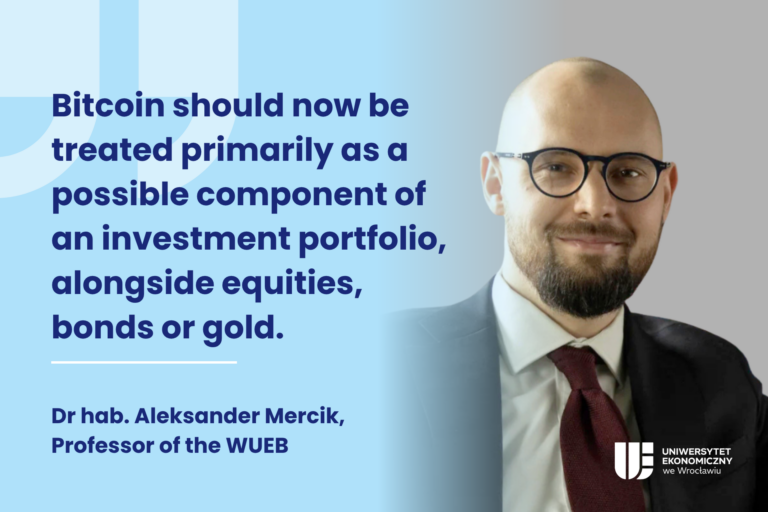
Bitcoin is not the digital equivalent of the Polish zloty. A WUEB expert explains how to understand cryptocurrencies.
WUEB Experts Weekly Review. Research, Projects and Academic Successes (31 August–6 September 2026)