

Rare earth elements are no longer just a technological issue. They are increasingly shaping economic and political security. In an interview for Polska Zbrojna journal, dr hab. Przemysław Skulski, Associate Profesor on WUEB explains why access to these resources is now a strategic challenge and why Europe is not fully prepared.
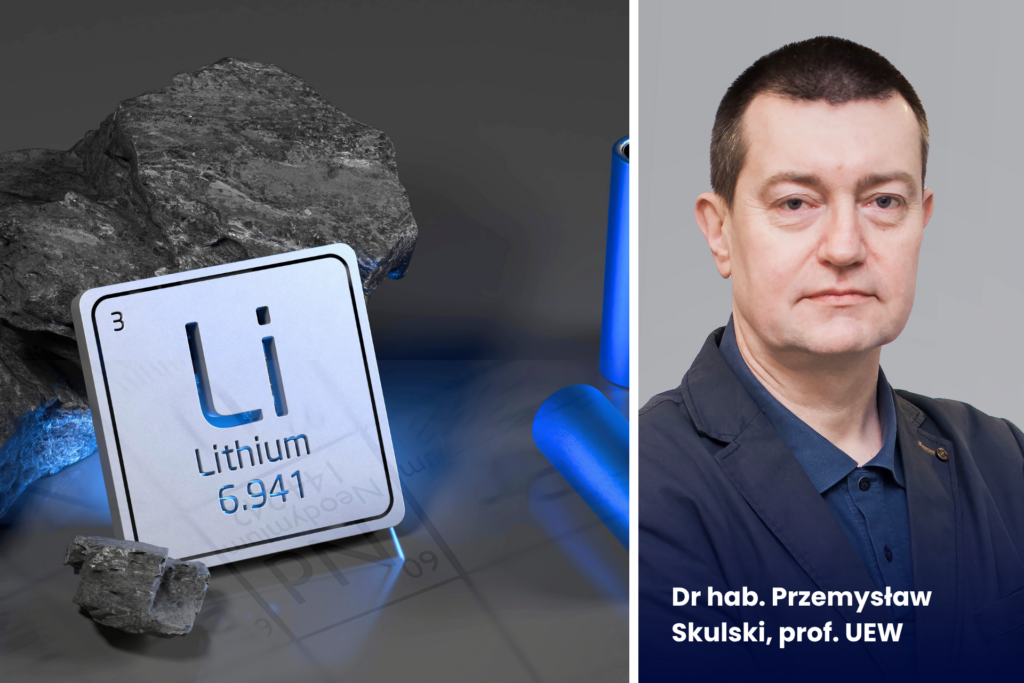
“The difficulties Western countries face in accessing rare earths did not end with the pandemic. They have intensified and are largely linked to the fact that we are building a new global security architecture.”
From technology to strategy
The expert commentary highlights a structural issue. For years, Western economies built their advantage on access to raw materials sourced outside their own territories. This model was cost-efficient but did not account for geopolitical risk, which is now becoming increasingly visible.
Rare earth elements are a group of 17 chemical elements used in modern technologies. Their unique properties, including magnetic and luminescent characteristics, make them essential in electronics, communication systems, energy technologies and defence solutions. Without them, it is difficult to sustain energy transition, digital development or a modern economy.
A world that gave too much to China
The COVID-19 pandemic marked a turning point by exposing the scale of dependence on global supply chains. As Przemysław Skulski notes, however, the problem had existed long before. Limited deposits, their uneven geographical distribution and high extraction costs led many Western countries to abandon the development of domestic capabilities.
At the same time, China consistently strengthened its position by expanding both extraction and processing technologies. As a result, it now controls the vast majority of global rare earth production, despite not holding proportionally the largest reserves.
„China has not only built a kind of web limiting access to rare earths from its own deposits, but has also sought to take over those located in other countries”.
This dominance has both economic and political dimensions. Export restrictions and trade tensions show that access to raw materials can be used as a tool of influence. In practice, this means that European countries and companies must take into account the risk of supply disruptions or rising production costs.
Europe is responding, but time cannot be recovered quickly
Efforts to reduce dependency are underway in both the United States and the European Union. They focus on three main directions:
- exploring new deposits and suppliers,
- developing processing technologies,
- investing in recycling, including the recovery of valuable elements from industrial waste and end-of-life products.
Each of these approaches has limitations. Identifying new deposits requires time and significant investment, and their exploitation is not always economically viable. Recycling is an important direction but also involves costs and technological challenges. As a result, reducing dependence on imports will be a gradual process, spread over many years.
The Polish context
In Poland, potential occurrences of rare earth elements are identified in regions such as Suwałki, the Świętokrzyskie Mountains and the Sudetes. The key issue remains the scale of these resources and whether their extraction can be both economically viable and socially acceptable.
At the same time, initial projects related to processing and recovery are being developed. In the long term, they may strengthen Poland’s position in this area.
Long-term implications for the economy
From the perspective of the economy and business, the importance of this issue will continue to grow. Rare earth elements are essential for many sectors, from energy to advanced technologies, and their availability directly affects costs, production stability and development potential.
More broadly, competition for critical raw materials is becoming a permanent feature of the global economy.
The expert perspective of Przemysław Skulski contributes to the wider debate on economic security and the future of the European economy. It shows that decisions taken today – both by governments and businesses – will have long-term consequences for competitiveness and economic independence.
badania.uew.pl – because the world needs competent voices where complexity is too often reduced to simplifications.
Author: Barbara Grzelczak
See similar content

WUEB Experts Weekly Review. Research, Projects and Academic Successes (12–18 October 2026)
How can economic fluctuations be smoothed? The 2026 Nobel Prize in Economic Sciences through the eyes of WUEB researchers
Wroclaw’s micro-hub at the Economic Forum. Natalia Szozda, Associate Professor, on when a city truly becomes smart
WUEB Experts Weekly Review. Research, Projects and Academic Successes (5–11 October 2026)
See also
WUEB Experts Weekly Review. Research, Projects and Academic Successes (12–18 October 2026)
How can economic fluctuations be smoothed? The 2026 Nobel Prize in Economic Sciences through the eyes of WUEB researchers
The World Within Wrocław’s Reach. How the PROM research mobilities confirm WUEB’s place on the map of global academia
Wroclaw’s micro-hub at the Economic Forum. Natalia Szozda, Associate Professor, on when a city truly becomes smart
Dr hab. Aleksander Mercik, Professor of the WUEB, receives the Andrzej Gospodarowicz Award in Finance from the President of the Polish Academy of Sciences
WUEB Experts Weekly Review. Research, Projects and Academic Successes (5–11 October 2026)
Wroclaw University of Economics and Business researchers among the world’s leading scientists: six included in the 2026 World’s Top 2% Scientists database